

The Ultimate Guide to Key Commercial Lease Dates
Defining the Most Important Commercial Lease Dates
Commercial lease dates are the specific milestones in a lease agreement that control when your obligations start, when your rent begins, and when your rights expire. For Pittsburgh law firm owners, missing even one of these can disrupt practice operations or force you into unfavorable terms.
Here are the key steps and dates every business should know:
| Step / Lease Date | What It Means |
|---|---|
| Lease Execution Date | Both parties sign the agreement; it becomes legally binding |
| Delivery / Possession Date | Landlord hands over access to the space |
| Lease Commencement Date | The official start of the lease term and tenant obligations |
| Rent Commencement Date | The date rent payments actually begin (can be later than commencement) |
| Renewal Option Deadline | Last date to notify the landlord of your intent to renew |
| Termination Option Deadline | Last date to exercise any early exit rights |
| Lease Expiration Date | The end of the original lease term |
These dates shape your financial planning, your accounting obligations under ASC 842 and IFRS 16, and your ability to negotiate from a position of strength. For law firms in the Strip District, Shadyside, or East Liberty, understanding these dates is the foundation of every smart real estate decision.
Donahue Real Estate Advisors brings over 35 years of experience guiding tenants through the full lifecycle of commercial lease dates across Pittsburgh and beyond. This experience shapes everything in this guide.
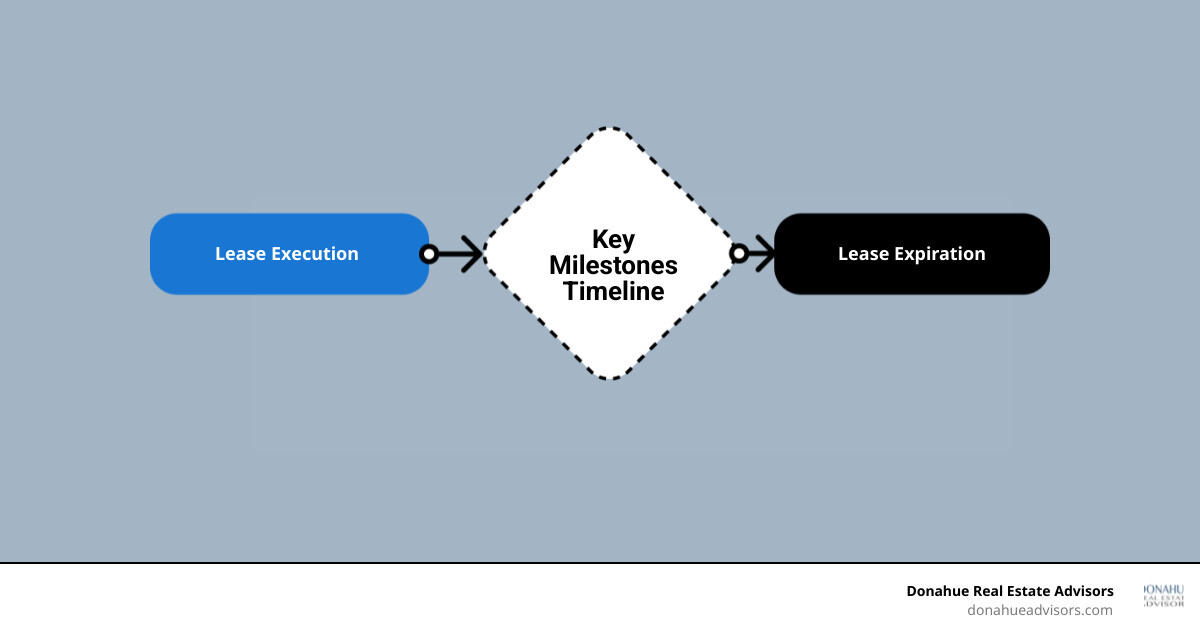

When we review a Commercial Lease Contract, the first thing we look at is the calendar. The timeline of a lease is a “deadline ecosystem” where one date often triggers the next. If the first domino falls incorrectly, the entire financial structure of your lease can collapse.
The Lease Execution Date is the moment the contract becomes legally binding. Both the landlord and the tenant have signed and delivered the document. While this date formalizes the relationship, it rarely signifies the day you move in or start paying. Instead, it sets the stage for the Due Diligence Period and the Landlord Acquisition Date, especially in new developments in areas like the North Shore or the Southside.
Following execution, we look for the Delivery Date or Possession Date. This is when the landlord physically hands over the keys. In a perfect world, the space is exactly as promised. However, if the landlord is still finishing “Landlord Work,” this date might slide. We always advise our clients to ensure the “delivered” condition is clearly defined to prevent disputes.
These early milestones are just the beginning. You also need to track dates for insurance Certificate of Occupancy (COI) renewals, security deposit returns, and even the deadline to open for business. In retail or high-traffic office buildings in the Strip District, a “continuous operation” clause might even dictate which days you are required to be open.
Lease Commencement Date vs. Rent Commencement Date
One of the most frequent points of confusion for tenants is the difference between lease commencement and rent commencement. The lease commencement date is when your legal occupancy and responsibilities begin. This includes your obligation to maintain insurance and follow building rules.
The Rent Commencement Date is when the bills start arriving. In many of the leases we negotiate, these two dates are not the same. We often secure a “rent abatement” or “free rent” period. This allows our clients to move in, complete their build-out, and get their operations running before the first rent check is due.
For example, a tenant might have a Lease Commencement Date of June 1st but a Rent Commencement Date of September 1st. Those three months of free rent are vital for managing upfront expenditures. When understanding a commercial lease, it is important to remember that landlords want rent to start immediately, while we work to delay it as long as possible to protect your cash flow.
We had one tenant where we negotiated six months of free rent, with the lease commencing immediately and rent due at the start of month seven. On paper, it looked like a strong concession. But while that free-rent clock was running, the tenant delayed design decisions, bid collection, and move planning. The result was painful: they moved in after the lease commencement date, so part of the free-rent period was wasted. Then their old space went into holdover at 200% rent. They did not just lose free rent. They ended up paying double rent while the new lease term was already underway. That is why understanding a commercial lease means tracking dates as carefully as dollars.
The Impact of Commercial Lease Dates on ASC 842 Compliance
As of April 2026, lease accounting standards like ASC 842 and IFRS 16 have completely changed how businesses view their real estate. These standards require nearly all leases to be recognized on the balance sheet as right-of-use (ROU) assets and lease liabilities.
The commercial lease term is the primary driver of these calculations. The “commencement date” for accounting purposes is the day the tenant gains control of the space. This date triggers the recognition of the asset and liability. If you have renewal options that are “reasonably certain” to be exercised, those additional years must also be factored into your financial statements from day one.
Inaccurate tracking of commercial lease dates can lead to significant errors in financial reporting. This is why we coordinate closely with our clients’ accounting teams to ensure the dates in the legal contract align with the dates used for compliance.
Strategic Deadlines for Pittsburgh Tenants: Renewal vs. Relocation
In the current April 2026 market, Pittsburgh office vacancy rates according to CoStar sit at approximately 18.5% across the Central Business District. However, in high-demand submarkets like the Strip District and the East End, vacancy is much tighter, hovering around 11%. This discrepancy creates a unique challenge for tenants deciding between renewing their current lease or relocating.
We recommend at least a 12-month lead time before your renewal notification date. If your lease expires in 2027, you should be talking to us now. This window provides the market leverage needed to negotiate. If a landlord knows you have no time to move, they have no incentive to offer competitive rates. By starting early, we can survey availabilities and use those options as leverage to improve your current terms.
Our law firm office lease renewal strategy highlights how essential this timeline is. Law firms, in particular, require significant lead time for build-outs and partner approvals. Waiting until six months before expiration is a recipe for a high-priced, “take-it-or-leave-it” renewal offer from your landlord.
Managing Renewal Option Deadlines in the 2026 Market
A renewal option is only a protection if you use it correctly. Most leases require written notice 6 to 12 months before the current term expires. If you miss this window by even one day, your option typically terminates automatically.
When you renew a commercial lease, you must also pay attention to the “Fair Market Value” (FMV) clause. Many leases state that the new rent will be the FMV at the time of renewal. Without expert representation, the landlord’s definition of “market value” in East Liberty might be much higher than what we are seeing in recent market data. We help our clients define these terms during the initial negotiation so there are no surprises five years down the road.
Termination and Holdover Risks for Commercial Lease Dates
What happens if you stay past your end of commercial lease date without a new agreement? You enter “holdover.” Most Pittsburgh leases include a holdover penalty that increases your rent to 150% or even 200% of your previous rate.
Beyond the cost, holdover status makes you a month-to-month tenant with very few rights. The landlord could lease your space to a larger tenant in the Strip District and give you only 30 days to vacate. Furthermore, you must consider your “surrender obligations.” Many leases require you to restore the space to its original condition, which can be an expensive and time-consuming process if not planned for months in advance.
Operational and Financial Milestones in Lease Management
Managing a lease requires constant attention to the calendar. It isn’t just about the big commencement and expiration dates. It is about the smaller, recurring milestones that impact your bottom line.
| Milestone | Typical Frequency | Why It Matters |
|---|---|---|
| Rent Escalation Date | Annually | When your base rent increases (often 2-3% or CPI-linked) |
| CAM Reconciliation | Annually (Spring) | When the landlord “squares up” actual operating expenses |
| Audit Period | 30-90 days post-reconciliation | Your limited window to dispute overcharges |
| Estoppel Certificate | Upon building sale/refinance | A legal document confirming your lease terms to a third party |
One of the biggest risks for tenants is lease cost creep. This happens when rent escalations and Common Area Maintenance (CAM) charges increase faster than your budget allows. We help our clients track these dates and review landlord statements to ensure you aren’t paying for expenses that should be the landlord’s responsibility.
Due Diligence and Landlord Acquisition Dates
In submarkets like Oakland, where new lab and office spaces are constantly under development, the Landlord Acquisition Date is critical. If you sign a lease for a building the landlord doesn’t yet own or hasn’t finished purchasing, you need protections. We ensure our clients have “contingency dates” that allow them to terminate the lease if the landlord fails to close on the property or secure necessary zoning permits by a certain deadline.
A commercial lease review should always include a check of the Due Diligence Period. This is your window to inspect the space, verify that your equipment fits, and ensure the electrical systems can handle your needs. Once this date passes, you are typically accepting the space “as-is.”
Best Practices for Tracking Portfolio Commercial Lease Dates
If your business has multiple locations across Pittsburgh, from the Southside to the North Shore, tracking dates in a simple spreadsheet is dangerous. We’ve seen companies lose renewal options because a notice was sent to the wrong address or wasn’t sent via certified mail as required by the lease.
One of the most common commercial lease issues for tenants is failing to understand the “notice method.” If your lease says notice must be delivered via overnight courier to a specific law firm in downtown Pittsburgh, sending an email to the property manager does not count. We recommend building a “trigger chain” where you have reminders set for 18, 12, and 9 months before any major deadline.
Negotiating Favorable Dates for Your Business
Negotiation is where we truly earn our keep as tenant advocates. Landlords want fixed dates that favor their construction schedules. We want “floating dates” that protect your business.
For example, we often negotiate for a “Long-Stop Date.” This is a drop-dead date that says if the landlord hasn’t delivered the space by a certain time, the tenant can walk away without penalty. This is especially important in the Strip District, where historic renovations can often run into unexpected delays.
We also focus on the definition of “Substantial Completion.” You shouldn’t have to start paying rent just because the walls are up. We define completion to include functional HVAC, lighting, and a Certificate of Occupancy. Precise language here prevents the landlord from forcing you into a space that isn’t ready for business.
Delivery and Possession Contingencies in the Strip District
The Strip District is currently one of the hottest markets in Pittsburgh, but its popularity brings challenges. Construction permits and “Landlord Work” can be delayed by the city’s busy planning department.
In our wealth management company case study, we demonstrated how to manage complex timelines. When a permanent space isn’t ready by the Possession Date, we negotiate for temporary swing space or rent credits to offset the disruption. We ensure that your commercial lease dates are linked to actual property readiness, not just a hopeful date on a calendar.
Frequently Asked Questions about Commercial Lease Dates
What happens if I miss a renewal notice deadline?
If you miss the deadline, you generally lose your right to renew under the pre-negotiated terms. The landlord is free to lease the space to someone else or offer it back to you at a much higher “market rate.” You lose all your leverage because the landlord knows you are now facing a forced relocation. This is why we prioritize helping track these dates for our clients years in advance.
Can the rent commencement date be changed after signing?
Yes, but it usually requires a formal lease amendment. If the landlord is late delivering the space, the rent commencement date should slide forward by an equal number of days. We often include language that says “Rent shall commence X days after the Delivery Date.” This ensures that if the landlord is late, your free rent period doesn’t get cut short.
How do force majeure clauses affect lease deadlines?
Force majeure clauses cover “uncontrollable events” like pandemics, natural disasters, or labor strikes. These clauses can extend performance deadlines, but they usually require you to provide prompt written notice to the landlord. Importantly, force majeure rarely excuses the obligation to pay rent; it usually only delays construction or maintenance deadlines.
Conclusion
Navigating commercial lease dates is a high-stakes game that requires a strategic partner. At Donahue Real Estate Advisors, we provide conflict-free representation, meaning we never represent landlords. Our loyalty is 100% with the tenant.
Whether you are looking at a high-end sublease at PPG Place or a long-term headquarters in the East End, we ensure your lease timeline works for you, not against you. Our work on a law firm’s long-term space case study shows how we align real estate strategy with business goals to create lasting value.
Don’t let a missed deadline or a poorly defined commencement date cost your business. We are here to advocate for your interests and ensure every milestone in your lease is a step toward your company’s success.
Ready to secure your business’s future? Schedule a lease review with our team today and let’s build a lease strategy that protects your bottom line.