

Stay or Go? The Ultimate Office Lease Renewal Strategy for Law Firms
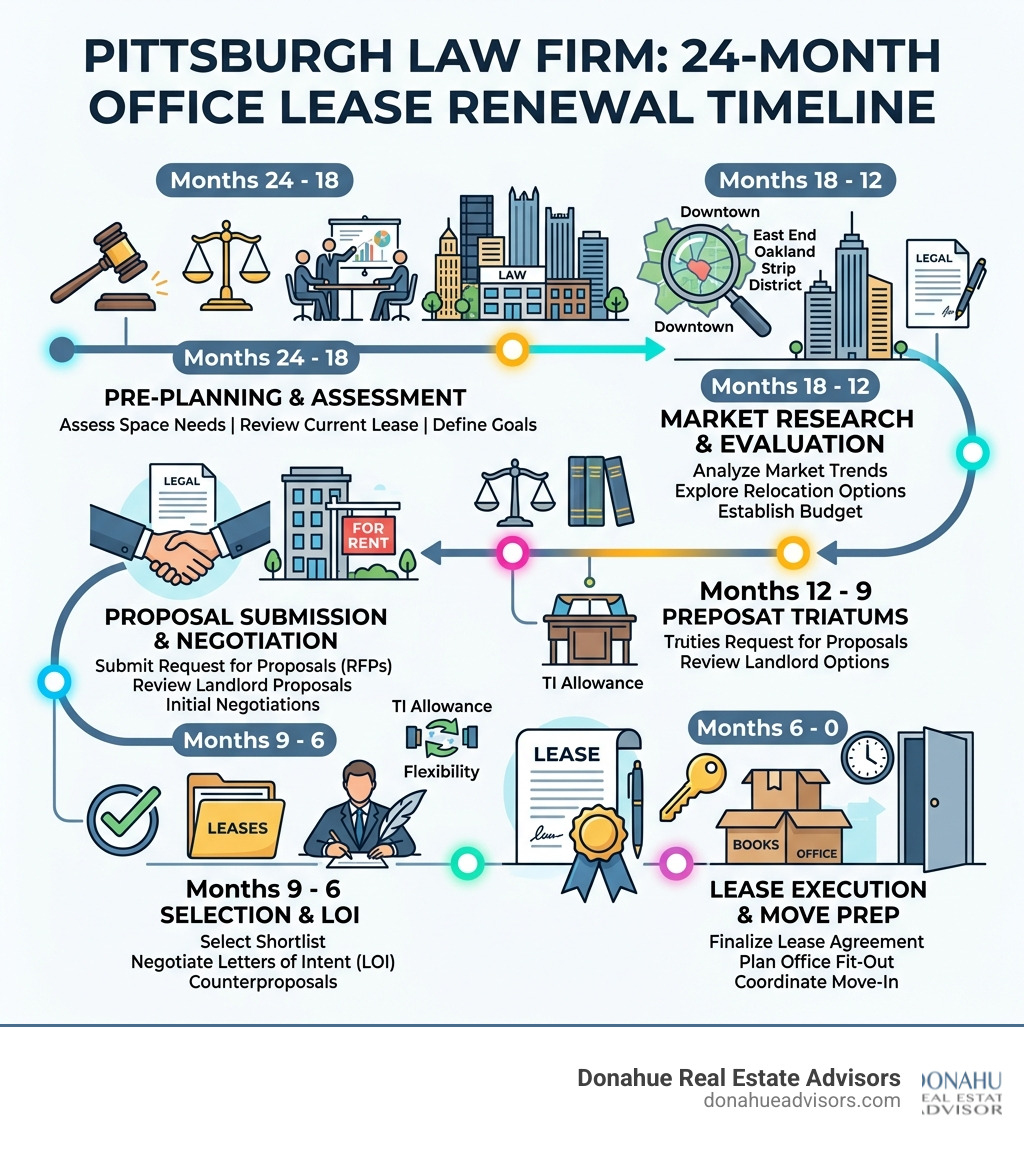
An office lease renewal strategy is the planned process of evaluating your current space, researching the Pittsburgh market, and negotiating favorable terms before your lease expires. Here is what that process looks like for law firms:
- Start 18 to 24 months early to preserve leverage and avoid rushed decisions
- Assess your space needs based on attorney headcount, hybrid work patterns, and growth plans
- Research Pittsburgh submarkets including Downtown, East End, Oakland, and the Strip District for comparable rents and vacancy rates
- Explore relocation alternatives even if you plan to stay, to create negotiating competition
- Negotiate key terms such as rent escalations, tenant improvement allowances, and flexible exit options
- Document everything in a signed lease amendment before committing
Your office lease is likely your firm’s second largest expense after payroll. Yet many Pittsburgh law firm owners treat renewal as a formality rather than a negotiation. That is a costly mistake.
Landlords know that roughly 70% of tenants renew to avoid the disruption of moving. They count on that. Without a clear strategy, you are likely to accept terms that favor the landlord, not your firm’s next five to ten years.
This guide is for Pittsburgh law firm owners who are weighing a real decision: renew where you are, or find a better space. We will walk through both paths so you can make the right call with confidence.
My name is Jack Donahue, SIOR, founder of Donahue Real Estate Advisors, and I have spent over 30 years representing office tenants across Pittsburgh, developing a conflict-free office lease renewal strategy for clients ranging from growing practices to established regional firms. As you read through this guide, every recommendation reflects what actually works in the Pittsburgh market today.
Mastering the Office Lease Renewal Strategy for Pittsburgh Law Firms
To master your office lease renewal strategy, you must first understand the landscape of the Pittsburgh legal market in 2026. The way law firms use space has fundamentally shifted. We see firms moving away from massive, mahogany-heavy suites toward efficient, tech-enabled environments that support both deep focus and collaborative hybrid work.
According to 2026 CoStar market projections, the Pittsburgh office market continues to offer significant opportunities for tenants who know how to navigate it. While Class A vacancy rates in the Central Business District (CBD) remain near 19.5 percent, this supply creates a “tenant’s market” where landlords are highly motivated to keep reliable legal practices in their buildings.
If you are considering to renew commercial lease, you are not just signing a piece of paper. You are making a multi-million dollar commitment. Understanding the commercial lease term is the first step in ensuring that commitment serves your firm’s profitability rather than the landlord’s bottom line.

The Critical 18 to 24 Month Planning Window
Time is the most valuable currency in real estate negotiations. We recommend that Pittsburgh law firms begin the planning process 18 to 24 months before their current lease expires. This might seem early, but it is essential for preserving leverage.
When you start early, you send a clear signal to your landlord: you are exploring all options. If you wait until six or nine months before expiration, the landlord knows you are likely a “captive audience.” At that point, the cost and logistical nightmare of moving a law firm on short notice makes relocation nearly impossible, and the landlord’s offer will reflect that lack of competition.
Early planning allows us to conduct thorough market benchmarking. We look at what other firms are paying in the same building and across the street. This data-driven approach is the foundation of a successful end of commercial lease transition.
Key Clauses in Your Office Lease Renewal Strategy
Negotiating a renewal is about much more than the monthly rent. For law firms, specific clauses can make or break the long-term viability of the space.
- Rent Escalations: Are they fixed annual increases or tied to a volatile index? We push for predictable, capped escalations that allow for accurate long-term budgeting.
- Tenant Improvement (TI) Allowances: Even if you stay in your current space, it likely needs a refresh. New paint, carpet, or a reconfigured lobby can boost morale and impress clients. In the current market, we often see TI allowances of $15 to $30 per square foot for renewals.
- Holdover Penalties: This is a clause many firms ignore until it is too late. Standard holdover rent can be 150 percent to 200 percent of your base rent. We negotiate these down to protect you in case a move or renovation takes longer than expected.
- Expansion and Contraction Rights: Law firms are dynamic. You may need an extra floor if you land a major case, or you might need to give back space if you shift to a more remote-heavy model.
Understanding a commercial lease requires a deep dive into these details to prevent “lease cost creep” over the life of the agreement.
Evaluating Space Needs in Pittsburgh Submarkets
Every neighborhood in Pittsburgh has a different personality and price point. Whether you are in the North Shore or East Liberty, your office lease renewal strategy must account for the specific dynamics of your submarket.
Analyzing the Future of Work for Legal Practices
The legal industry was once the last holdout for traditional office layouts, but that has changed. Many Pittsburgh firms now find they have 20 percent to 30 percent more space than they actually use. This “excess space” is essentially a tax on your firm’s revenue.
We help firms through “space programming.” This involves looking at your attorney-to-staff ratios and how many days a week your team is actually in the office. By optimizing your square footage, you might find that you can move to a higher-quality building in a submarket like the Strip District or Oakland while keeping your total occupancy costs the same.
Improving employee wellbeing is also a major factor. Modern legal offices prioritize natural light, soundproofing for confidentiality, and ergonomic common areas. As you decide whether to renew or relocate, consider if your current building supports the talent you want to attract and retain. Every commercial lease contract should be viewed through the lens of your firm’s future culture.
Leveraging Market Data for Your Office Lease Renewal Strategy
Data is your best defense against a bad deal. In submarkets like Shadyside or the Southside, vacancy rates can vary wildly from the CBD. For example, the East End has seen a surge in demand from tech-adjacent legal practices, which keeps rents firmer there than in older Downtown towers.
Using CoStar data for 2026, we can see that average Class A asking rents in the Pittsburgh market are approximately $32.00 to $46.00 per square foot. However, “effective rent”—what you actually pay after concessions like free rent and TI allowances—is often much lower.
We provide a comprehensive commercial lease review that compares your current terms to these market realities. If you aren’t sure where you stand, you can schedule a lease review with us to see the actual “comps” for your specific building and submarket.
The Relocation vs. Renewal Decision Framework
One of the biggest mistakes a law firm can make is telling the landlord they definitely want to stay. To get the best deal, you must be willing to walk away—or at least look like you are.
| Feature | Renewal Option | Relocation Option |
|---|---|---|
| Upfront Costs | Minimal (Refresh only) | High (Moving, IT setup, new furniture) |
| Disruption | Low | High (Business downtime) |
| Incentives | Modest TI and Rent Abatement | Significant TI and Free Rent |
| Space Efficiency | Often stuck with old layout | Purpose-built for modern needs |
| Leverage | Moderate | High (Landlords bid for your business) |
Understanding the landlord’s financial position is also key. If the building owner has a large loan coming due or high vacancy in the building, they will be much more aggressive in offering concessions to keep a stable tenant like a law firm. This insight is part of the value provided by a dedicated tenant rep.
Case Study: Navigating Temporary and Long-Term Transitions
We recently worked with a law firm who faced a complex dilemma in the Pittsburgh market. They needed a presence in Pittsburgh but were navigating a transition that required both immediate and long-term planning.
In the first phase, we helped them secure high-quality temporary space that allowed them to establish their Pittsburgh footprint without committing to a decade-long lease before they were ready. You can read the details on this challenging deal with a tight timeline in our law firm temporary space case study.
Once the firm’s growth trajectory was clear, we leveraged our conflict-free representation to find a premier long-term location. Because we do not represent landlords, we were able to survey every available option in Pittsburgh and negotiate a deal that included significant concessions and a layout tailored to their specific practice needs. The company was able to expand several times on their current floor as their headcount grew. The full story is available in the law firm long-term space case study.
Creating Competition to Maximize Concessions
Even if you love your current office, the best way to lower your rent is to tour at least three other buildings. When your current landlord’s representative sees us walking you through a competitor’s lobby, the dynamic of the negotiation changes instantly.
By creating a credible threat of relocation, we can often secure:
- Rent-Free Periods: It is not uncommon to get three to six months of free rent on a five-year renewal.
- Amortized Improvements: The landlord pays for your office upgrades upfront, and the cost is built into the rent over time.
- Right of First Refusal (ROFR): Ensuring that if the suite next door becomes available, you have the first shot at it.
Many firms ask, should I hire a tenant rep? The answer is almost always yes, because the landlord’s broker is a professional negotiator who does this every day. You need someone on your side of the table who only has your interests in mind. If you are still wondering, do I need a tenant rep?, consider that our fees are typically paid by the landlord, meaning you get expert advocacy at no direct cost to your firm.
Executing a Conflict-Free Negotiation
At Donahue Real Estate Advisors, we believe you cannot serve two masters. Many large brokerage firms represent both tenants and landlords. This creates a conflict of interest. If a broker’s firm is also the leasing agent for the building you are in, can they truly push the landlord for the lowest possible rent?
Our tenant rep process is built on independence. We only represent you, the tenant. This allows us to be aggressive in our negotiations and transparent in our advice. Understanding the difference between a landlord rep and tenant rep is the first step in protecting your firm’s financial interests.
Avoiding Common Tenant Pitfalls
The biggest mistake we see Pittsburgh law firms make is procrastination. When you are busy with depositions and trials, real estate often falls to the bottom of the to-do list. However, every month you wait is a month of leverage you lose.
Another common error is the “DIY” negotiation. Some firm owners believe that because they are skilled attorneys, they can handle a real estate negotiation just as well as a professional broker. While legal skills are vital, they are different from market-specific real estate expertise. A DIY approach often results in missing out on market-standard concessions like “operating expense caps” or “audit rights” that can save tens of thousands of dollars over the lease term.
Choosing commercial tenant representation ensures that you have a buffer between you and the landlord. This preserves your personal relationship with the building owner while allowing us to be the “bad cop” during the tough financial discussions.
Finalizing the Agreement and Documentation
Once the “handshake” deal is done, the real work begins. The terms of your renewal must be documented in a formal lease amendment. This is where we coordinate closely with your legal counsel to ensure that every verbal promise is reflected in the written contract.
We look for clarity on:
- Commencement Dates: Exactly when do the new terms and the new rent start?
- Work Letters: If the landlord is performing improvements, what is the exact scope of work and the deadline for completion?
- Restoration Clauses: When you eventually leave, do you have to tear out the extra offices you built, or can you leave them as is?
Finalizing these details protects you against future disputes and ensures a smooth transition into your next lease term.
Frequently Asked Questions about Office Lease Renewals
When is the best time to start a law firm lease renewal?
You should start 18 to 24 months before your lease expires. This gives you enough time to evaluate your space, survey the market, and potentially design a new office if you decide to relocate. If you wait until the last year, you lose the ability to use relocation as a credible threat.
Can we negotiate tenant improvements during a renewal?
Absolutely. Landlords would much rather spend money on paint and carpet for an existing tenant than lose that tenant and face months of vacancy. We frequently negotiate “refresh” allowances for law firms that want to stay in their current building but need their space to feel modern and professional.
Why should a law firm use a tenant representative for a renewal?
A tenant representative provides market data you cannot find online, creates competition among landlords, and handles the time-consuming negotiations so you can focus on your practice. Best of all, because we are conflict-free, we provide unbiased advice that large “dual-agency” firms simply cannot offer.
Conclusion
The Pittsburgh legal community is one of the strongest in the country, and your office should reflect the quality of your work. Whether you decide to stay in your current building or move to a vibrant new space in the Strip District or North Shore, your office lease renewal strategy will determine your firm’s overhead and operational efficiency for years to come.
Strategic real estate planning is not just about finding a roof over your head; it is about creating a competitive advantage. At Donahue Real Estate Advisors, we are proud to be the conflict-free voice for Pittsburgh tenants.
Don’t leave your firm’s second-largest expense to chance. Take control of your future and ensure your next lease serves your goals.
Schedule your Pittsburgh lease strategy session today and let us help you navigate the “Stay or Go” dilemma with confidence.