

When it’s time to renegotiate a commercial lease, most business leaders don’t realize how much leverage they actually have. Here’s a quick look at how the process works and what you can realistically achieve:
How to renegotiate a commercial lease:
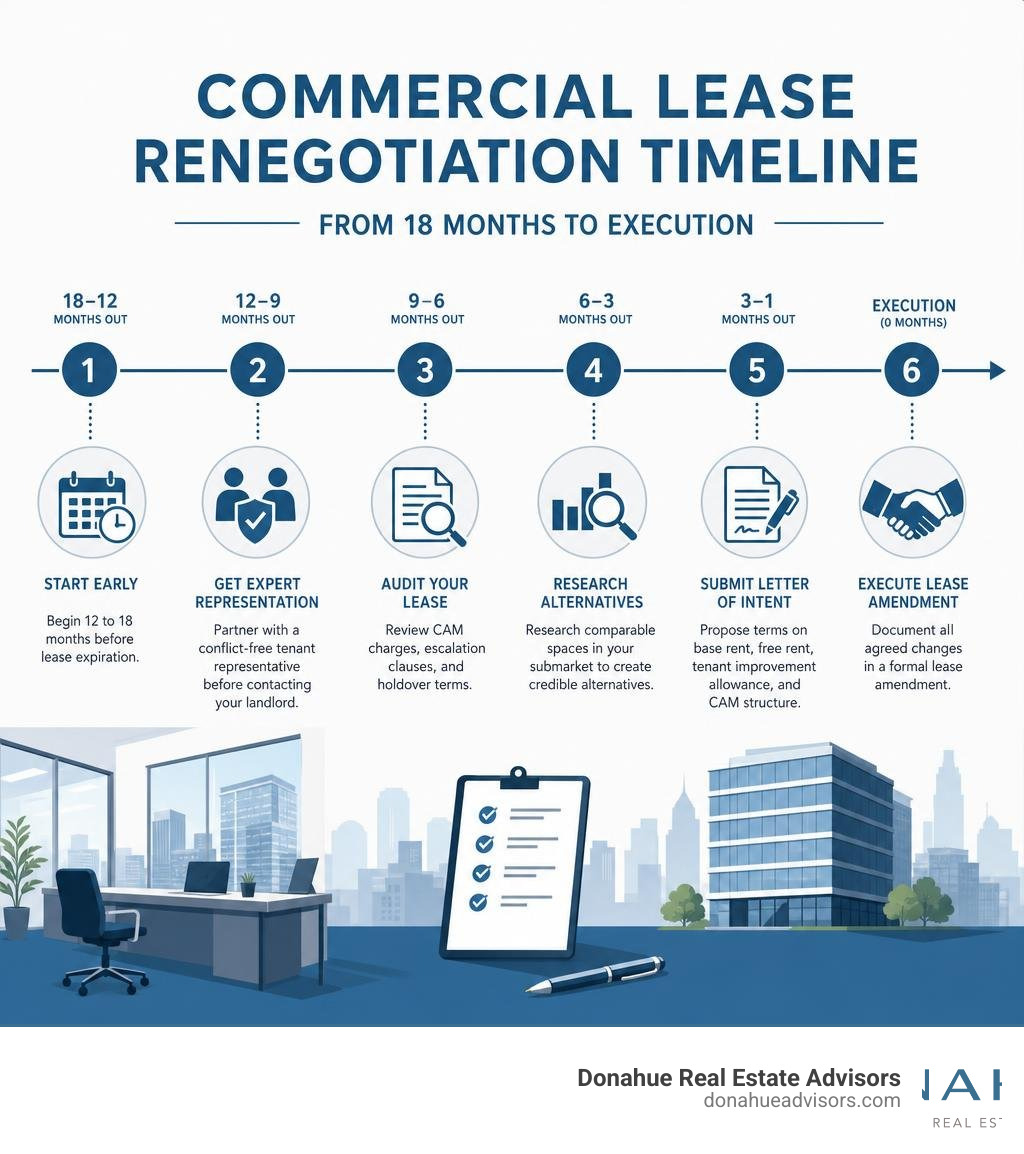
- Partner with expert tenant representation before contacting your landlord
- Start the process 12 to 18 months before your lease expiration date
- Audit your existing lease for CAM charges, escalation clauses, and holdover terms
- Research comparable spaces in your submarket to create credible alternatives
- Submit a letter of intent covering base rent, free rent, tenant improvement allowance, and CAM structure
- Document all agreed changes in a formal lease amendment
For most businesses, the lease is the second-largest expense after payroll. Yet most tenants approach renewal the same way they handle routine admin work, and that gap in attention routinely costs hundreds of thousands of dollars over a lease term.
The Pittsburgh commercial real estate market in 2026 gives tenants in submarkets like the Strip District, Oakland, East Liberty, Shadyside, and the North Shore real negotiating power. Landlords are motivated to keep good tenants. Replacing one costs far more than most people expect.
At Donahue Real Estate Advisors, we have spent decades helping Pittsburgh businesses renegotiate commercial lease terms from a position of strength, drawing on deep industry experience and continuing through the work of one of southwestern Pennsylvania’s most respected independent tenant representation firms. In the sections below, we will walk you through exactly how to approach this process strategically, so you keep more money in your business and get space that actually works for your team.
Why You Have Leverage to Renegotiate Commercial Lease Terms in 2026
Many Pittsburgh business owners assume that the landlord holds all the cards, especially if they are happy with their current location in thriving submarkets like the Strip District, Oakland, the North Shore, East Liberty, Shadyside, the East End, or the Southside. However, the balance of power remains firmly in the tenant’s corner.
The commercial lease cycle has accelerated significantly. According to LoopNet’s 2026 Lease Process Report, the median commercial lease cycle is 73 days in 2026, which is down from 96 days in 2019. This means transactions are moving faster, and landlords are highly motivated to avoid any extended periods of vacancy.
To truly understand your leverage, you must look at the situation through the lens of the landlord’s economics. When a tenant vacates a space, the landlord does not just lose monthly rent. They face a massive, immediate financial hit to find a replacement.
For a typical 5,000 square foot tenant paying $30 per square foot in base rent, a landlord’s estimated cost to replace that tenant totals approximately $350,000. This eye-popping figure is broken down as follows:
- Lost Rent (6 Months Vacancy): $75,000
- New Tenant Improvement (TI) Allowance ($40/SF): $200,000
- Broker Commissions (5% of a 5-Year Lease): $37,500
- Free Rent Abatement (3 Months): $37,500
- Total Estimated Landlord Replacement Cost: $350,000
By choosing to renegotiate and stay, you save the landlord from spending hundreds of thousands of dollars. This cost avoidance is your primary source of leverage. It allows you to negotiate competitive rental rates, updated space build-outs, and more favorable legal terms.
| Landlord Replacement Cost Item | Financial Impact (5,000 SF at $30/SF) | Tenant Benefit / Savings Potential |
|---|---|---|
| Lost Rent (6 Months Vacancy) | $75,000 | Leverage to secure immediate rent reductions |
| Tenant Improvement Allowance | $200,000 | Capital to refresh your current office space |
| Broker Commissions | $37,500 | Room to negotiate lower administrative fees |
| Free Rent Abatement | $37,500 | Months of zero rent at lease commencement |
| Total Landlord Exposure | $350,000 | Your ultimate leverage point |
Understanding the local legal landscape is also critical. Commercial leases in our region are governed by distinct state-level rules. Before you begin discussing terms, it is helpful to understand the basics of Pennsylvania commercial leases to ensure your proposed amendments align with state requirements.
Key Clauses to Audit Before Starting Negotiations
Before you pick up the phone or send an email to your landlord, you need to know exactly what is written in your current agreement. A thorough lease audit is the foundation of any successful renegotiation strategy.

Your renegotiation strategy will depend heavily on your existing lease structure. Here is how different structures impact your overhead:
- Triple Net (NNN) Leases: You pay a lower base rent but are responsible for all operating expenses, including real estate taxes, building insurance, and common area maintenance (CAM). In this structure, controlling CAM caps and audit rights is your highest priority.
- Full Service / Gross Leases: You pay a single, higher flat rate, and the landlord covers operating expenses. Your main focus here will be managing base rent escalations and ensuring the “base year” resets appropriately upon renewal.
- Modified Gross Leases: A hybrid structure where you pay base rent plus a portion of the operating expenses. You must carefully audit which specific expenses are passed through to your business.
To help you navigate these structures, we recommend reviewing our comprehensive guides on the Commercial Lease Contract and scheduling a professional Commercial Lease Review to uncover hidden liabilities.
Force Majeure and Rent Escalation Clauses
The commercial landscape has shifted permanently. Modern leases must account for unexpected business interruptions. You should carefully review your force majeure clause. Historically, these clauses only covered acts of God, but post-pandemic leases frequently include specific language regarding government-mandated shutdowns, public health protocols, and rent abatement rights during periods of forced vacancy.
Additionally, look closely at your rent escalation clauses. Most leases contain annual rent increases. These are typically structured as either fixed percentage increases (such as 3% annually) or escalations tied to the Consumer Price Index (CPI). CPI-tied escalations can cause your rent to skyrocket during inflationary periods. Your goal during renegotiation should be to cap any CPI-tied escalations at a maximum of 3% to 5% to ensure predictable future costs.
How to Renegotiate Commercial Lease CAM Caps and Operating Expenses
Common Area Maintenance (CAM) charges are often the most abused portion of a commercial lease. Landlords routinely pass inappropriate expenses down to tenants, from capital improvements that should be amortized over decades to excessive property management fees.
According to a Stratafolio 2025 audit sample of 212 office leases, the average tenant overcharge was 11.4%. If you are not auditing your CAM reconciliations, you are likely overpaying.
When you renegotiate a commercial lease, you should focus on three critical CAM components:
- CAM Caps: Negotiate a cap on how much your controllable operating expenses can increase year over year. Propose a 3% to 5% non-cumulative cap. A non-cumulative cap is far better for tenants than a cumulative cap because it prevents the landlord from “carrying over” unused escalation room from previous years.
- Operating Expense Audit Rights: Ensure your lease grants you a clear window, typically 90 to 120 days after receiving the annual reconciliation statement, to audit the landlord’s financial books. This clause should include a fee-shifting provision stating that if the audit reveals an overcharge of 3% or more, the landlord must pay for the cost of your audit.
- Expense Exclusions: Explicitly exclude capital expenditures, landlord marketing costs, leasing commissions, and executive salaries from your CAM pool.
For a deeper dive into these hidden expenses, read our guide on Commercial Lease Issues for Tenants.
The Step-by-Step Preparation Timeline
Time is your most valuable asset when renegotiating a commercial lease. If you wait until a few months before your lease expires, you lose your leverage. The landlord knows you do not have enough time to design, permit, build out, and move into a new space, which forces you to accept whatever terms they offer.
We recommend starting this process 12 to 18 months before your lease expiration date. To keep your team on track, consult The Ultimate Guide to Key Commercial Lease Dates and begin planning your approach to Renew Commercial Lease terms well in advance.
Step 1: Partner with Expert Tenant Representation to Renegotiate Commercial Lease Terms
The absolute first step in your renegotiation process must be partnering with an expert tenant representative. Many business owners believe they can save money by negotiating directly with the landlord. This is a critical mistake.
Landlords are real estate professionals who negotiate leases every single day, and they are represented by sophisticated listing brokers whose sole job is to maximize the building’s value. Going into this environment alone is a massive disadvantage.
Furthermore, listing brokers have an inherent conflict of interest. They represent the landlord’s financial interests, not yours.
At Donahue Real Estate Advisors, we offer conflict-free tenant representation. We do not represent landlords, and we do not manage commercial buildings. We represent you, the tenant, exclusively. This means our only goal is to secure the lowest possible rent, the highest possible concessions, and the most flexible lease terms for your business. Best of all, tenant representation is virtually free to you, as the landlord pays the leasing commission out of a pool of funds already budgeted for the transaction. Learn more about how we protect your interests on our Tenant Rep page.
Step 2: Conduct Market Research and Create Credible Alternatives
To win a negotiation, you must have the power to walk away. The only way to establish walk-away power is to create credible alternatives.
With your tenant representative, you should tour three to five comparable properties in your target Pittsburgh submarkets. Whether you are looking at creative brick-and-beam spaces in the Strip District, tech-focused footprints in Oakland, or modern offices on the North Shore, having physical options on the table changes the dynamic of the negotiation.
We will help you request formal proposals from these competing buildings. When your current landlord realizes you are actively touring other properties and holding written offers, they will immediately become more flexible.
During this research phase, it is vital to distinguish between “face rent” (the asking price written on the marketing brochure) and “effective rent” (the actual net cost after accounting for free rent, tenant improvement allowances, and other concessions).
High-Impact Concessions Tenants Can Realistically Achieve
Once you have established leverage and completed your market research, you can begin negotiating specific concessions. These concessions have a massive impact on your total cost of occupancy over the commercial lease term.

Rent Abatement and Tenant Improvement (TI) Allowances
The two highest-impact financial concessions you can negotiate are free rent and tenant improvement allowances.
According to Cushman & Wakefield data for 2026, the median free rent abatement is 4.2 months on Class A office leases across the top 25 metros. Depending on the vacancy rates in your specific Pittsburgh submarket, we can often secure several months of entirely free rent at the start of your renewed lease term. This provides an immediate cash flow boost to your business.
Additionally, if your current space is looking tired or no longer fits your team’s workflow, you should negotiate a Tenant Improvement (TI) allowance. Landlords routinely provide $10 to $30 per square foot for space refreshes on renewals. If you do not use the entire TI allowance for construction, make sure your lease amendment allows you to convert any unused TI dollars directly into a base-rent reduction, rather than forfeiting those funds to the landlord. To understand how these concessions integrate into your lease structure, read our guide on Understanding a Commercial Lease.
Good-Guy Clauses and Personal Guarantee Reductions
For privately held businesses and growing companies, personal liability is a major concern. Landlords often demand a personal guarantee from the company’s principals, which puts your personal assets on the line if the business struggles.
During renegotiation, we can often work to reduce or eliminate these personal guarantees. A highly effective alternative is the “good-guy clause.” This clause limits your personal liability to the period of actual occupancy. As long as you give the landlord sufficient notice (typically 90 to 120 days) and surrender the space in good, clean condition, your personal guarantee is released upon vacancy. This protects your personal finances while giving the landlord peace of mind that you won’t simply abandon the property overnight. Learn more about protecting your business at the end of commercial lease.
Critical Mistakes: Free Rent Timing and Holdover Rent Risks
Even highly successful business owners make costly mistakes when negotiating commercial renewals. Two of the most common and damaging mistakes involve the timing of free rent and underestimating holdover rent risks.
Many tenants accept a “free rent” concession but allow the landlord to place it at the very end of the lease term. This is a mistake. Free rent is far more valuable at the beginning of the lease term, where it can offset moving costs, space modifications, or simply bolster your operating cash flow when you need it most.
An even more dangerous trap is the holdover clause. If your lease expires and you have not executed a formal renewal or amendment, you automatically become a “holdover” tenant. Most standard commercial leases contain holdover penalties that spike your rent to 150% or even 200% of your expiring rate.
If negotiations run long and you cross your expiration date without a signed agreement, your landlord can legally double your rent overnight. This is why starting 12 to 18 months in advance is not just a recommendation, it is a critical safety measure for your business. To protect your business from these traps, we highly recommend you schedule a lease review with our team today.
Frequently Asked Questions about Commercial Lease Renegotiation
Can you renegotiate a commercial lease before it expires?
Yes, you can renegotiate a commercial lease at any point during your term if both parties agree. Mid-term renegotiations are common during broader economic downturns, periods of severe business hardship, or when a tenant is looking to expand their footprint early in exchange for an extended lease term. Landlords are often willing to restructure rent payments mid-term if it prevents a tenant bankruptcy and ensures the building remains occupied.
What is the difference between face rent and effective rent?
Face rent is the nominal rental rate stated in the lease agreement, such as $30 per square foot. Effective rent is the true average annual cost of the lease after factoring in all landlord concessions, such as free rent months, moving allowances, and tenant improvement dollars. When comparing properties, always calculate the effective rent to see the true financial picture.
How do landlord replacement costs give tenants leverage?
As shown in our replacement cost breakdown, a landlord faces massive upfront expenses, including vacancy downtime, new build-out costs, and broker commissions, when a tenant leaves. Because renewing an existing tenant is vastly cheaper than finding a new one, the landlord’s desire to avoid these replacement costs is your strongest negotiating tool.
Conclusion
Renegotiating your commercial lease is not a simple administrative renewal. It is a major financial transaction that will impact your company’s balance sheet, workplace culture, and operational flexibility for years to come.
At Donahue Real Estate Advisors, we provide conflict-free tenant representation and strategic advisory to all types of businesses across southwestern Pennsylvania, including technology startups, retail brands, professional services, and corporate offices. We have helped organizations of all sizes, across all industries, evaluate their options and secure optimal terms.
Partner with Donahue Real Estate Advisors for a lease strategy session today, and let us help you turn your commercial lease into a strategic business advantage.