

5 Cheaper Alternatives to Office Space for Wealth Management Firms
Why the Right Office Space for Wealth Management Firms Matters More Than Ever
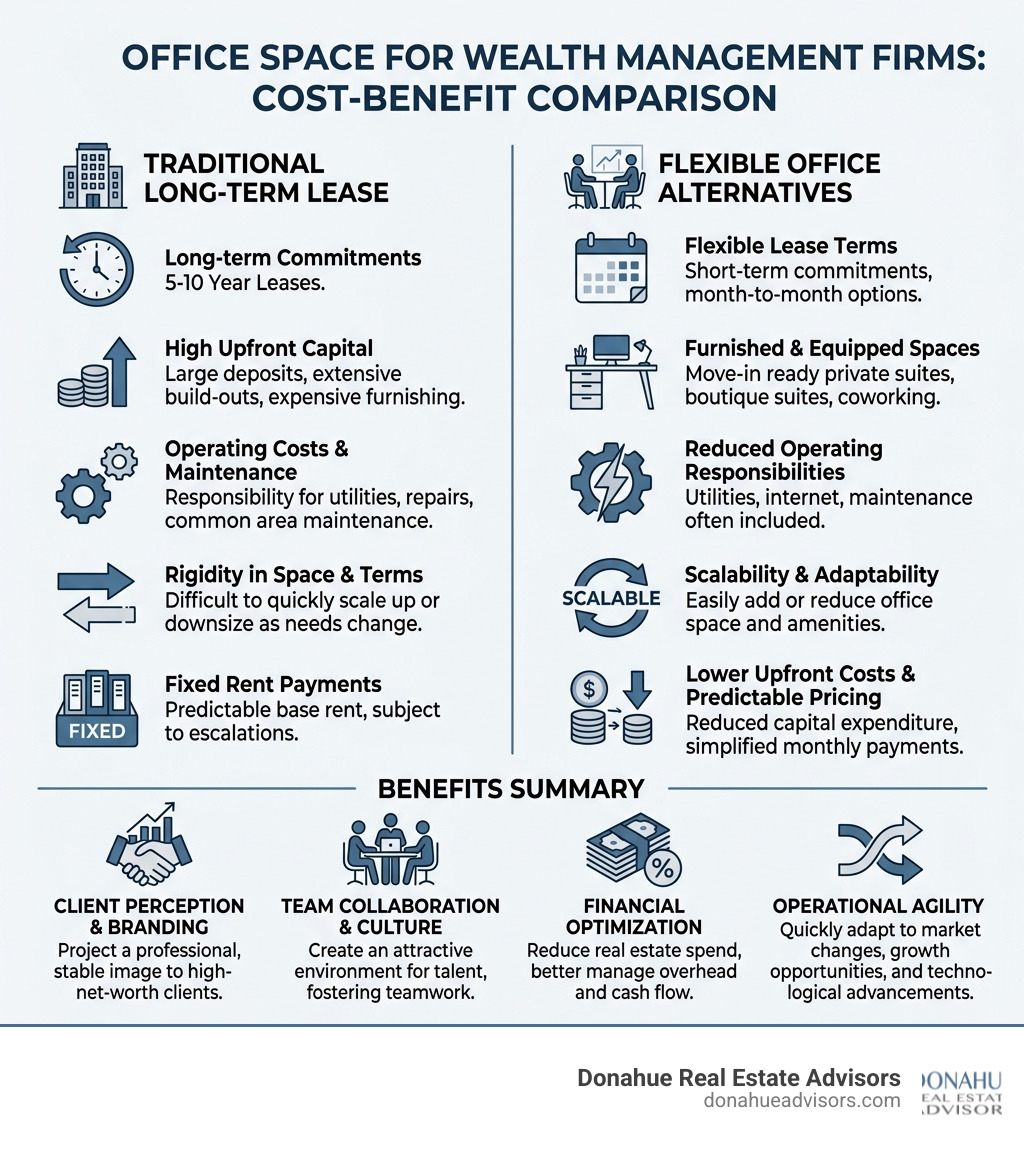
Office space for wealth management firms plays a direct role in how clients perceive your practice, how well your team collaborates, and how much you spend each month on overhead. Here are the five most cost-effective alternatives to a traditional long-term lease in 2026:
- High-end coworking and boutique suites – Private, furnished offices with flexible terms and premium amenities
- Strategic lease renewals with optimized allowances – Renegotiate your current lease for better terms, more space, or a funded build-out
- Subleasing premium financial suites – Access Class A space at a significant discount from credit tenants
- Right-sizing in Pittsburgh’s emerging submarkets – Lower rents in areas like the Strip District, East Liberty, and Shadyside without sacrificing quality
- Flex-and-core hybrid models – Keep a smaller core footprint and scale up with flexible space as needed
Each of these options can meaningfully reduce your real estate costs while still giving your clients and team the professional environment they expect.
Wealth management is a trust-based business. Clients are handing you control over their financial futures, and the space where you meet them sends a signal before you say a word. A cramped, outdated, or generic office works against you. But overpaying for space you don’t fully use is just as damaging to your bottom line.
In 2026, Pittsburgh’s office market gives wealth management firms more options than ever, from renovated historic buildings in the Golden Triangle to modern suites in the East End. The challenge is knowing which option fits your firm’s size, growth plans, and client profile.
We have spent years helping professional services firms, including financial advisors and wealth management practices, secure the right office space for wealth management firms without overpaying or locking into unfavorable terms. In the sections below, we will walk you through five practical, Pittsburgh-specific strategies to get more from your real estate dollar in 2026.
Learn more about office space for wealth management firms:
The Shifting Landscape of Office Space for Wealth Management Firms in 2026

As we navigate April 2026, the Pittsburgh office market continues to evolve. Vacancy rates in the central business district remain elevated, providing a unique window of opportunity for tenants. However, the flight to quality is more pronounced than ever. Wealth management firms are increasingly gravitating toward Class A vs Class B Office Space to satisfy the expectations of high-net-worth (HNW) clients.
The rise of hybrid work has fundamentally changed how much office space a firm actually needs. In the past, firms might have allocated 250 square feet per person. Today, that number has often dropped, as advisors spend more time in the field or working remotely, while the office itself has become a “hub” for high-stakes client meetings and team collaboration.
Talent retention is another major driver. In a competitive market for top-tier advisors, providing an office that feels like a destination rather than a chore is essential. Whether it’s a historic building in the Golden Triangle or a tech-forward suite in the Strip District, your real estate is a tool for recruiting.
1. High-End Coworking and Boutique Suites
For smaller wealth management firms or solo practitioners, the overhead of a traditional 5,000-square-foot lease is often unjustifiable. This is where high-end coworking and boutique suites come in. Unlike the “foosball and beer tap” coworking spaces of the past, 2026 offers sophisticated, turnkey solutions specifically designed for financial professionals.
These spaces provide better office space by offering:
- Turnkey Privacy: Soundproofed private offices that ensure client confidentiality.
- Shared Luxury: Access to grand lobbies and boardrooms that would be too expensive to build out on your own.
- Networking: Proximity to CPAs and estate attorneys, creating natural referral loops.
Flexible terms allow you to start with a single executive suite and expand as your assets under management (AUM) grow. For many, this is an investment that pays for itself through better client impressions and reduced management headaches.
2. Strategic Lease Renewals with Optimized Allowances

If your firm is already in a location you like, moving might not be the answer. Instead, a strategic lease renewal can be a powerful way to reduce costs. Many Pittsburgh landlords, facing 2026 vacancy pressures, are more willing than ever to provide a significant tenant improvement allowance.
This allowance can be used to modernize your space, perhaps adding a dedicated media room for video conferencing or updating the reception area to better reflect your brand. In our this wealth management firm case study, we saw how they could leverage market data to secure favorable terms while staying put.
Many firms ask, “Do I need a tenant rep?” when renewing. The answer is almost always yes. Without a representative, you are negotiating against a landlord who knows the market better than you do. We use real-time market data to ensure our clients get concessions that reflect the true 2026 market value.
3. Subleasing Premium Financial Suites
Subleasing is often the “hidden gem” of the commercial real estate world. When a larger firm—perhaps a major bank or a law firm—finds itself with excess space, they often list it as a sublease at a deep discount.
| Feature | Direct Lease | Sublease |
|---|---|---|
| Cost | Market Rate | 20-50% Discount |
| Terms | 5-10 Years | Remaining Term (1-4 Years) |
| Furniture | Tenant Purchase | Often Included (Plug-and-Play) |
| Build-out | Custom | As-Is |
For a wealth management firm, finding a “plug-and-play” suite previously occupied by another financial tenant can save hundreds of thousands in capital expenditures. When asking “How much office space do I need?“, a sublease allows you to test a larger footprint without the long-term risk. We specialize in identifying these undervalued opportunities in Pittsburgh’s most prestigious buildings.
4. Right-Sizing in Pittsburgh’s Emerging Submarkets
While the Golden Triangle remains the traditional heart of Pittsburgh finance, 2026 has seen a shift toward “lifestyle” submarkets. These areas often offer better parking, trendy dining for client lunches, and a more modern vibe.
- The Strip District: Perfect for firms wanting a “cool,” industrial-chic aesthetic.
- North Shore: Offers great views and easy access for clients traveling from the North Hills.
- East Liberty & Shadyside: Ideal for firms targeting the affluent residents and tech-wealth of the East End.
- Oakland: Great for firms with ties to the university and medical systems.
Using The Ultimate Office Space Needs Assessment for Growing Teams, we help firms determine if moving to a submarket like the Southside or Oakland could provide a rent advantage while actually improving the daily experience for staff and clients.
5. Flex-and-Core Hybrid Models
The “Flex-and-Core” model is gaining massive traction in 2026. Under this strategy, a firm signs a traditional lease for a smaller “core” space—enough for their essential staff and primary meeting rooms—and then uses flexible coworking memberships for overflow or satellite needs.
This operational agility was demonstrated when firms like Granite Harbor Advisors Expands Presence in Houston (though we focus on Pittsburgh, the principle applies) used modular planning to support rapid growth. By keeping your fixed costs low with a smaller core, you protect your business against market volatility.
If you are wondering, “Should I hire a tenant rep?” for a hybrid model, the answer is that these deals are complex. They require coordinating different types of agreements, and having an advocate ensures the “flex” part of your office actually works when you need it.
Essential Features for Modern Financial Environments
Regardless of which alternative you choose, certain features are non-negotiable for office space for wealth management firms. Privacy is the most critical. You need soundproofing that ensures a conversation in the conference room can’t be overheard in the lobby.
As seen in this law firm case study, even short-term solutions must meet high standards for professional conduct. Modern firms are also adding:
- Wellness Rooms: A quiet space for staff to recharge.
- Concierge Services: To greet HNW clients with a high level of hospitality.
- Hospitality Hubs: Moving away from the “breakroom” toward a high-end kitchen area where you can host evening client events, similar to the long-term successes in this law firm case study.
Designing Office Space for Wealth Management Firms to Build Client Trust
Aesthetics matter. In 2026, the trend has moved away from heavy mahogany and toward a minimalist, light-filled design. High-contrast finishes—think dark frames against light walls—create a sharp, professional look. Lighting is also a strategic tool; well-lit spaces feel transparent and inviting, which helps build the foundational trust required in wealth management.
Technology Infrastructure in Office Space for Wealth Management Firms
Your office is only as good as its backbone. For financial firms, this means:
- Data Security: Private VLANs to keep client data isolated from other tenants in a building.
- Recording Studios: Many Pittsburgh advisors are now producing their own podcasts or webinars to reach clients; having a small, sound-treated media room is a huge asset.
- High-Speed Fiber: Essential for real-time trading and seamless video conferencing.
Frequently Asked Questions about Financial Office Leasing
What are the typical costs for wealth management space in major markets?
In 2026, Pittsburgh remains a cost-effective alternative to markets like NYC or Chicago. While a Park Avenue suite might run over $100 per square foot, Class A space in Pittsburgh’s Golden Triangle or the Strip District typically ranges from $30 to $45 per square foot, depending on the building’s age and amenities. Using local market data, we can pinpoint exact rates for specific buildings to ensure you aren’t overpaying.
How has hybrid work changed square footage requirements for advisors?
Most firms have realized they don’t need a dedicated desk for every single employee if people are only in three days a week. We are seeing a shift toward “hot-desking” for junior staff while maintaining private offices for senior advisors. This often allows a firm to reduce its total square footage by 15-25% without feeling crowded.
Why is location critical for high-net-worth client acquisition?
HNW clients value their time. If your office is in an area with difficult parking or high traffic, they are less likely to visit. Choosing a location like North Oaks or a prestigious building with valet parking in downtown Pittsburgh removes friction from the client relationship.
Conclusion
At Donahue Real Estate Advisors, we believe that your office should be a tool for growth, not a financial burden. Whether you are looking to right-size in the East End or negotiate a better deal on your current downtown lease, our conflict-free advocacy ensures your interests—and only your interests—are protected.
We exclusively represent tenants, meaning we never have a reason to push you toward a specific building or landlord. We use 2026 market intelligence to help you find the most strategic office space for wealth management firms in Pittsburgh.
Ready to optimize your real estate footprint? Tenant rep services can save you time and money.
Schedule a lease strategy session with us today to evaluate your options for 2026 and beyond.