

Paging Dr. Tenant: The Guide to Medical Office Leases in Pittsburgh
What You Need to Know About a Medical Office Lease in Pittsburgh
Medical office lease Pittsburgh is a specialized market with its own rules, pricing, and requirements – very different from a standard office search.
Here’s a quick snapshot according to Loopnet to get you oriented:
| Factor | Data |
|---|---|
| Active city listings | 36 medical office spaces |
| Regional listings | 88 near Pittsburgh, PA |
| Average asking rent | $25.61 per square foot |
| Rental rate range | $10.00 – $35.50 SF/YR |
| Market vacancy rate | 17.3% |
| Average space size | ~23,489 SF |
| Smallest available | ~120 SF |
| Largest available | 51,191 SF |
Whether you’re a physician, dentist, or allied health professional, finding the right space in Pittsburgh means more than picking a nice building. It means understanding specialized infrastructure, lease structures that protect your practice, and neighborhoods where your patients can actually reach you.
Pittsburgh has become a hub for healthcare, technology, and education. That mix drives real demand for professional medical space – and it also means landlords hold significant leverage if you walk in unprepared.
The good news? A 17.3% vacancy rate means you have options. But without the right strategy, you can easily end up in a space that costs too much, fits poorly, or locks you into unfavorable terms for years.
This guide is built for medical professionals and their advisors who want to approach the Pittsburgh leasing market with a clear head and a strong position.
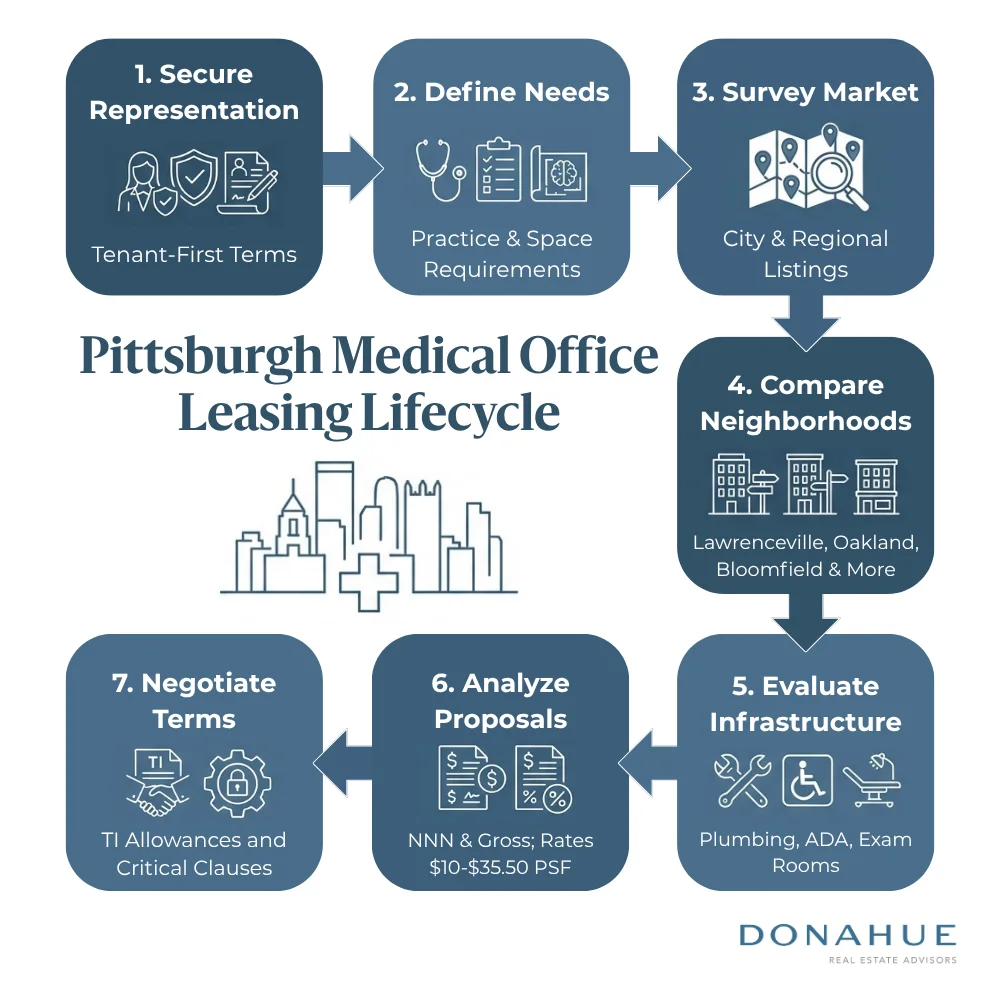
Navigating the Market for a Medical Office Lease in Pittsburgh
When we look at the current landscape for a Medical office lease Pittsburgh, we see a market that is both robust and surprisingly accessible. Currently, there are approximately 36 medical office listings available directly within the Pittsburgh city limits, with that number expanding to 88 listings when you include the immediate surrounding regional areas.
The overall Pittsburgh office market is sitting at a 17.3% vacancy rate. While that might sound high for landlords, it is music to the ears of a tenant. It means there is “elbow room” in the market to negotiate. However, medical space is a “sticky” asset class. Unlike a tech startup that can move its laptops to a coworking space overnight, a medical practice has heavy sinks, lead-lined walls, and sensitive equipment. Landlords know this, which is why having a tenant rep is vital to ensure you aren’t being overcharged for that perceived lack of mobility.
If you are just starting your search, you can browse current Pittsburgh, PA Medical Offices for Lease to get a feel for the aesthetic of available buildings. From historic renovations in the Strip District to modern glass towers in Oakland, the Commercial Real Estate Pittsburgh market offers a diverse portfolio for any practice style.
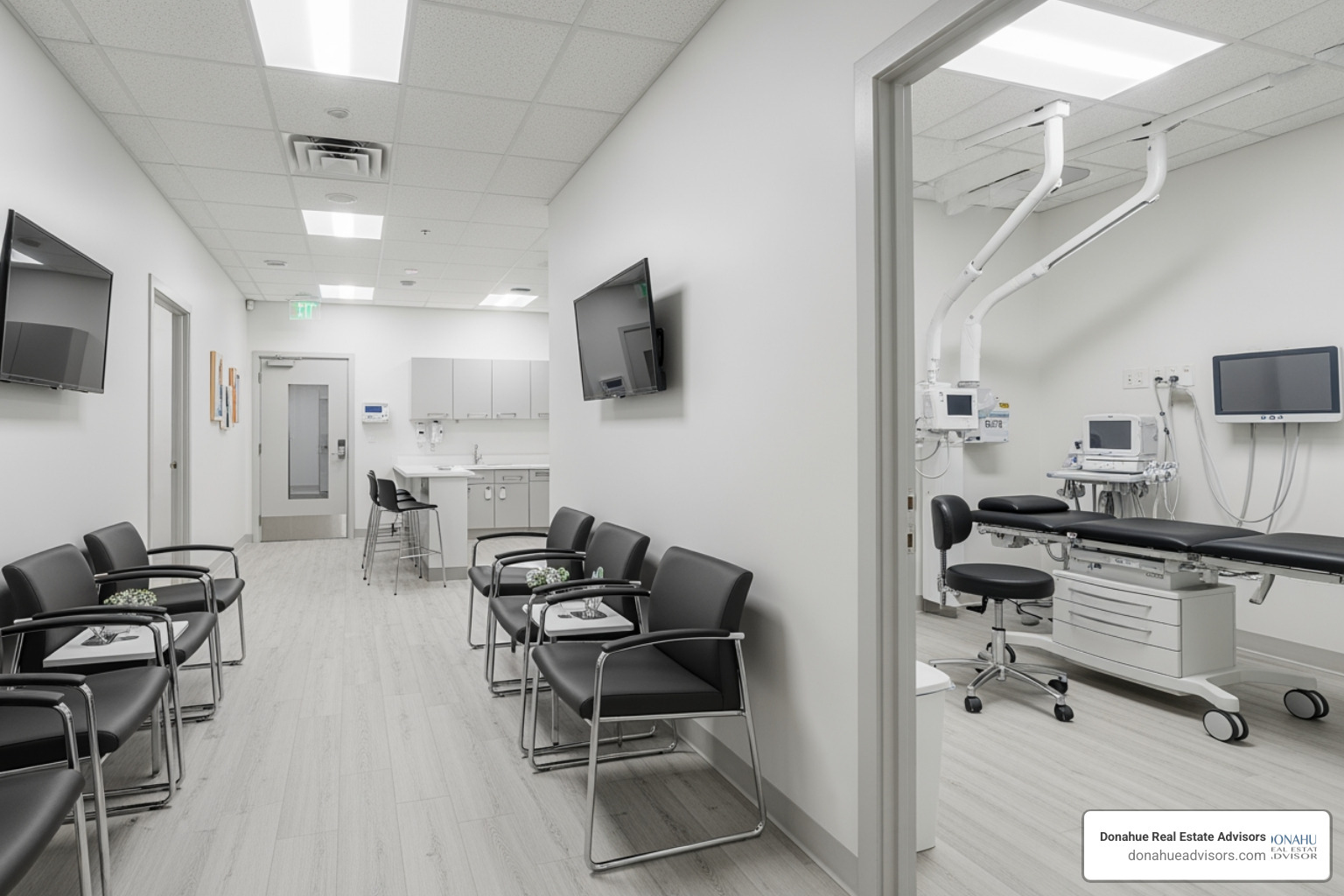
Understanding Size Ranges for a Medical Office Lease in Pittsburgh
Size is one of the most misunderstood factors in medical leasing. In Pittsburgh, the average available medical office space is approximately 23,489 SF. Now, don’t let that number scare you—that average is skewed by large clinical wings and hospital-adjacent complexes.
The reality of the market is much more flexible:
- Small Suites: We see spaces as small as 120 to 500 SF, perfect for solo practitioners, therapists, or satellite consultation offices.
- Mid-Sized Practices: Many listings fall in the 1,500 to 5,000 SF range, which is the “sweet spot” for most dental practices or multi-physician groups.
- Large Facilities: For those looking to build out a full surgical center or urgent care, there are several 20,000+ SF options currently on the market.
When determining your office space needs, we recommend looking at your practitioner-to-exam-room ratio. A general rule of thumb is 1,200 to 1,500 square feet per physician, but this varies wildly if you need heavy imaging equipment or large physical therapy gyms.
Market Trends and Vacancy Impacts
The 17.3% vacancy rate mentioned earlier is a key indicator of market health. While the “asking rent” across all office types in Pittsburgh averages $25.61 PSF, the medical sector often commands a slight premium due to the specialized nature of the build-outs.
One trend we are watching closely is the “medicalization” of traditional retail and office space. As traditional office tenants downsize, landlords are becoming much more open to medical tenants. They love the stability of a doctor’s office. We have seen several case studies where we successfully moved a medical client into a space while securing significant landlord concessions because the landlord wanted a reliable, long-term tenant.
Infrastructure and Financial Benchmarks for Medical Space
Pricing for a Medical office lease Pittsburgh is not a “one size fits all” calculation. While the city-wide average asking rent is $25.61 PSF, the actual range is quite broad, spanning from $10.00 to $35.50 SF/YR.
Where you fall on that spectrum depends heavily on the lease structure. Most medical leases in Pittsburgh are Triple Net (NNN). In an NNN lease, the tenant is responsible for their proportional share of the building’s operating expenses, including real estate taxes, insurance, and maintenance. Before you sign, it is critical that you are understanding a commercial lease and how these “nets” can fluctuate year over year.
| Neighborhood | Typical Rate Range (PSF) | Lease Type |
|---|---|---|
| Downtown / CBD | $22.00 – $32.00 | NNN / Full Service |
| Oakland | $25.00 – $35.50 | NNN |
| Lawrenceville | $18.00 – $28.00 | NNN |
| Bloomfield | $15.00 – $22.00 | NNN / Modified Gross |
| Monroeville / Suburbs | $12.00 – $20.00 | NNN |
Factors Influencing Your Medical Office Lease in Pittsburgh
Why does one building cost $15/SF while another costs $30/SF? In Pittsburgh, it usually comes down to three things:
- Hospital Proximity: Being within walking distance of UPMC Presbyterian or AHN Forbes is going to cost more. You are paying for the referral network and the convenience for your physicians.
- Parking Ratios: For a medical tenant, parking is life. If your patients can’t park, they won’t come. Spaces with dedicated, free on-site parking command a premium over downtown spots where patients have to use a public garage.
- Patient Demographics: Landlords in high-income or high-growth areas like Shadyside or Lawrenceville know the value of the “rooftops” surrounding their building.
Because these factors are so complex, a professional commercial lease review is non-negotiable. We look past the base rent to see if the “hidden costs” of the location actually make financial sense for your practice’s bottom line.
Specialized Requirements vs. Traditional Office Space
This is where doctors and accountants often run into trouble. A “standard” office lease might provide for new carpet and paint. A medical lease needs to account for:
- Medical-Grade Plumbing: You need sinks in every exam room. That requires core drilling through concrete floors—an expensive endeavor that a traditional landlord might not expect.
- HIPAA Compliance: Your layout must ensure sound privacy between exam rooms and secure storage for patient records.
- ADA Accessibility: This goes beyond a ramp at the front door. It includes specialized restroom clearances and hallway widths that accommodate wheelchairs and gurneys.
- Utility Intensity: Medical equipment often requires dedicated circuits and enhanced HVAC for server rooms or labs.
We recently highlighted some of these complexities in our medical tech case study, showing how specialized infrastructure planning can save a tenant six figures during the build-out phase.
Top Pittsburgh Neighborhoods and Accessibility Trends
Choosing the right neighborhood for your Medical office lease Pittsburgh is a balancing act between where you want to work and where your patients can actually get to you.
- Oakland: The undisputed healthcare heart of the city. It is home to major academic and medical institutions. It is high-demand, high-cost, and parking-challenged, but the prestige is unmatched.
- Bloomfield: Often called Pittsburgh’s “Little Italy,” this area is centrally located between major hospital hubs and offers a more “neighborhood” feel with competitive rates around $18.00 SF/YR.
- East Allegheny: This area has seen a surge in interest. You can find specialized East Allegheny, PA Medical Offices For Lease – CityFeet that offer proximity to the North Shore and downtown without the CBD price tag.
Neighborhood Spotlight: Lawrenceville and Bloomfield
Lawrenceville has transformed from an industrial corridor into a tech and healthcare hotspot. There are currently about 9 active medical office listings in the Central Lawrenceville area. What makes this area unique is the “retail exposure.” Many medical offices here are taking over ground-floor spaces in new developments, giving them high visibility to the thousands of pedestrians walking Butler Street every day.
Our services often involve helping clients decide between the “cool factor” of a renovated Lawrenceville warehouse and the functional efficiency of a medical professional building in Bloomfield. While Lawrenceville offers great branding, Bloomfield often offers better patient parking and lower NNN costs.
Accessibility: Parking and Public Transit
In Pittsburgh, accessibility is defined by the “T” (light rail), the busways, and—most importantly—the hills.
- Public Transit: If you have a high volume of patients who rely on public transport, being near a main T-station stop or a major bus line in Oakland is a requirement.
- Patient Drop-off: Does the building have a “porte-cochère” or a dedicated pull-off lane? If your patients are elderly or have mobility issues, a downtown curb-side drop-off is a nightmare.
- Walkability: Areas like the South Side and Lawrenceville have high walkability scores, which is great for attracting young, healthy patients who work in the nearby tech firms.
Mastering the Negotiation and Build-Out Process
Negotiating a Medical office lease Pittsburgh is where we earn our keep. Unlike a residential lease, everything in a commercial lease is negotiable—from who pays for the lightbulbs to how much the landlord will contribute to your construction.
Customization Options for Medical Tenants
When you find a “shell” space, you are looking at four walls and a concrete floor. To turn that into a clinic, you need a Tenant Improvement (TI) allowance.
- TI Allowances: This is a bucket of money the landlord gives you to build out the space. In Pittsburgh, we see TI allowances ranging from $20 to $70+ per square foot, depending on the lease length.
- Turnkey Delivery: In some cases, the landlord will handle the construction themselves and hand you the keys to a finished office. This is easier for you but gives you less control over the quality of the finishes.
As a commercial tenant representation specialist, we ensure that your “build-out” includes the specialized electrical for your X-ray machines and the proper sterilization rooms needed for your specific practice.
Critical Lease Clauses for Professionals
We always tell our clients to look out for the fine print. Here are the “landmines” we look for:
- Operating Expense Caps: We negotiate 4-5% non-cumulative caps on annual operating expense increases. You shouldn’t be penalized because the landlord decided to buy expensive new landscaping.
- Audit Rights: You should have the right to audit the landlord’s books. If they say the snow removal cost $50,000, you should be able to see the receipt.
- Subleasing Rights: If your practice grows and you need to move, or if you want to bring in a partner to share space, you need the right to sublease without the landlord being able to unreasonably say “no.”
- Restoration Clauses: Some leases require you to “return the space to its original condition.” For a medical tenant, that could mean spending $100,000 to rip out all those sinks you just installed. We negotiate to remove these clauses.
If Listed Medical Offices Do Not Fit, Tenants Still Have Options
If current medical listings do not check every box, tenants are not stuck. Common alternatives include:
- Leasing shell space and building it out for clinical use
- Converting traditional office space when zoning, plumbing, power, and accessibility allow
- Backfilling second-generation healthcare space left by another practice
- Expanding into flex space for lab, imaging, or administrative functions
- Negotiating a turnkey build-out with landlord-funded improvements
- Phasing occupancy by taking smaller space now with expansion rights later
- Relocating within nearby Pittsburgh submarkets to improve parking, access, or rent
- Renewing in place and reconfiguring the current suite instead of moving
The right path depends on patient flow, budget, timeline, and how specialized the practice needs the space to be.
Frequently Asked Questions about Medical Office Leases in Pittsburgh
How many medical office spaces are currently available for lease in Pittsburgh?
There are currently 36 Medical Office listings available within the city of Pittsburgh. If you expand your search to the greater metro area, there are 88 listings currently active. Inventory changes daily, but with a 17.3% market vacancy, there is currently a healthy supply for tenants to choose from.
What is the average rental cost per square foot for medical offices in Pittsburgh?
The average asking rent is $25.61 per square foot. However, the market is tiered. You can find “value” spaces in older professional buildings for as low as $10.00 PSF, while premium, “Class A” medical space in high-demand hubs like Oakland or the CBD can reach $35.50 PSF.
What differentiates medical offices from traditional office spaces in Pittsburgh?
The primary difference is infrastructure and compliance. Medical offices require specialized plumbing (sinks in every room), medical-grade wiring, enhanced HVAC for air exchange, and strict ADA and HIPAA compliance. Traditional offices are built for desks and meetings; medical offices are built for patient care and regulatory scrutiny.
Conclusion
Securing a Medical office lease Pittsburgh is a significant milestone for any practice. It is likely your second-highest expense after payroll, and the terms you sign today will impact your cash flow and patient experience for the next decade.
At Donahue Real Estate Advisors, we believe that doctors and accountants should focus on their patients and clients, not on haggling with landlords. We provide tenant-first advocacy with no conflicts of interest. We don’t represent landlords, so our only goal is getting you the best possible deal.
Whether you are looking for a starter suite or a 20,000 SF surgical center, we are here to guide you through the selection, negotiation, and build-out process. Ready to find your next space? Let’s talk about how our tenant rep services can protect your practice. Schedule a lease review today.