

The choice between office vs. co-working space is one of the most consequential real estate decisions a Pittsburgh business can make right now, especially for companies undecided between renewing an existing lease or relocating. Here is a quick breakdown to help you decide:
| Factor | Traditional Office | Co-Working Space |
|---|---|---|
| Lease length | 3 to 10 years | Monthly to 1 to 2 years |
| Cost per sq ft | Higher (avg. $21-84/sq ft/yr all-in) | Can be up to ~70% cheaper per sq ft |
| Upfront costs | ~$175–$250 per sq ft (buildout, deposit) | Typically one month’s rent |
| Customization | Full control | Limited |
| Scalability | Fixed headcount | Expand or contract easily |
| Best for | Stable teams of 15+ | Hybrid, growing, or distributed teams |
Pittsburgh’s office market has shifted sharply. Hybrid work is no longer an experiment. Nearly half of companies in finance, technology, and professional services have already moved to hybrid models, and office attendance in major U.S. markets now hovers between 40% and 60% on peak days. Yet many Pittsburgh businesses are still renewing leases sized for a pre-pandemic workforce, paying for desks that sit empty most of the week.
The stakes are high. Total occupancy costs for a traditional lease in a major U.S. metro average $21-84/sq ft/yr all-in annually. Getting this decision wrong means years of overpaying on a space that no longer fits.
At Donahue Real Estate Advisors, our team of commercial real estate advisors brings decades of experience representing tenants across Pittsburgh’s office and co-working space submarkets. This guide draws on that experience to give you a clear, conflict-free framework for making the right call.
Understanding Office vs. Co-Working Space: Layouts and Construction
To choose the right property type, we must first look at how these spaces are built and structured. The physical design impacts everything from your daily operations to your long-term facility costs.
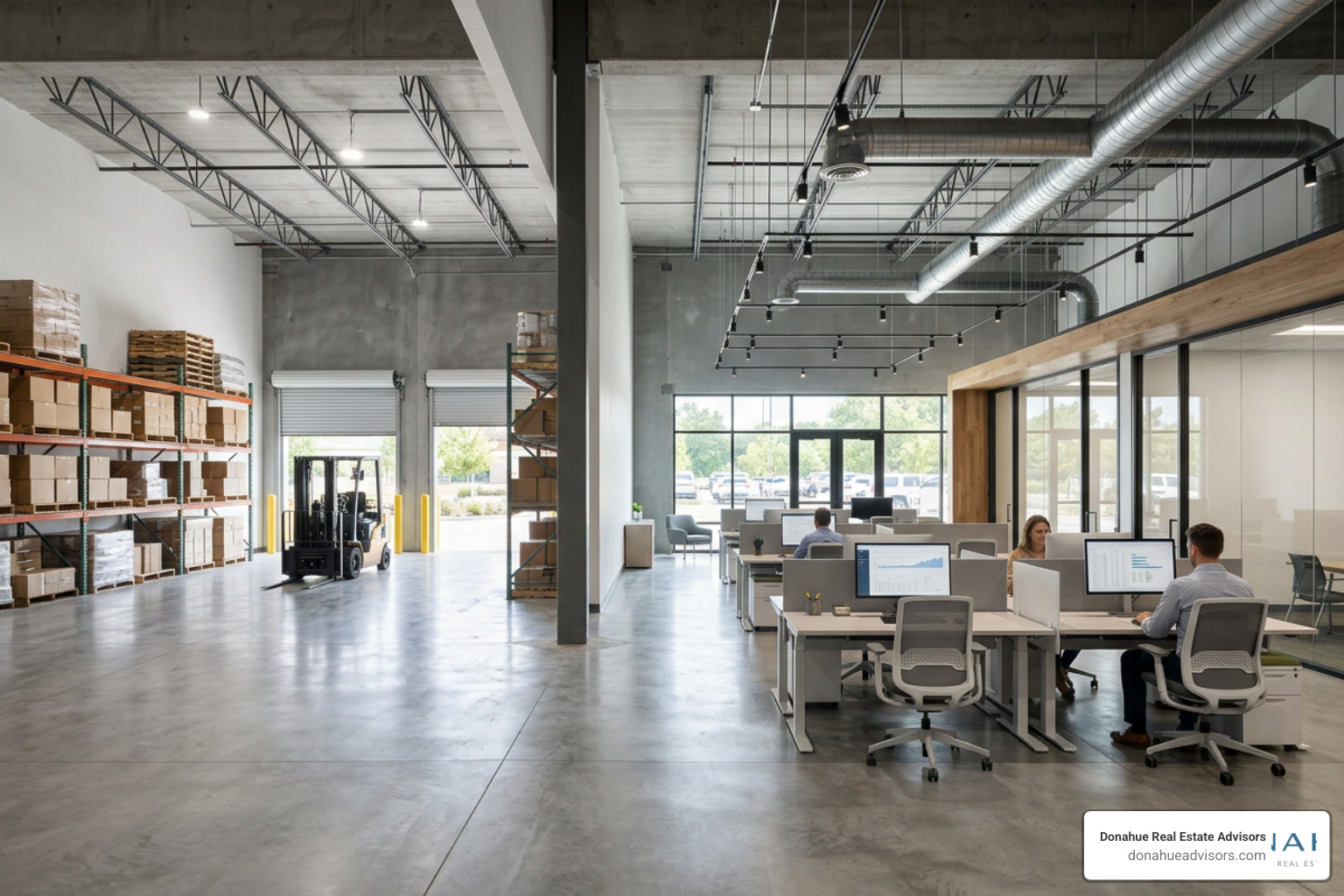
Traditional office buildings are typically multi-story structures located in commercial or retail zones. They are built with a focus on administrative work, client meetings, and high-density employee seating. In contrast, co-working space properties are designed to be highly adaptable. They are usually single-story buildings with higher ceilings, concrete slab flooring, and a layout that can easily be divided between office use and light industrial, research, or storage functions.
When evaluating these options, businesses often compare Class A vs. Class B Office Space to determine the right level of finish and prestige. While Class A traditional offices offer premium finishes and extensive amenities, Class B co-working spaces provide unmatched utility and physical adaptability at a lower cost.
Traditional Office Space Layouts and Shared Infrastructure
A traditional office space relies heavily on shared infrastructure. When you lease a suite in a multi-tenant commercial building, you share common areas like the main lobby, elevators, hallways, and core bathrooms with other tenants.
This shared setup allows you to focus purely on your private suite, but it also means you pay for a portion of those shared spaces through a “loss factor” or common area maintenance (CAM) fee. Traditional layouts are highly structured, featuring dedicated conference rooms, private offices, and open cubicle zones.
Construction and Industrial Integration
Co-working space construction is fundamentally different because it integrates industrial utility directly into the office environment. These buildings are often situated in industrial parks or transitional zoning districts. They feature high clear-ceiling heights, typically ranging from 14 to 24 feet, which allow for vertical storage, specialized laboratory equipment, or light manufacturing setups.
Unlike traditional offices, co-working buildings include functional loading options such as grade-level drive-in doors or dock-high doors. This makes them ideal for companies that need to keep their administrative staff close to their inventory, service vehicles, or prototyping labs. For businesses exploring these opportunities in Western Pennsylvania, platforms like LoopNet and CityFeet show the wide variety of layouts available, from highly finished office-heavy co-working suites to industrial-focused work bays.
Financial Comparison: Direct Rent and Hidden Occupancy Costs
The financial differences between a traditional commercial lease and a co-working space arrangement extend far beyond the base rent. To find the true cost of occupancy, we must look at the entire lease structure, including operating expenses, capital expenditures, and hidden vacancy costs.
| Financial Metric | Traditional Commercial Lease | Flex Space Lease / Coworking |
|---|---|---|
| Base Rent Pricing | Quoted per rentable square foot (RSF) | Quoted per seat, per month, or flat monthly rate |
| Lease Structure | Often Triple Net (NNN) or Modified Gross | Full Service Gross or all-inclusive subscription |
| Operating Expenses | Tenant pays pro-rata share of taxes, insurance, CAM | Included in the monthly fee |
| Upfront CapEx | High (fit-out, furniture, IT cabling) | Low to zero (fully furnished and cabled) |
| Security Deposit | 2 to 3 months of base rent | Typically 1 month of rent |
Before committing to a physical footprint, ask yourself: how much office space do I need? If you lease a traditional office, you must size the space for your peak headcount. If you choose a co-workingible space, you can lease only what you use daily and scale up on demand.
The True Cost of a Traditional Office vs. Co-working Space Lease
Traditional office leases are highly capital-intensive at the start. In addition to a multi-month security deposit, tenants are responsible for buying furniture, installing IT networks, and setting up utilities, janitorial services, and security systems. These operational costs can add up to thousands of dollars per month on top of your base rent.
Co-working spaces, on the other hand, usually bundle these expenses into a single monthly invoice. Utilities, high-speed internet, cleaning, and shared kitchen amenities are managed by the landlord or operator.
Capital Expenditures and the Shadow Vacancy Tax
The biggest financial trap in traditional leasing is capital expenditure (CapEx) for tenant improvements. Building out a custom office suite can cost anywhere from $50 to $150 per square foot. Even with a landlord-provided tenant improvement (TI) allowance, tenants often pay significant out-of-pocket costs to get a space ready for occupancy.
Additionally, hybrid work models have introduced the “shadow vacancy tax.” This is the cost of paying for empty desks on days when your team is working remotely. If your office is only at 40% capacity on Mondays and Fridays, you are essentially throwing away a large portion of your monthly rent. This financial drain has led many workplace leaders to consider office downsizing to align their physical footprints with actual daily usage. Some even wonder, Will Office Space Become Obsolete? While offices are not disappearing, the way we calculate their financial return has changed permanently.
Strategic Decision Factors for Pittsburgh Businesses
Choosing between office vs. co-working space is not just a financial calculation; it is a strategic decision that affects your company culture, talent attraction, and operational efficiency.

To determine which model supports your business goals, we recommend starting with The Ultimate Office Space Needs Assessment for Growing Teams. This assessment helps you analyze how your employees collaborate, how often they need quiet focus areas, and what physical amenities they require to perform their best.
Evaluating Office vs. Co-working Space for Hybrid Workforces
For companies embracing hybrid schedules, the co-workingibility of shared workspaces is highly attractive. When comparing a coworking space vs. office, the primary advantage of the co-workingible model is agility. It allows you to offer your team professional meeting areas and hot desks without committing to a 5-year lease.
This is particularly valuable for a tech office space where engineering and development teams may work remotely most of the week but need highly collaborative, tech-enabled hubs for team sprints.
Submarket Dynamics in the East End, Oakland, and the Strip District
Pittsburgh’s commercial real estate submarkets show distinct trends in 2026. According to CoStar’s 2026 pricing and vacancy data, traditional Class A office vacancy rates remain elevated in downtown commercial corridors, while creative office and co-working spaces in neighborhood markets are seeing steady demand.
- The Strip District: This submarket has become a hub for tech, robotics, and creative firms. The mix of historic rehabs and new constructions offers highly desirable spaces with modern office amenities that help companies attract top talent.
- Oakland and the East End (Shadyside, East Liberty): Driven by proximity to Carnegie Mellon University and the University of Pittsburgh, these neighborhoods have very low vacancy rates. Here, co-working spaces that accommodate research equipment alongside administrative desks are highly sought after.
- North Shore and Southside: These waterfront submarkets offer excellent accessibility and traditional office options for professional services firms that require high-quality client-facing environments.
Common Pitfalls in Commercial Leasing and How to Avoid Them
Leasing commercial real estate is full of hidden legal and financial risks. Without experienced, conflict-free representation, tenants can easily agree to terms that cost them dearly down the road.
Free Rent Timing Mistakes and Holdover Rent Risks
One of the most common mistakes we see tenants make is failing to negotiate the timing of free rent concessions. Landlords often offer several months of free rent as an incentive to sign a lease. However, if that free rent period runs concurrently with your space buildout, you are not actually saving money on operational occupancy; you are simply receiving free rent on a space you cannot yet use. We work to ensure that free rent periods begin after the space is fully completed and ready for business.
Another major risk is holdover rent. If your current lease expires before your new office or co-working space is ready for move-in, you enter a “holdover” status. Most standard commercial leases penalize holdover tenants by charging 150% to 200% of the previous monthly rent, plus potential damages for delaying the next tenant. We prevent this by negotiating clear transition windows and building realistic construction timelines into your new lease agreement.
Decision Framework: Choosing Your Optimal Real Estate Strategy
To help you navigate this choice, we have developed a practical, step-by-step decision framework tailored for Pittsburgh business leaders in 2026.
Step 1: Partner with Expert Tenant Representation
The most critical step in any commercial real estate transaction is securing conflict-free tenant representation. Most commercial brokerages represent both landlords and tenants, which can create inherent conflicts of interest during negotiations.
At Donahue Real Estate Advisors, we exclusively represent tenants. This ensures our interests are completely aligned with yours, giving us the leverage needed to negotiate the best possible terms, rent abatements, and tenant improvement allowances.
Our strategic advisory has helped numerous local organizations across various industries, including technology, professional services, and corporate headquarters, navigate complex transitions. For example, in our Nelson Mullins Temporary Space Case Study, we successfully secured a co-workingible, short-term office solution that allowed the client to establish a local presence without rushing into a long-term commitment.
Later, as detailed in our Nelson Mullins Long-Term Space Case Study, we leveraged market data to secure a premium, custom-designed permanent office suite that perfectly matched their long-term growth and cultural goals. This dual-phase approach demonstrates how strategic planning protects capital regardless of your industry.
Step 2: Audit Utilization and Model Headcount Volatility
Before signing any lease, you must understand how your team actually uses physical space. We recommend auditing your current office utilization by reviewing badge swipe data, conference room booking logs, and daily parking usage.
Once you have a clear picture of your average and peak daily attendance, model three distinct headcount scenarios for the next three years:
- The Growth Case: Your team expands rapidly. Can your chosen space accommodate additional desks, or does the landlord offer expansion options?
- The Stable Case: Your headcount remains flat. Are you paying for unused square footage?
- The Contraction Case: You transition to a more remote-friendly model. Does your lease allow you to sublease extra space, or can you easily scale back your square footage?
If your headcount is highly volatile or your utilization rates hover below 50%, a co-workingible space network or a shorter-term co-working lease is likely your most cost-effective option. If your headcount is stable and you require a highly customized environment to preserve company culture, a traditional commercial lease is the stronger choice.
Frequently Asked Questions about Office vs. Co-working Space
Is co-working space always more cost-effective than a traditional office lease?
On a simple cost-per-desk basis, co-working space can sometimes appear more expensive because you are paying a premium for co-workingibility and bundled services. However, when you factor in the total cost of occupancy, including buildout costs, furniture, utilities, and the “shadow vacancy tax” of paying for empty desks, co-working space is often significantly cheaper for teams with fluctuating headcount or hybrid work models. For stable teams of 15 or more employees who plan to occupy their space consistently for five or more years, a traditional commercial lease usually becomes the more economical choice over the long term.
What are the zoning and location differences between office and co-working buildings in Pittsburgh?
Traditional office buildings are typically located in central business districts or high-density commercial zones like Downtown, Oakland, and parts of Shadyside. These areas offer excellent walkability, public transit access, and proximity to restaurants and retail. co-working buildings are usually located in light industrial or commercial-transitional zones, such as parts of the Strip District, Lawrenceville, or suburban business parks. These locations offer better highway access, dedicated parking, and loading capabilities, but may have fewer walkable retail options for employees.
How does headcount volatility impact the choice between traditional and co-working spaces?
Headcount volatility is one of the most important factors in this decision. If your business is scaling quickly or adjusting its hybrid work policies, committing to a 5-year traditional lease is highly risky. You could easily outgrow the space in 18 months or find yourself paying for empty offices. co-working spaces allow you to add or remove desks and private suites with minimal notice, converting a fixed real estate liability into a co-workingible, variable operational expense that tracks your actual business growth.
Conclusion
Choosing between office vs. co-working space requires a careful analysis of your operational needs, financial goals, and team culture. In Pittsburgh’s dynamic 2026 commercial real estate market, there is no one-size-fits-all solution.
Whether you need a prestigious, client-facing office in Oakland, a creative collaborative hub in the Strip District, or an adaptable office-warehouse co-working space in the East End, the key to success is having an experienced, conflict-free advocate on your side of the negotiating table.
At Donahue Real Estate Advisors, we are committed to helping Pittsburgh businesses make smart, data-driven real estate decisions. We do not represent landlords, which means our advice is always focused on what is best for your business.
Ready to optimize your real estate strategy and avoid costly leasing pitfalls? Schedule a lease strategy session with our team today, and let us help you find the perfect space for your team’s future.