

Audit Your Way to Savings: A Guide to Lease Operating Expenses
What Every Business Tenant Should Know About Operating Expense Audit Leases
Operating expense audit leases are commercial lease agreements that give tenants the legal right to review and verify the operating costs their landlord charges them each year.
Here’s a quick snapshot of what that means in practice:
| Key Element | What to Know |
|---|---|
| What gets audited | Property taxes, insurance, maintenance (CAM), utilities, management fees |
| Who initiates it | The tenant, typically after receiving the annual reconciliation statement |
| When to act | Within 30-180 days of receiving the annual statement (check your lease) |
| Common overcharges found | Capital improvements billed as maintenance, inflated management fees, double-billed admin costs |
| Cost of the audit | Usually tenant-funded — unless overcharges exceed 4-5.5%, at which point the landlord often pays |
| Potential savings | Thousands to hundreds of thousands of dollars over a lease term |
Real estate costs are typically the second-largest line item on a company’s budget — often 25% to 40% of total expenses. Yet operating expense charges are one of the least scrutinized parts of most commercial leases. That’s a costly blind spot.
Landlords estimate operating costs, collect monthly payments, then reconcile at year-end. The problem? Those reconciliations aren’t always accurate. Errors — and sometimes questionable inclusions — are common. Without an audit, tenants have no way to know if they’re paying their fair share or someone else’s.
After more than 30 years representing tenants in the Pittsburgh commercial real estate market, Donahue Real Estate Advisors has seen how operating expense audit leases can recover significant overpayments and shift leverage back to the tenant. This guide gives you the tools to do exactly that.
Understanding Operating Expense Structures in Commercial Leases
To effectively navigate operating expense audit leases, we first have to speak the language of the lease. In commercial real estate, “Operating Expenses” (OpEx) refer to the costs of running and maintaining a building. Think of it as the “nut” the landlord has to crack every month to keep the lights on, the lobby clean, and the taxes paid.
Most commercial leases fall into one of several categories, each defining how these costs are shared. Understanding a Commercial Lease starts with identifying your specific structure:
- Triple Net (NNN): In this structure, the tenant pays a lower base rent but is responsible for their proportionate share of all property operating expenses, including property taxes, insurance, and maintenance. If you are in a NNN building in downtown Pittsburgh, you are essentially paying for everything from the window washing to the real estate tax bill. You can learn more about this in our guide to Understanding NNN Leases in Commercial Real Estate.
- Gross Lease (Full-Service): Historically common in office buildings, the landlord pays all operating expenses out of the rent you pay. While this sounds simple, it is becoming rare. Most “Gross” leases today are actually “Modified Gross” or “Base Year” leases.
- Modified Gross: This is a hybrid. The landlord and tenant agree on which expenses are included in the base rent and which might be passed through. It’s a middle ground that requires careful Commercial Lease Review to ensure you aren’t being double-charged.
According to An Introduction to Operating Expenses in Commercial Leases, maintenance is often the least consistently defined category. It can include everything from snow removal (a major factor here in Pittsburgh) to elevator repairs.
Crucially, your share of these costs is based on your Pro-rata share, which is usually calculated by dividing your Rentable Square Footage (RSF) by the total RSF of the building. If the building’s measurement standards are off, your entire bill will be off for the life of the lease.
The Role of the Base Year in Operating Expense Audit Leases
If you have a “Base Year” lease, your rent includes a “stop” or a “credit” for operating expenses incurred during the first year of your lease (the Base Year). You only pay for increases above that amount in subsequent years.
This is where lease cost creep often begins. If the landlord manages to keep expenses artificially low during your Base Year (perhaps by deferring maintenance or receiving a temporary tax abatement), your future “increases” will look much larger.
We always advise our clients to use historical data to verify that the Base Year reflects a “normal” operating environment. This acts as your inflation protection. For a deeper dive into these definitions, check our glossary of commercial lease terms.
Direct vs. Proportional Allocations
Not all expenses should be shared equally. We often see disputes regarding utility metering. If you are a tech firm in the Strip District running servers 24/7, your electricity usage is much higher than a standard sales office. Conversely, if you are a standard office user, you don’t want to subsidize the high-energy user down the hall.
Common Area Maintenance (CAM) covers shared property costs like lobby security, landscaping, and parking lot upkeep. In campus-wide settings, we look closely at how campus-wide expenditures are allocated to ensure our clients aren’t paying for amenities they don’t use.

Why Tenants Must Conduct Operating Expense Audit Leases
Why go through the trouble of an audit? Because, quite frankly, landlords are human, and their accounting systems are often complex and prone to error. In our experience, many overcharges are inadvertent, but that doesn’t make them any less expensive for you.
Conducting operating expense audit leases is about two things: cost recovery and budget predictability. If you find an error this year, you aren’t just getting a refund for the past 12 months; you are preventing that same error from being billed for the next five to ten years.
According to Controlling Rental Costs Through Lease Audits, most sophisticated leases include a 5% overcharge threshold. If an audit reveals that the landlord overstated expenses by 5% or more, the landlord is typically required to pay for the cost of the audit itself. This is a powerful incentive for accuracy.
Identifying Common Overcharges and Hidden Costs
When we dig into the books, we look for “The Hidden Costs in Leases.” Some of the most frequent offenders include:
- Capital Expenditures (CAPEX): Landlords often try to pass through the cost of a new roof or a brand-new HVAC system as “maintenance.” In most leases, these are the landlord’s responsibility. If they are allowed to be passed through, they must be amortized over their useful life, not billed as a lump sum.
- Management Fee Caps: Most leases cap management fees at 3% to 5% of the building’s gross revenue. We often find landlords trying to bill for “administrative surcharges” on top of the management fee—a practice known as “double-dipping.”
- Executive Salaries: You should be paying for the on-site property manager, not the landlord’s regional VP who lives in another state.
- Ownership Costs: Legal fees for the landlord’s refinancing or the cost of marketing vacant space to other tenants should never be in your OpEx bill.
These are classic commercial lease issues for tenants that can only be caught through a detailed review of the general ledger.
Triggers for a Professional Audit
While we recommend an annual high-level review, certain events should trigger a deep-dive professional audit:
- Ownership Changes: When a building is sold, the new owner may have a different accounting philosophy or may “discover” expenses the previous owner didn’t bill.
- Year-End Reconciliations: If your “true-up” bill at the end of the year shows a spike of more than 5% over the previous year without a clear reason (like a massive property tax reassessment), it’s time to look closer.
- Significant Cost Spikes: Did the “Janitorial” line item jump 40% while the building stayed half-empty? That’s a red flag.
- Lease Renewals: Before you sign on for another five years, ensure the baseline you are working from is accurate.
Navigating the Gross-Up Clause in Operating Expense Audit Leases
The “Gross-Up” clause is perhaps the most misunderstood part of operating expense audit leases.
Imagine a 100,000-square-foot building that is only 50% occupied. The janitorial costs for the common areas might be $50,000. If you occupy 10,000 square feet, your pro-rata share is 10%. Without a gross-up, you’d pay $5,000.
However, a gross-up clause allows the landlord to “estimate” what the variable expenses (like janitorial or utilities) would be if the building were 95% or 100% occupied. This is actually fair—it ensures that the tenants in the building aren’t unfairly subsidizing the vacant space’s share of variable costs.
The audit’s job is to ensure the landlord only grosses up variable expenses. Property taxes and landscaping don’t change based on occupancy, so they should never be “grossed up.”
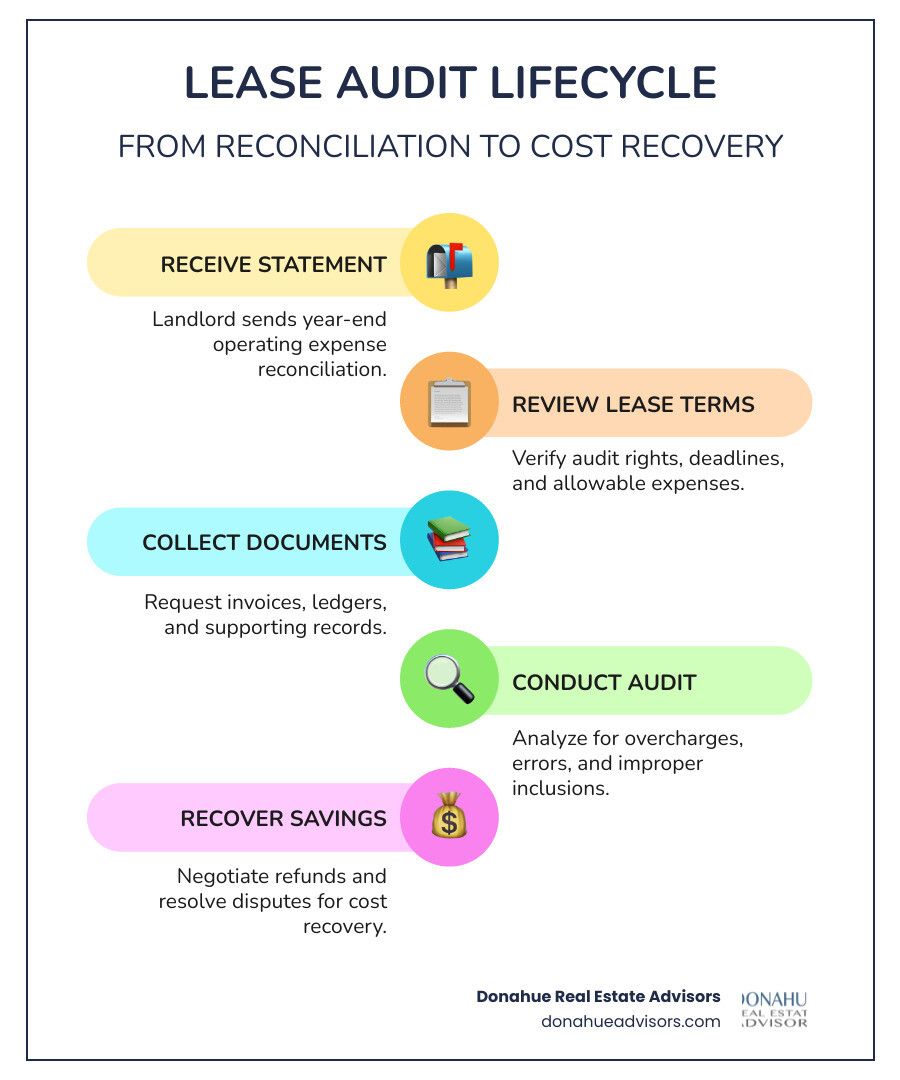
Key Steps in the Audit Process
- Document Collection: Request the annual reconciliation, the detailed general ledger, and the “Base Year” statement (if applicable).
- Preliminary Review: Compare year-over-year costs. Look for the “red flags” mentioned earlier.
- Formal Inquiry: Ask for clarification on specific line items. A professional, collaborative tone often resolves 90% of issues here.
- Detailed Testing: If the landlord’s answers are vague, move to invoice testing and payroll review.
- Dispute Resolution: If overcharges are found, negotiate a credit or refund. Most leases specify that if the parties can’t agree, an independent CPA will make the final determination.
Negotiating Stronger Audit Rights and Protections
The best time to win a lease audit is before you ever sign the lease. When we represent tenants, we negotiate for robust audit windows—ideally 90 to 180 days—to give your accounting team time to review the statements.
We also push for look-back periods. Most landlords want to limit your right to audit to the current year. We fight for a 2- or 3-year look-back, especially if you suspect the Base Year was calculated incorrectly.
Essential Lease Exclusions for Tenants
A strong lease should explicitly exclude certain items from OpEx. When we review a commercial lease contract, we look for these specific exclusions:
- Depreciation: This is an accounting entry, not an out-of-pocket expense.
- Mortgage Interest and Debt Service: That’s the landlord’s cost of doing business, not yours.
- Leasing Commissions and Tenant Improvements: You shouldn’t pay for the landlord to find and build out space for your neighbors.
- Executive Salaries: Only personnel directly involved in the day-to-day operation of the building should be included.
- Marketing and Advertising: Costs to promote the building for lease are ownership expenses.
Implementing Expense Caps
One of the most effective ways to protect your bottom line is through Expense Caps. We negotiate caps on “controllable” operating expenses (like management fees, janitorial, and landscaping).
There are two main types:
- Cumulative Caps: The increase is capped at, say, 5% per year, but the landlord can “carry over” unused capacity from a previous year.
- Non-Cumulative Caps: The increase is strictly limited to 5% over the previous year’s actual spend. This is much better for the tenant.
If you are concerned about your current exposure, you should schedule a commercial lease review with us to see where we can tighten these protections.
Frequently Asked Questions about Lease Audits
When is the best time to trigger an audit?
The best time is immediately following the receipt of your Annual Reconciliation Statement, which usually arrives in the spring (March or April). You should also consider an audit during an ownership transfer or if you are approaching a lease renewal.
Who typically pays for the audit fees?
Initially, the tenant pays. However, as noted in several industry-standard clauses, if the audit reveals an overstatement of 5% or more (sometimes as low as 4%), the landlord is typically required to reimburse the tenant for all reasonable audit costs.
Can I audit my base year after the first year?
Yes, provided your lease doesn’t have a “statute of limitations” clause that expires. Many tenants don’t realize their Base Year was wrong until year three or four when the increases start hitting. This is why negotiating a long look-back right is so critical.
Conclusion
Operating expense audit leases are not about being adversarial; they are about ensuring financial integrity. In a market like Pittsburgh, where utility costs and property tax assessments can be volatile, having a clear, audited view of your occupancy costs is a competitive advantage.
At Donahue Real Estate Advisors, we stand as your conflict-free partner. Because we exclusively represent tenants, our only goal is to protect your interests and optimize your lease expenses. Whether you are a CEO of a growing tech firm or the CFO of a major healthcare group, we provide the strategic, data-driven advisory you need to ensure you are never overpaying for your space.
Don’t leave your second-largest expense to chance. Take control of your lease and protect your bottom line.
Ready to optimize your lease strategy and uncover potential savings? Schedule a Lease Strategy Session with Donahue Real Estate Advisors today.