

Commercial Real Estate Conflict of Interest: What Every Tenant Should Know
Why Commercial Real Estate Conflict of Interest Costs Pittsburgh Businesses More Than They Realize
Commercial real estate conflict of interest is one of the most common, and most costly, problems facing Pittsburgh businesses today. Yet most tenants never see it coming.
Here is a quick breakdown of what it means and why it matters:
| Type of Conflict | What It Means | Risk to Tenant |
|---|---|---|
| Dual agency | One broker/brokerage represents both tenant and landlord | Negotiation bias, reduced leverage |
| Self-dealing | Broker has personal financial stake in the deal | Steered toward unfavorable properties |
| Personal interests | Broker relationships influence advice | Advice not fully aligned with your goals |
For Pittsburgh businesses weighing a lease renewal in Oakland, a relocation to the Strip District, or a new footprint in the East End or North Shore, the stakes are high. Commercial real estate is typically a business’s second-highest operating expense. The broker you choose, and whether they are truly on your side, has a direct impact on your bottom line.
At Donahue Real Estate Advisors, our founder spent 15 years at Grubb & Ellis representing both landlords and tenants before opening a practice dedicated entirely to conflict-free tenant representation. That experience on both sides of the table gives our team a deep understanding of how commercial real estate conflict of interest plays out, and exactly how to protect you from it.
Understanding the Commercial Real Estate Conflict of Interest
To make the best decisions for your business, you must first understand what a conflict of interest looks like in a commercial transaction. At its core, a conflict of interest occurs when a broker has competing professional or personal obligations that make it impossible to provide undivided loyalty to you, the client.
When you hire a professional to guide your real estate decisions, you expect them to act as a fiduciary. A fiduciary duty is a legal and ethical obligation to act solely in your best interest. However, the traditional commercial brokerage model is built on a foundation that frequently compromises this duty.
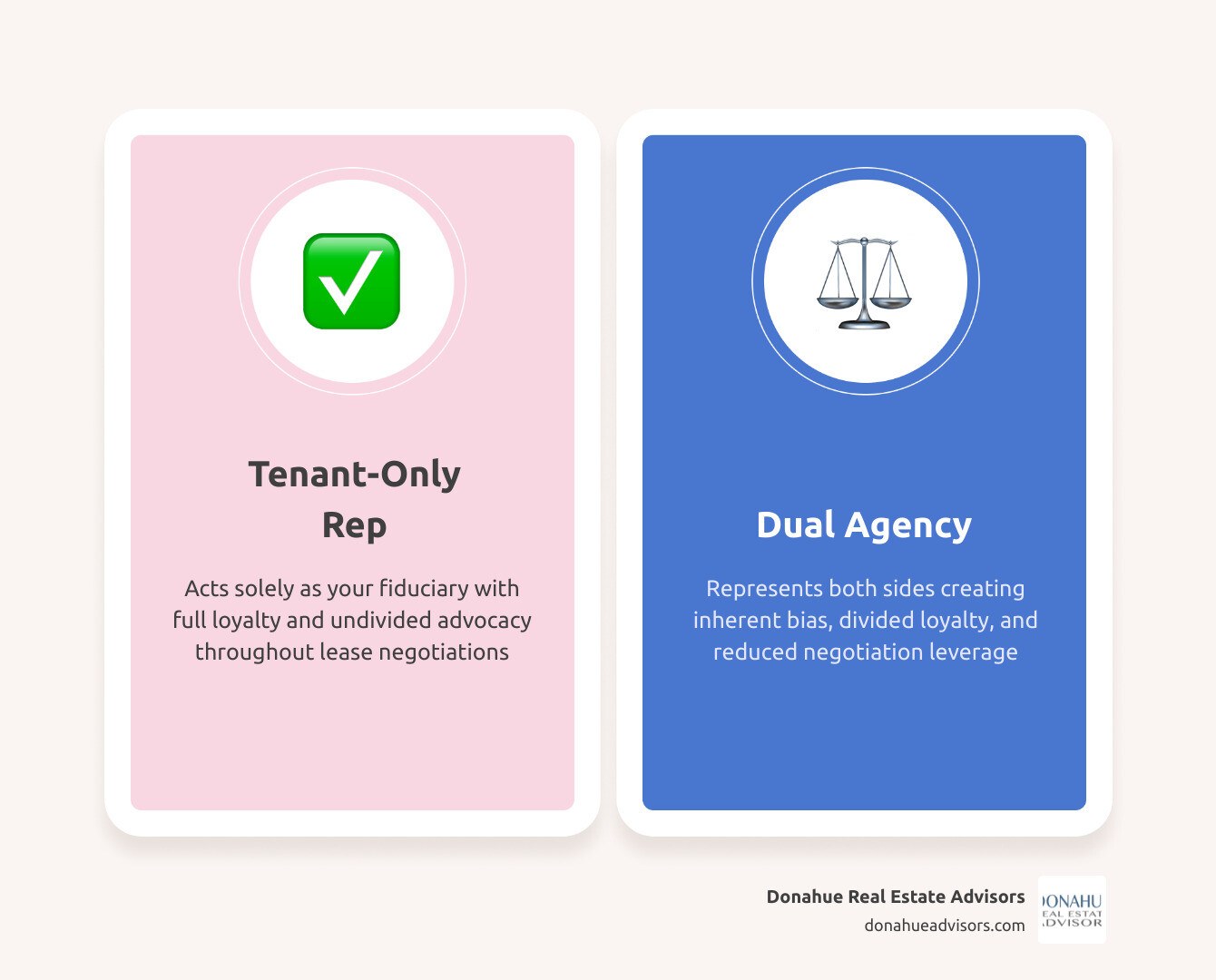
In many transactions, a single brokerage firm attempts to represent both the building owner and the business looking for space. This structure is known as dual representation or dual agency. While many brokers claim they can remain neutral, the reality is that no one can serve two masters with opposing goals. The landlord wants the highest possible rent, minimal tenant concessions, and maximum lease terms. You, the tenant, want the exact opposite.
To explore how these dynamics differ in practice, it helps to understand the fundamental Difference Between a Landlord Rep and Tenant Rep. A landlord representative is contracted to fill vacant space at the highest possible price, while a true tenant representative is dedicated exclusively to securing the best terms for the occupant.
The global standards set by the Royal Institution of Chartered Surveyors in their Conflicts of interest global standards reinforce that professional integrity requires clear boundaries. When these boundaries blur, transaction transparency disappears, and tenants pay the price.

How Dual Agency Creates a Commercial Real Estate Conflict of Interest
Dual agency is the most common form of commercial real estate conflict of interest. It typically occurs in one of two ways. In some cases, the exact same individual broker represents both you and the landlord. In other cases, you work with one broker and the landlord works with another, but both brokers work for the same parent real estate firm.
Either way, the underlying conflict remains. The brokerage firm is highly motivated to keep the entire commission in-house, a practice often referred to as a double-ended commission. When a firm can collect 100% of the commission instead of splitting it with an outside broker, their financial incentive to close that specific deal increases dramatically.
This incentive structure directly harms your negotiation leverage. If your broker is also trying to protect the landlord’s listing, they cannot aggressively push for lower rental rates, larger tenant improvement allowances, or flexible termination options. They are structurally discouraged from showing you competing properties listed by other firms, even if those spaces in Shadyside or East Liberty would be a far better fit for your business goals.
If you are wondering whether you should navigate this landscape alone or hire an outside professional, our guide on Do I Need a Tenant Rep? outlines how an exclusive advocate changes the dynamic of your search.
Self-Dealing, Referral Fees, and Personal Interests
Beyond dual agency, other subtle conflicts can quietly erode your financial position. Self-dealing occurs when a broker has a direct or indirect financial interest in a property they are recommending to you. This could mean they own a portion of the building, have an equity stake in the development company, or have a personal relationship with the landlord.
According to the RICS guidelines on Conflicts of interest in commercial property investment, even the perception of a conflict can damage trust and lead to poor financial outcomes. When a broker is influenced by personal interests, their recommendations are no longer objective. They are designed to maximize their own revenue rather than protect your capital.
The Legal and Ethical Obligations of Commercial Brokers
Commercial real estate brokers operate under a web of legal and ethical rules. State licensing boards, professional associations, and corporate policies all place strict limits on how conflicts must be handled.
For example, public commercial real estate investment trusts and corporations must follow strict governance guidelines, such as those outlined in the Ares Commercial Real Estate Code of Ethics. These policies make it clear that a conflict can exist even if no direct financial loss occurs. The mere appearance of impropriety is enough to breach professional standards.
For tenants, understanding these rules is critical during a Commercial Lease Review. You must know whether your broker is legally permitted to represent both sides and what disclosures they are required to provide.
Regulatory Standards and Disclosure Requirements
In Pennsylvania, real estate professionals are legally obligated to disclose their business relationships to consumers. If a broker intends to act as a dual agent, they must obtain the written, informed consent of both parties.
However, informed consent is often treated as a bureaucratic checkbox rather than a meaningful conversation. Brokers may present a standard disclosure form in a stack of lease documents, and many tenants sign it without fully understanding the rights they are giving up.
Legal ethics boards take a much stricter view of dual representation. For instance, the North Carolina State Bar 2013 Formal Ethics Opinion 14 ruled that a lawyer cannot ethically represent both the borrower and the lender in a commercial loan closing. The bar association determined that because commercial transactions involve active, complex negotiations, a single professional cannot adequately advocate for both sides, even with consent.
Similarly, public sector ethics rulings, such as the Massachusetts Conflict of Interest Opinion EC-COI-22-1, show that professional responsibility extends beyond active participation. If a professional has a personal stake in a matter under their purview, they cannot objectively serve the client.
When you are Understanding a Commercial Lease, you must realize that your broker’s legal disclosure obligations do not automatically protect your wallet. A disclosed conflict is still a conflict.
Critical Mistakes Pittsburgh Tenants Make in Lease Negotiations
When Pittsburgh businesses face a lease expiration, they are often undecided between renewing their current lease or relocating to a new submarket. Landlords are fully aware of this hesitation and use it to their advantage. Without independent, conflict-free representation, tenants frequently make critical mistakes that cost them hundreds of thousands of dollars.
One of the most common mistakes is failing to create a competitive environment. If your current landlord knows you are not actively looking at other spaces in Oakland, the Southside, or the North Shore, they have no incentive to offer you market-rate terms on your renewal. They know that moving is disruptive and expensive, so they will offer minimal concessions.
To avoid these pitfalls, you must understand the common Commercial Lease Issues for Tenants that arise when a negotiation is not handled with a clear, strategic plan.
Free Rent Timing and Holdover Rent Risks
Two specific areas where tenants consistently lose leverage are the timing of free rent concessions and the financial risks of holdover rent.
Landlords often offer “free rent” as an incentive to sign a lease. However, the structure of this concession matters immensely. If the free rent is applied during your space build-out when you cannot actually operate, it is not a true savings. A skilled tenant representative ensures that rent abatement periods run after the space is fully completed and occupied, giving your business real operational relief.
Even more dangerous is the risk of holdover rent. If your current lease expires and you have not finalized your renewal or completed construction on your new space, you enter a “holdover” status. Most commercial lease contracts dictate that holdover rent is billed at 150% to 200% of your previous rental rate.
If your new space build-out in the Strip District is delayed by construction or permitting, and your broker did not negotiate a flexible transition or extension option in your original Commercial Lease Contract, you can find yourself trapped. You will be forced to pay exorbitant holdover rates or sign a rushed, unfavorable renewal just to keep a roof over your head.
How Pittsburgh Businesses Can Protect Themselves
The best way to protect your business from a commercial real estate conflict of interest is to establish clear boundaries before you begin looking at properties or talking to landlords.
The table below highlights the stark differences between working with a traditional dual-agency broker and partnering with an exclusive tenant representative:
| Strategic Factor | Dual Agency Brokerage | Exclusive Tenant Representative |
|---|---|---|
| Primary Loyalty | Split between tenant and landlord | 100% dedicated to the tenant |
| Access to Listings | May favor in-house landlord listings | Shows all market and off-market options |
| Negotiation Goal | Close the deal quickly to secure commission | Secure lowest rate and maximum concessions |
| Information Security | Tenant’s financial limits may leak to landlord | Total confidentiality maintained |
| Market Leverage | Limited, as they represent competing landlords | Maximized by creating active bidding wars |
To dive deeper into whether this level of protection is right for your business, read our analysis on Should I Hire a Tenant Rep?.
Partner with Expert Tenant Representation
At Donahue Real Estate Advisors, we operate on a tenant-first model. We do not take landlord listings, and we do not manage commercial buildings. This means our advisory services are completely unbiased. Whether you decide to renew your lease in East Liberty or relocate your headquarters to the North Shore, our only goal is to secure the most favorable financial and operational terms for your business.
This strategic advocacy has a proven track record across all industries, helping diverse Pittsburgh businesses secure optimal terms. For example, when a law firm needed to navigate a complex office space transition in Pittsburgh, they relied on our conflict-free approach. We successfully secured their temporary space needs, which you can read about in our Nelson Mullins Temporary Space Case Study.
Later, when they were ready to establish a permanent presence, we guided them through a comprehensive market search and lease negotiation, as detailed in our Nelson Mullins Long-Term Space Case Study. This case study demonstrates how a structured process and conflict-free representation create massive financial leverage for all types of Pittsburgh businesses.
To understand how we manage these projects from start to finish, you can explore our comprehensive Tenant Rep and Commercial Tenant Representation service overviews.
Best Practices to Avoid a Commercial Real Estate Conflict of Interest
If you want to ensure your next real estate transaction is handled with complete integrity, follow these four best practices:
- Partner with Expert Tenant Representation: Partnering with an expert tenant representation firm must be your very first step. By retaining a firm that never represents landlords and has no building listings, you eliminate the conflict of interest at the source.
- Request written disclosure early: Before you tour any properties or share your financial information, ask your broker to put their representation status in writing. Ask specifically if their firm represents any of the landlords in the buildings you are considering.
- Screen your broker thoroughly: Ask prospective brokers how many landlord listings their firm holds in your target submarkets. If they hold significant listings in those areas, they have a structural incentive to steer you toward those properties. You can learn more about how to evaluate these relationships by reviewing our Tenant Rep Process.
- Involve independent legal counsel: Never rely on a landlord’s broker or a dual agent to draft or interpret your lease. Always partner with a dedicated, local real estate attorney who can protect your legal rights.
Frequently Asked Questions about Commercial Real Estate Conflicts
What is a conflict of interest in commercial real estate?
A conflict of interest occurs when a broker or real estate firm has competing professional, financial, or personal interests that interfere with their ability to act in their client’s best interest. In commercial transactions, this most commonly manifests as dual representation, where the same firm represents both the tenant and the landlord, compromising their fiduciary duty and creating transaction bias.
Why is dual agency problematic for tenants?
Dual agency is problematic because it eliminates your negotiation leverage. A broker representing both sides cannot aggressively negotiate to lower the rent or increase concessions for the tenant without harming the landlord client. Additionally, because the brokerage firm stands to collect a double-ended commission, they may be incentivized to steer you toward in-house listings rather than showing you all available market options.
How do undisclosed referral fees affect transaction costs?
Undisclosed referral fees and vendor incentives can inflate your overall transaction costs by 2% to 5%. When brokers receive financial kickbacks for recommending specific landlords, movers, architects, or contractors, their recommendations are no longer objective. Tenants often end up paying higher rates for services because the vendor has factored the cost of the broker’s kickback into their pricing.
Conclusion
Your commercial lease is more than just a monthly expense; it is a critical strategic asset that can either support your business growth or drain your capital. When you are weighing a lease renewal against a relocation in Pittsburgh’s competitive submarkets, you cannot afford to work with a broker who has divided loyalties.
The Pittsburgh office market continues to offer unique opportunities for tenants who know how to leverage their position. However, capitalizing on these opportunities requires a clear strategy and a partner who is 100% on your side.
Avoid the hidden costs of dual representation. Contact Donahue Real Estate Advisors today to schedule a conflict-free lease strategy session, and let us help you secure the perfect space with zero conflicts and total confidence.