Most office lease mistakes happen because someone avoids the uncomfortable truth that commercial real estate is difficult. Ego often gets in the way, or overconfidence takes the wheel during high-stakes discussions. Most tenants only negotiate a lease once every five to ten years. That is simply not enough practice to become proficient at it.
Understanding the common personas of office tenants allows you to identify where you might be making costly assumptions. These patterns appear across all industries and company sizes. Recognizing them early saves your business serious money and operational headaches.
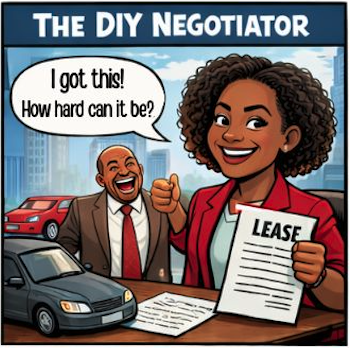
The DIY Negotiator
This tenant believes that past negotiation experience translates perfectly to commercial leasing. Perhaps they handle vendor contracts or employee compensation packages regularly. They may have negotiated an office lease or two over the course of their career.
Commercial leasing is a different animal entirely. The DIY Negotiator fails to realize that landlords and their brokers negotiate leases for a living. They do this every single day.
The DIY Negotiator often relies on publicly available listing sites for data. These sites rarely show the actual “effective rent” after concessions. They only show the asking price, which paints an incomplete picture.
What they lack is deep market knowledge and leverage. A study from NAIOP shows that tenants with professional representation typically save significantly on their total lease costs. That percentage difference creates a massive gap over a ten-year term.
Consider a scenario where you lease 25,000 square feet at $22 per square foot in a central business district. That equals $550,000 per year. Over ten years, the total commitment is $5.5 million.
A 10% savings keeps $550,000 in your company’s bank account instead of the landlord’s. The DIY Negotiator often focuses on lowering the rent to $21.50 per square foot and calls it a victory. They saved $12,500 per year, or $125,000 over the lease term.
They failed to see that the market rate was actually closer to $20 per square foot for comparable buildings. A skilled tenant representative would have known that immediately. The true cost of handling it alone was $500,000 in this specific example.
Working with a tenant representative alters this outcome completely. They provide current market data and insight into landlord motivations. They also hold relationships that open doors you did not know existed.
Residential real estate experience does not transfer here. In a home purchase, consumer protection laws shield the buyer. In commercial real estate, the law assumes both parties are sophisticated entities, offering you almost no statutory protection.
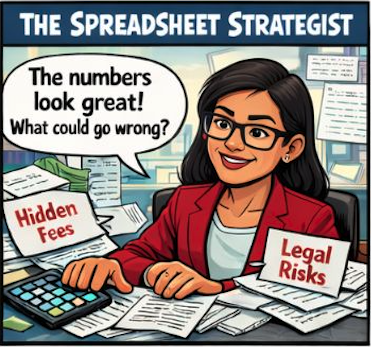
The Spreadsheet Strategist
This persona lives by the numbers. They construct elaborate models comparing rent per square foot across different properties. They calculate the net present value of lease payments and feel confident in their analysis.
The issue is they view only one piece of the puzzle. Rent is important, but it is far from the only factor that matters in a commercial lease. The financial model often ignores the qualitative aspects of the deal.
They overlook tenant improvement allowances or escalation clauses. They fail to factor in operating expense pass-throughs or base year stops. Renewal options and their specific terms are often treated as afterthoughts.
The Spreadsheet Strategist misses legal and operational risks that do not fit neatly into Excel cells. They do not account for things like exclusive use clauses or co-tenancy provisions. Assignment and subletting restrictions also fail to make it into the spreadsheet.
Hidden costs in commercial leases often add 15% to 25% to the total occupancy expense. The Spreadsheet Strategist remains blind to these costs because they fixate on the base rent line item. The table below illustrates the difference between “Face Rate” and “Total Cost of Occupancy.”
| Expense Item | What the Spreadsheet Sees | The Reality (Hidden Costs) |
|---|---|---|
| Base Rent | $25.00/SF | $25.00/SF (Subject to annual compounding) |
| Load Factor | Ignored | You pay for 15-20% unusable common space |
| Operating Expenses | Current Estimate | Uncapped increases annually |
| HVAC Maintenance | Landlord Responsibility? | Tenant often pays for replacement |
| Restoration | $0 | Cost to remove improvements at move-out |
Consider a company that locked in a rate of $19 per square foot. They did not negotiate a cap on operating expense increases. Over seven years, those expenses jumped from $4 per square foot to $7 per square foot.
Their “great deal” ended up costing them hundreds of thousands more than a lease with slightly higher base rent but capped expenses. The spreadsheet failed to account for market trends in operating costs. It also ignored the condition of the building’s mechanical systems.
A tenant representative adds context to the raw numbers. They know which lease terms are negotiable and which ones landlords will defend aggressively. They understand how different provisions interact and impact your total cost of occupancy.
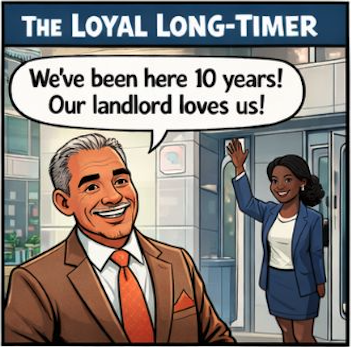
The Loyal Long-Timer
This tenant has occupied the same building for fifteen or twenty years. They maintain a friendly relationship with the landlord or property manager. They believe this loyalty provides them with leverage in renewal negotiations.
The harsh reality is that loyalty does not equate to leverage in commercial real estate. Landlords appreciate consistent tenants, but they operate a business. They will charge exactly what the market tolerates.
The Loyal Long-Timer fails to recognize that their landlord knows they are unlikely to move. Relocation is disruptive, expensive, and time-consuming. Landlords rely on inertia to keep tenants in place at rates above the market standard.
Tenants who renew without exploring alternatives pay an average of 12% to 18% more than the market rate. That occurs because they possess no credible alternative to walk away to. Without a BATNA (Best Alternative to a Negotiated Agreement), you have zero power.
In Pittsburgh’s office market, this scenario plays out regularly. A company that has operated in a Class B building in the North Shore for twenty years receives a renewal proposal at $25 per square foot with no tenant improvements. They view that as reasonable because they watched rent creep up incrementally over time.
They do not realize that newer Class A space in nearby buildings is leasing for $28 to $34 per square foot. Landlords there are offering aggressive concessions to fill vacancies. Those concessions effectively drive the rates close to $25 per square foot. The market shifted, but the tenant pays based on outdated assumptions.
The real cost extends beyond higher rent. It includes the outdated space and lack of modern amenities. It also involves recruiting challenges that come with an aging office environment.
Good candidates expect modern features and well-designed environments today. If your office looks like it is stuck in 2005, you will struggle to attract top talent. This indirect cost is often higher than the rent savings.
Working with a tenant representative means having someone who shops the market on your behalf. Even if you ultimately stay in your current building, that market intelligence gives you real negotiating power. Landlords respond differently when they know you have legitimate options.
The Delegator
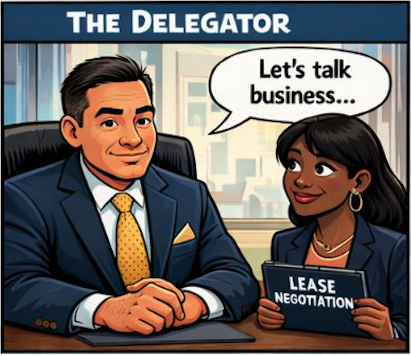
This persona realizes they need help with the lease negotiation. Consequently, they assign the task to someone internal. This might be the CFO’s direct report, a facilities manager, or an office administrator.
The problem arises because they send someone with limited real estate experience to negotiate against professionals. It is similar to sending your accountant to argue a case in court. They might understand numbers, but they do not understand the specific case law.
Commercial real estate is highly specialized. The landlord’s leasing team possesses decades of combined experience. They know every tactic, every piece of leverage, and every way to structure a deal in their favor.
Your internal person might be smart and capable. However, they are outgunned and usually know it. This creates a psychological disadvantage before negotiations even commence.
Internal staff without real estate expertise typically secure 40% fewer concessions than professional tenant representatives. They do not know what to ask for because they do not know what is possible. They often accept the first “standard” lease form the landlord provides.
Consider a growing tech company in Pittsburgh that tasked their operations manager with negotiating a 30,000 square foot lease. The operations manager excelled at his core job. Yet, he had never negotiated a commercial lease before.
The operations manager negotiated the rent from $25.00/SF to $23.50/SF and felt proud to have saved $1.50/SF on the rate. He did not realize that other items could be negotiated. The landlord offered $5.00/SF for a tenant improvement allowance, expecting the tenant to counter for more, but they never did; the tenant left money on the table. The operations manager didn’t know about free rent or that they could include items in the negotiation, and didn’t ask for any free rent.
He accepted a 3% annual escalation when 2.5% was standard in the market at that time. Over a ten-year lease, these missed opportunities cost the company over $600,000. That does not account for the opportunity cost of the operations manager’s time.
While he was learning lease terminology, he was not focusing on operational efficiencies. The business suffered in two areas simultaneously. This is a classic example of “stepping over dollars to pick up pennies.”
A tenant representative levels the playing field immediately. They negotiate with landlords every day. They know the market, the tactics, and how to structure deals that protect tenant interests. For more information on how this works, check out our page on tenant representation services.
 The Silent Sufferer
 The Silent Sufferer
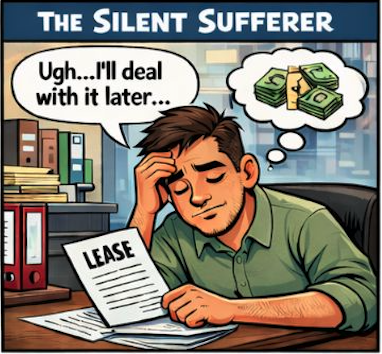
This is perhaps the most common of the personas of office tenants, and the most costly. The Silent Sufferer knows their lease situation is less than ideal. They know they pay too much or the space does not function well.
They do not act on this knowledge. They suffer in silence due to fear, pride, or embarrassment. They do not want to admit they made a mistake or that they need assistance.
They forget that everyone needs specialized expertise for complex decisions. You would not perform your own surgery or represent yourself in a complicated lawsuit. Real estate requires that same level of respect.
The real cost here is both financial and operational. Overpaying on rent drains resources that could fund growth, hiring, or product development. Poor space layouts hurt productivity and lower employee satisfaction.
Restrictive lease terms limit strategic flexibility significantly. Companies that do not address suboptimal lease situations lose an average of 3% to 5% of their annual revenue to inefficiencies. For a company doing $10 million in revenue, that equals up to $500,000 per year.
One Pittsburgh law firm stayed in an outdated downtown building for twelve years after their lease terms became unfavorable. They were embarrassed to admit they signed a bad deal initially. They also dreaded the logistical hassle of a move.
Their rent was $28 per square foot when the market rate for comparable space was $22. They were also locked into a lease structure that made it nearly impossible to sublease excess space. As their headcount fluctuated, they paid for empty offices.
Over those twelve years, they overpaid by roughly $1.4 million. This capital could have been used to upgrade their technology or hire more associates. The opportunity cost was staggering.
When they finally worked with a tenant advisor, they moved to better space at a lower cost. They also negotiated flexible lease terms that supported their business model. They immediately regretted not making the change ten years earlier.
The Silent Sufferer needs to understand that seeking help is a sign of smart business leadership. Every successful company delegates specialized decisions to experts. Real estate decisions should follow that same logic.
Why Smart Businesses Delegate Real Estate Decisions
You hire accountants to handle your taxes because tax code is dense. You hire lawyers for legal matters because the law is nuanced. You hire IT professionals to manage your technology infrastructure because downtime is expensive.
Why would real estate be any different? Commercial leasing is complex, high-stakes, and something most businesses only deal with occasionally. It makes zero sense to handle something this important yourself.
The personas of office tenants we discussed all share a common thread. They attempt to save money or avoid discomfort by handling real estate decisions themselves. Consequently, they end up costing their businesses far more in the long run.
In Pittsburgh’s office market specifically, local knowledge matters tremendously. Market conditions vary significantly between neighborhoods. Downtown differs from the North Shore, which differs from Southside Works, which differs from Cranberry.
Understanding these micro-markets gives you an edge. Knowing which landlords are motivated and having relationships with property owners creates leverage. This is what Donahue Real Estate Advisors brings to every engagement.
We have worked in Pittsburgh’s commercial real estate market for years. We know the players and understand the trends. We possess the data to back up every negotiating position.
Our clients typically save 10% to 20% on their total occupancy costs compared to handling it alone. But it’s not just about saving money; it’s about securing lease terms that support your business strategy.
It involves having flexibility as your company grows or contracts. It is about avoiding legal landmines that create problems years down the road. For example, a “restoration clause” requires you to return the office to its original condition when you leave.
If you miss that clause during negotiation, you could face a six-figure bill when you move out. A tenant rep strikes that clause or caps the liability. That is the value of experience.
The best time to engage a tenant representative is before you start looking at space. That allows us to help you define your requirements first. We help you understand your options and develop a strategy before you commit to anything.
The second best time is right now, wherever you are in the process. Even if you have already started touring buildings or received proposals, a tenant representative adds value. We can step in and improve your outcome immediately.
Conclusion
The five personas of office tenants we explored all make preventable mistakes. The DIY Negotiator overestimates their abilities and market knowledge. The Spreadsheet Strategist focuses on numbers while missing the critical context of lease clauses.
The Loyal Long-Timer assumes their relationship creates leverage when it often creates vulnerability. The Delegator sends the wrong person to do a specialized job. Finally, the Silent Sufferer pays the price of inaction for years due to embarrassment.
These patterns do not stem from bad intentions. They arise from ego, overconfidence, and the discomfort of admitting you need help. This area feels like it should be straightforward, but the details prove otherwise.
Commercial real estate is full of hidden costs and risks. The personas of office tenants who try to manage it without professional representation consistently pay more. They also receive worse terms than those who work with tenant representatives.
Before your next lease renewal or relocation, take an honest look at your approach. Identify which persona you might be falling into. Then make the smart business decision to delegate this specialized task to people who do it for a living.