

What to Know About East End Office Space in Pittsburgh
The East End of Pittsburgh has emerged as one of the region’s most consequential office markets, shaped by the combined gravity of world-class universities, dominant healthcare systems, a growing technology sector, and years of mixed-use redevelopment. While Downtown Pittsburgh remains the city’s largest commercial office submarket by inventory, the East End has been quietly outpacing it in several key indicators, including rent growth and new development activity.
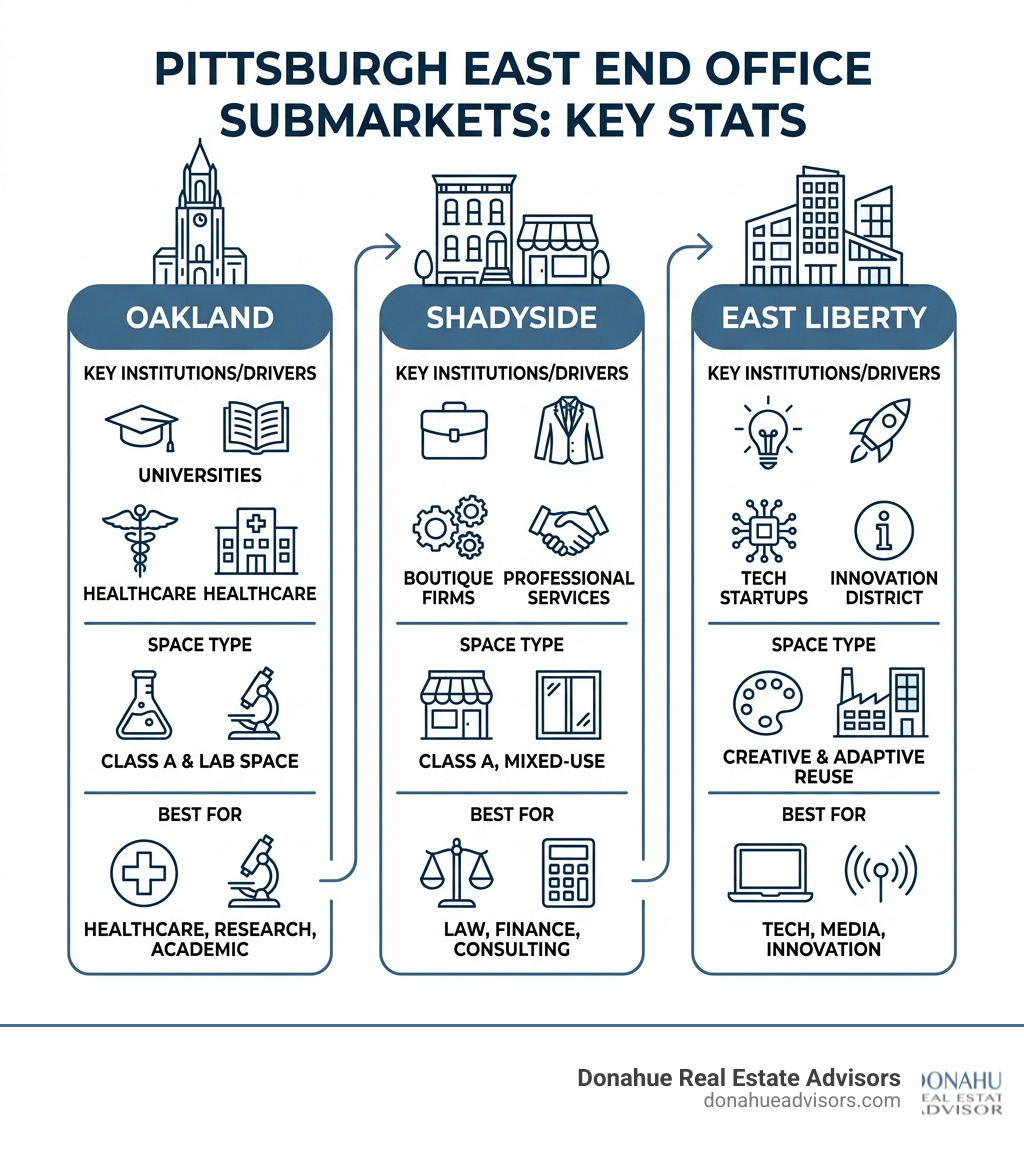
The East End encompasses several distinct business districts, each with its own character and tenant base: Oakland, the city’s academic and medical hub; Shadyside, a walkable neighborhood favored by professional services firms; and East Liberty, which has undergone a dramatic transformation into one of Pittsburgh’s most active tech corridors. Together, these neighborhoods form a connected arc of commercial activity forming a corridor that extends east from the edge of Downtown Pittsburgh through Oakland, Shadyside, and East Liberty toward Squirrel Hill.
At Donahue Real Estate Advisors, we track these trends closely through ongoing market analysis and tenant advisory work across Pittsburgh’s office market.
For companies evaluating office space in Pittsburgh, the East End deserves serious consideration alongside Downtown options. This guide breaks down what tenants need to know about each submarket, including current market data, building inventory, typical tenants, and how to approach a lease decision.
East End Pittsburgh Office Market: Quick Facts
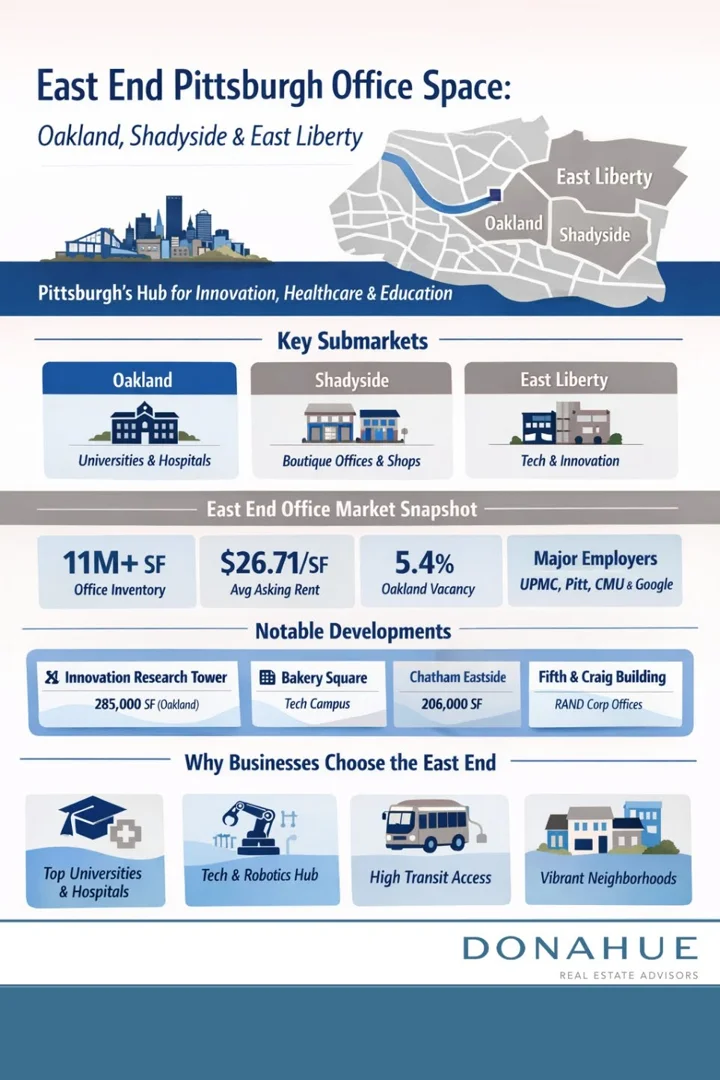
The following table summarizes key characteristics of the East End Pittsburgh office market based on current CoStar data (Q3/Q4 2025).
| Metric | East End Pittsburgh Office Market |
|---|---|
| Major neighborhoods | Oakland, Shadyside, East Liberty |
| CoStar submarket designations | Oakland submarket; East End submarket |
| Oakland inventory | 5.4 million SF across 150 buildings |
| East End inventory | 5.5 million SF across 284 buildings |
| Oakland market asking rent | $26.51/SF (3rd highest in Pittsburgh) |
| East End market asking rent | $26.71/SF (2nd highest in Pittsburgh) |
| Oakland vacancy rate | 5.4% (among the lowest in the metro) |
| East End vacancy rate | 15.0% |
| Oakland 12-month net absorption | +272,072 SF (2nd best in metro) |
| Key industries | Healthcare, education, robotics, technology, professional services |
| Major employers/institutions | UPMC, University of Pittsburgh, Carnegie Mellon University, Google (Bakery Square) |
| Flagship development | Innovation Research Tower: 285,000 SF, delivering first half 2026 (Oakland) |
| Building types | Medical office, institutional, boutique offices, adaptive reuse, Class A mixed-use |
| Transit access | Port Authority bus rapid transit corridors, Forbes/Fifth Ave, Penn Ave, I-376 |
Sources: CoStar Pittsburgh Office Market Report, February 2026 (Donahue Real Estate Advisors); submarket rent and vacancy data as of Q3/Q4 2025.
Major Office Developments in the East End
| Development | Neighborhood | Approx Size | About |
|---|---|---|---|
| Bakery Square | East End | 750K+ SF campus | Tech hub anchored by Google |
| Innovation Research Tower | Oakland | 285K SF | Lab + office development |
| Chatham Eastside | East End | 206K SF | Mixed-use office building |
| Fifth & Craig Building | Oakland | Major office building | Home to RAND lease |
Where the East End Is Located in Pittsburgh
The East End sits immediately east of Downtown Pittsburgh and the Hill District, following the Forbes and Fifth Avenue corridors as they climb toward Oakland and continue through Shadyside, East Liberty, and Point Breeze before reaching the Squirrel Hill neighborhood and beyond.
Key geographic relationships:
Downtown Pittsburgh (CBD) is approximately 2.5 miles west of Oakland via Forbes or Fifth Avenue. The Strip District and Lawrenceville border the East End to the north along the Allegheny River corridor. Squirrel Hill lies to the southeast of East Liberty and Oakland. Interstate 376 (the Parkway East) runs parallel to and south of the East End, providing direct access to the airport corridor and the eastern suburbs.
Port Authority of Allegheny County bus rapid transit lines, including the 61 and 71 routes, run directly through the Forbes/Fifth Avenue corridor, connecting the East End to Downtown, Oakland, Shadyside, and East Liberty with frequent service. This transit connectivity makes the East End one of the most accessible non-downtown office locations in the region for employees who commute by bus.
The East End functions as Pittsburgh’s academic and healthcare corridor. The concentration of UPMC, the University of Pittsburgh, Carnegie Mellon University, and dozens of affiliated research organizations creates a dense cluster of institutional tenants that anchors the market and supports adjacent professional services demand.
For more insights on the broader market, you can explore our detailed breakdown of commercial real estate Pittsburgh.
Why Companies Choose the East End for Office Space
Several structural factors make the East End an attractive office location for a wide range of tenants.
Access to a Highly Educated Workforce
Carnegie Mellon University and the University of Pittsburgh together produce tens of thousands of graduates annually across engineering, computer science, medicine, business, and the arts. Companies located in the East End are within walking distance of this talent pipeline, a meaningful recruiting advantage for technology companies, research organizations, and professional services firms.
Research and Innovation Ecosystem
The East End is embedded in one of the nation’s most concentrated innovation ecosystems. Pittsburgh is home to more than 1,800 tech companies, including Google, Apple, Uber, Meta, and Duolingo, according to the CoStar Pittsburgh Market Report. Amazon has committed $20 billion in local innovation center investment, and the city’s AI Strike Team has set a goal of bringing 100,000 new tech jobs to the region by 2028. Much of this activity is anchored in and around the East End.
Strong Absorption in the Oakland Submarket
While many Pittsburgh submarkets are experiencing negative or flat net absorption, Oakland stands out. According to CoStar data, Oakland recorded 272,072 square feet of positive net absorption over the past 12 months, the second-highest figure in the entire Pittsburgh metro. This reflects genuine demand for East End space, particularly in newer and purpose-built buildings.
Premium Rents Signal Tenant Confidence
The East End submarket commands the second-highest average asking rent in Pittsburgh at $26.71/SF, and the Oakland submarket sits at $26.51/SF, both well above the Pittsburgh market average of $23.22/SF. The East End also leads all Pittsburgh submarkets in rent growth, with a 5.3% annualized rate compared to a market average of roughly 1.2%. This trend reflects the premium that tenants place on East End locations.
Mixed-Use Neighborhoods
Unlike suburban office parks, the East End’s neighborhoods offer walkable access to restaurants, retail, cafes, parks, and cultural amenities. This is increasingly relevant to employers competing for talent who expect more than a parking lot outside their office window.
Oakland Office Space
Oakland is Pittsburgh’s education and healthcare hub: a dense, institutionally anchored neighborhood that functions as a small city within the city. It is home to two of the nation’s leading research universities, a major hospital system, and a growing cluster of research and technology facilities.
Major Institutions
The University of Pittsburgh (Pitt) and Carnegie Mellon University (CMU) anchor Oakland’s institutional base. UPMC (the University of Pittsburgh Medical Center) is the region’s largest non-governmental employer, operating 40 hospitals and employing more than 92,000 people across Pennsylvania and internationally, according to the CoStar Pittsburgh Economy report. Highmark Health also maintains a major presence in the broader Oakland area.
Office Market Characteristics
Most office space in Oakland is institutional in character: research and technology facilities, medical office buildings, and laboratory-adjacent commercial space. The CoStar submarket report shows Oakland inventory at approximately 5.4 million square feet across 150 buildings, with a vacancy rate of just 5.4%, among the lowest in the Pittsburgh metro.
The submarket has also seen inventory growth of more than 10% in recent years, driven by new institutional development. The largest project currently underway in the metro is the Innovation Research Tower in Oakland. Developer Walnut Capital is building the 285,000-square-foot, 10-story tower, which will include laboratory and office space along with ground-floor retail. It is scheduled to deliver in the first half of 2026.
Recently, the Rand Corporation signed a 57,354-square-foot lease at the Fifth and Craig Building in Oakland (Q1 2025), one of the larger new lease transactions recorded in the East End submarket over the past year, with tenant representation by Savills.
| Building / Project | Size | Notes |
|---|---|---|
| Innovation Research Tower | 285,000 SF | Walnut Capital; laboratory + office; delivery H1 2026 |
| Fifth and Craig Building | 57,354 SF leased (Q1 2025) | Rand Corp; Savills/Elmhurst Group |
| Oakland submarket total inventory | 5.4 million SF | 150 buildings; 5.4% vacancy rate |
Source: CoStar Pittsburgh Office Market Report, February 2026.
Who Leases in Oakland
Primary tenants in Oakland include healthcare organizations and medical practices affiliated with UPMC and Highmark, university departments and research centers, life sciences and biotechnology companies, federal and state government research agencies, and technology companies seeking proximity to CMU and Pitt.
Operating Costs in Oakland
Oakland has higher operating expenses than most Pittsburgh submarkets, reflecting its dense urban character and institutional tenant base. CoStar data puts annual operating expenses for 4 & 5 Star buildings in Oakland at $13.50/SF, the second highest in the metro, behind only West Pittsburgh ($16.80/SF). For 3-star buildings, Oakland expenses average $11.37/SF annually. Tenants negotiating leases should factor these costs into total occupancy cost calculations.
For a deeper dive into how these numbers compare to the rest of the city, check out our report on Pittsburgh vacancy rates.
Shadyside Office Space
Shadyside is one of Pittsburgh’s most affluent and walkable neighborhoods, situated between Oakland to the west and East Liberty to the northeast. It is known for its tree-lined residential streets, the boutique retail and dining corridor along Walnut Street, and a concentration of smaller commercial buildings that attract professional services firms and medical practices.
Neighborhood Character
Unlike Oakland’s large institutional footprint or East Liberty’s emerging tech corridor, Shadyside’s office market is characterized by smaller boutique buildings, often converted Victorian-era structures or low-rise commercial properties. Many of these buildings are well-suited to law firms, consulting firms, financial advisors, and healthcare practices that prefer a neighborhood address over a high-rise tower.
The Walnut Street corridor is Shadyside’s commercial spine, offering concentrated retail amenity within walking distance of most office locations. Restaurants, specialty coffee shops, boutique retailers, and medical offices line the street, creating an environment that appeals to both employees and clients.
Typical Tenants
Shadyside attracts law firms, accounting and consulting practices, insurance agencies, financial advisory offices, healthcare practices (particularly specialty medicine and mental health), and smaller technology startups seeking an affordable East End alternative to Oakland or East Liberty.
What to Know About Leasing in Shadyside
Shadyside sits within the East End submarket as tracked by CoStar. Building inventory tends toward smaller floor plates, which suits tenants in the 1,000 to 10,000 square foot range. Parking is more constrained than in suburban office parks, so tenants should evaluate proximity to Port Authority bus routes and consider parking arrangements during lease negotiations. Shadyside’s walkability score and neighborhood amenities are genuine assets for recruiting employees who prioritize quality of life.
East Liberty Office Space
East Liberty has undergone one of the most dramatic commercial real estate transformations of any Pittsburgh neighborhood over the past two decades. Once in significant decline, the neighborhood now anchors Pittsburgh’s technology corridor, anchored by Google’s Pittsburgh office at Bakery Square and supported by a growing roster of tech companies, innovation-oriented tenants, and mixed-use development.
Google and Bakery Square
Google’s Pittsburgh office, located at Bakery Square (a mixed-use adaptive reuse development in the former Nabisco/Heinz factory complex), is the most visible symbol of East Liberty’s tech transformation. Bakery Square recorded strong leasing activity in the past 12 months, including 40,000-SF leases to CMU Software Engineering and the gaming company Hellbender (Q1 and Q2 2025), plus an additional 32,174 SF in Q1 2025. Total 12-month net absorption at Bakery Square reached 54,513 SF according to CoStar data.
Chatham Eastside
Another major East End property is Chatham Eastside, a 206,423-square-foot building in the East End submarket that recorded 206,423 SF of net absorption over the past 12 months, one of the largest single-property absorption figures in the entire Pittsburgh market. This reflects the completion of major leasing activity in a building that had previously been largely vacant.
Office Market Characteristics
East Liberty offers a mix of Class A office space in newer mixed-use developments, adaptive reuse buildings with flexible floor plans, and innovation-oriented spaces that appeal to startups and technology companies. The East End submarket (which encompasses East Liberty and adjacent neighborhoods) has a market asking rent of $26.71/SF, the second highest in Pittsburgh, and the highest annualized rent growth rate of any submarket at 5.3%.
The overall vacancy rate in the East End submarket is approximately 15.0%, which is higher than Oakland’s 5.4%, but this figure reflects the mixed-vintage inventory of the submarket, which includes both trophy assets and older buildings. Recently delivered properties in the submarket command significantly higher rents; CoStar notes that Bakery Office Three, upon delivery, was asking above $40/SF full service.
Nearby Liberty East
The Liberty East building in the East End submarket also recorded a notable lease in Q2 2025, with Triple signing for 26,245 SF. The building reflects the broader pattern of smaller technology and professional services companies seeking well-located East End space at below-trophy rents.
Comparing East End Submarkets
The table below provides a side-by-side comparison of the three primary East End neighborhoods for prospective tenants.
| Submarket | Best For | Building Types | Typical Tenants | Avg. Asking Rent | Vacancy |
|---|---|---|---|---|---|
| Oakland | Healthcare, research, life sciences | Medical office, lab, institutional | UPMC affiliates, research orgs, CMU/Pitt departments, tech | $26.51/SF | 5.4% |
| Shadyside | Professional services, small firms | Boutique commercial, converted buildings | Law firms, consulting, financial services, healthcare practices | Part of East End submarket | Varies by building |
| East Liberty | Technology, startups, creative firms | Adaptive reuse, Class A mixed-use | Tech companies, CMU spinoffs, media, innovation-oriented tenants | $26.71/SF (East End) | 15.0% (East End) |
Sources: CoStar Pittsburgh Office Market Report, February 2026. Rent and vacancy figures reflect CoStar submarket designations (Oakland; East End).
One of the most consistent themes in tenant decision-making over the past several years has been the growing importance of neighborhood amenities, specifically the walkable environment around an office building that affects employee experience, recruitment, and day-to-day quality of life. By this measure, the East End ranks among Pittsburgh’s most competitive office locations.
Restaurants and Retail
Oakland’s Craig Street and Forbes Avenue corridors offer cafes, quick-service restaurants, and retail within walking distance of most office buildings. Shadyside’s Walnut Street is one of Pittsburgh’s most curated dining and retail strips. East Liberty’s Penn Circle has seen significant investment in new restaurants, a Whole Foods, REI, and national retail brands, all within a short walk of Bakery Square and surrounding office buildings.
Parks and Green Space
Frick Park, one of Pittsburgh’s largest urban parks, is accessible from the East End. Schenley Park borders Oakland and provides trails, athletic fields, and a public golf course. These green spaces are within walking or biking distance of most East End office locations.
Universities and Cultural Institutions
The proximity to the University of Pittsburgh and Carnegie Mellon University gives East End-based companies access to world-class cultural programming, continuing education, and university facilities. The Carnegie Museums of Art and Natural History are located in Oakland’s museum district.
Public Transit
Port Authority bus lines run frequently along Forbes and Fifth avenues, connecting the East End to Downtown Pittsburgh in approximately 20 to 30 minutes. East Liberty is also served by Penn Avenue routes that connect to the Strip District and Lawrenceville. For companies with employees who commute without cars, the East End’s transit connectivity is a genuine advantage over suburban alternatives.
Who Should Lease Office Space in the East End
The East End is not the right fit for every company. Tenants who are best positioned to benefit from an East End location include:
Healthcare organizations and medical practices, particularly those affiliated with or seeking proximity to UPMC, Highmark, or affiliated research programs. Oakland’s institutional density and the lowest vacancy rate in the metro (5.4%) make it the default choice for healthcare-aligned tenants.
Technology companies seeking access to CMU and Pitt talent pipelines. The concentration of robotics, AI, and software engineering graduates in the East End creates a recruiting advantage that is difficult to replicate in suburban office parks.
Research organizations and think tanks. Rand Corporation’s recent 57,354-SF lease in Oakland is representative of the demand from policy and research organizations seeking proximity to university resources and federal research programs in the region.
Professional services firms, including law firms, consulting practices, accounting firms, and financial advisors, that benefit from proximity to institutional clients in Oakland or the walkable environment of Shadyside.
Startups and early-stage companies. East Liberty in particular offers a range of space types, from shared-amenity Class A buildings to smaller suites in adaptive reuse buildings, at rents that reflect the neighborhood’s still-evolving market rather than trophy pricing.
Companies where employee experience is a core part of talent strategy. For employers competing for candidates who have options, the East End’s walkability, restaurant culture, and proximity to parks and universities represents a meaningful competitive advantage over car-dependent suburban alternatives.
Frequently Asked Questions
What does office space cost in the East End of Pittsburgh?
According to CoStar data from February 2026, the East End submarket has an average asking rent of $26.71/SF, and the Oakland submarket averages $26.51/SF. Both are well above the Pittsburgh market average of $23.22/SF. Premium buildings command higher rents: recently delivered properties such as Bakery Office Three were asking above $40/SF full service upon delivery. The overall Pittsburgh 4 & 5 Star building average is $31.82/SF. Tenants in boutique Shadyside buildings or older East End stock may find rates below the submarket average. Total occupancy cost should also account for building operating expenses, which are higher in Oakland ($13.50/SF annually for 4 & 5 Star buildings) than in many other Pittsburgh submarkets.
Is Oakland a good place for medical offices?
Yes. Oakland is Pittsburgh’s primary medical office market, anchored by UPMC, the University of Pittsburgh Medical Center, and Highmark Health. The Oakland submarket has a vacancy rate of just 5.4%, one of the lowest in the metro, and recorded 272,072 SF of positive net absorption over the past 12 months, the second-best figure in Pittsburgh. Medical offices in Oakland benefit from proximity to hospital systems, referral networks, affiliated research programs, and a patient base that is familiar with the neighborhood. Demand is strong enough that the largest office project currently underway in Pittsburgh, the 285,000-SF Innovation Research Tower, is being built in Oakland, with planned lab and office space that will serve both research and commercial tenants.
How does East Liberty compare to Downtown Pittsburgh for office space?
Downtown Pittsburgh (the CBD) has the highest total office inventory in the metro at 33.8 million SF, but also a higher vacancy rate of 15.5% and a 12-month average asking rent of $28.34/SF, slightly above the East End submarket’s $26.71/SF. The East End offers a meaningfully different environment: walkable neighborhoods, access to tech and university talent, and a more dynamic street-level experience than most downtown towers. For technology companies, research organizations, and firms that prioritize employee experience, East Liberty and Oakland often outperform downtown options. Downtown has advantages in prestigious address, floor plate size for large single-tenant users, and parking infrastructure. Both markets currently favor tenants due to elevated vacancies relative to pre-pandemic norms.
Which Pittsburgh neighborhood is best for startups?
#
East Liberty is generally considered Pittsburgh’s most startup-friendly office environment. Google’s presence at Bakery Square has created a gravitational pull for technology and innovation-oriented companies. The neighborhood offers a range of building types and lease structures, from suites in Class A mixed-use buildings to more flexible arrangements in adaptive reuse properties. Oakland is better suited to startups with specific proximity needs to CMU, Pitt, or UPMC research programs. Shadyside offers smaller footprint space that suits early-stage professional services firms or healthcare-adjacent companies that prefer a lower-density neighborhood environment.
What is the overall Pittsburgh office market vacancy rate?
As of the CoStar Pittsburgh Office Market Report dated February 2026, the Pittsburgh metro office vacancy rate is 10.8%, well below the national benchmark of 14.0%. Vacancy across building classes varies significantly: 4 & 5 Star buildings have a 16.5% vacancy rate, 3 Star buildings are at 11.6%, and 1 & 2 Star buildings are at just 5.3%. Oakland’s 5.4% vacancy rate is among the lowest in the region.
Conclusion
The East End of Pittsburgh is not simply an alternative to Downtown. For many companies, it is the preferred choice. The combination of Oakland’s institutional density and low vacancy, East Liberty’s technology corridor momentum, and Shadyside’s walkable professional services environment creates a market that serves a wide range of tenants across industries and size ranges.
The data supports the narrative. Oakland’s net absorption of 272,072 SF over the past 12 months is the second-best figure in the Pittsburgh metro. The East End submarket leads all Pittsburgh submarkets in annualized rent growth at 5.3%. The Pittsburgh region’s innovation economy, which includes more than 1,800 tech companies, CMU’s robotics and AI programs, and UPMC’s research infrastructure, is concentrated in the East End. The largest development project currently underway in Pittsburgh is being built here.
At the same time, the market is nuanced. Oakland’s low vacancy means limited available inventory, and tenants may need to act decisively or consider build-to-suit arrangements for larger requirements. The East End submarket’s 15.0% vacancy rate reflects a more complex picture, with strong demand for newer and well-positioned buildings alongside legacy inventory that continues to give back space. Tenants who understand these dynamics are in a better position to negotiate favorable lease terms.
Work With a Tenant Representation Advisor
Before signing a lease in the East End or anywhere else in Pittsburgh, it’s important to work with an advisor who represents your interests exclusively. Donahue Real Estate Advisors provides independent tenant representation, meaning our team works solely on behalf of tenants rather than landlords or building owners.
This structure allows us to evaluate the market objectively, helping businesses compare available properties, analyze lease economics, negotiate favorable terms, and understand the long-term implications of their location decisions. In a market as nuanced as Pittsburgh’s, where vacancy, operating expenses, and development pipelines vary widely by neighborhood, having dedicated tenant representation can make a meaningful difference in both cost and outcome.
Whether you are evaluating office space in the East End, Downtown, or another Pittsburgh submarket, working with a tenant-focused advisor ensures your lease decision is based on
Schedule a Lease Review with Donahue Real Estate Advisors to discuss your space needs, review current market opportunities, and determine the best leasing strategy for your business.
Market statistics sourced from: CoStar Pittsburgh Office Market Report, February 2026, prepared by Donahue Real Estate Advisors (License 664207). Economy data sourced from Oxford Economics via CoStar. All figures reflect Q3/Q4 2025 data unless otherwise noted.