

Why Multi-Location Employers in Pittsburgh Can’t Afford to Skip Tenant Representation
Tenant representation for multi-location and regional employers is a specialized real estate service where a broker works exclusively for the tenant, never the landlord, to secure better lease terms, lower costs, and smarter locations across every site in your portfolio.
Here is what it means in practice:
- Who it’s for: Companies with two or more locations, businesses planning to expand into new Pittsburgh submarkets, or organizations facing lease renewals and unsure whether to stay or move.
- What it does: A tenant rep broker negotiates on your behalf, compares market options, and builds leverage so landlords compete for your tenancy.
- What it costs: In most transactions, the landlord’s broker shares their commission with the tenant rep, meaning there is typically no out-of-pocket cost to you.
- When to start: For major or specialized spaces, begin 18 to 36 months before your lease expires. For standard leases, start at least 12 months out.
- Why it matters: Traditional commercial brokers earn 80 to 90% of their revenue from landlords. That creates a conflict of interest when they claim to represent you.
Most Pittsburgh business leaders sign leases that favor the landlord, not because they made a bad decision, but because they negotiated without the right information or the right advocate in their corner. When your workspace does not fit how your team actually works, productivity suffers and talent walks. And when a lease expires without a plan, landlords use that clock against you.
At Donahue Real Estate Advisors, our team has spent over three decades on both sides of the commercial real estate table, gaining deep experience on the landlord side before dedicating our practice entirely to conflict-free tenant representation for multi-location and regional employers across the Pittsburgh market. This background is exactly what we use to protect you during negotiations.
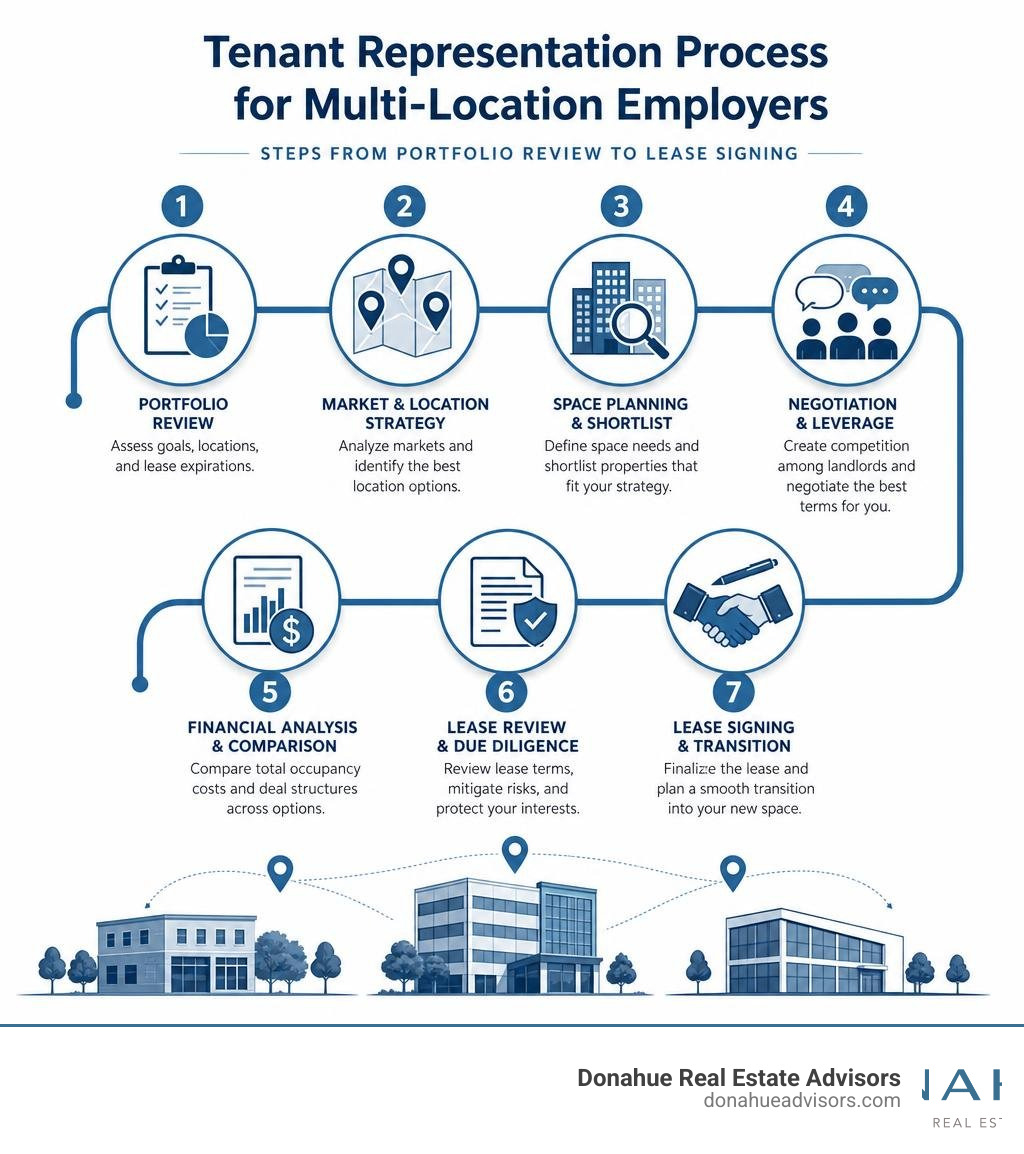
Partner with Expert Tenant Representation: The First Step in Portfolio Strategy
When you manage a regional footprint or multiple offices across Western Pennsylvania, every lease negotiation requires a distinct set of tactics. Many business owners mistakenly believe they can save money or simplify the process by calling the number on a “For Lease” sign or negotiating directly with their current landlord. This is almost always a costly miscalculation.
The first step in any successful real estate strategy is to partner with an expert tenant representative. Attempting to navigate the market on your own or relying on a traditional broker who also lists properties for landlords immediately puts your business at a disadvantage.
To understand why, you must look at how the commercial real estate industry is structured. Traditional brokerage firms derive 80% to 90% of their revenues from representing landlords. This business model creates a significant conflict of interest. A broker who is actively trying to fill a landlord’s building cannot offer you completely objective, tenant-first advice. When you work with a firm that acts as a sole fiduciary to tenants, you eliminate this conflict entirely.
In a market with high overall vacancy but limited top-tier space, landlords are highly motivated to retain strong, creditworthy regional employers. However, they will not offer their best terms unless they know you are willing to walk away.
A dedicated tenant representative creates that leverage. We analyze the market, present alternative options, and handle the communication so you can maintain a positive direct relationship with your landlord. To learn more about how this dynamic works, you can read about the difference between a landlord rep and tenant rep.
Why Regional Employers Need Tenant Representation for Multi-Location and Regional Employers
Managing a real estate portfolio across different submarkets in Pittsburgh requires deep local market intelligence. A lease in the Strip District does not look like a lease in Oakland, and the concessions available in the East End are vastly different from those in the North Shore.
For regional employers, tenant representation for multi-location and regional employers is critical because it prevents you from treating each office as an isolated transaction. Instead, it allows you to look at your entire real estate footprint as a single, cohesive system.
Let’s look at how the submarkets in Pittsburgh differ in 2026:
- The East End (including Shadyside and East Liberty): These areas remain highly competitive for technology, creative, and professional services firms. Vacancy rates here are lower than the city average, and landlords are less inclined to offer massive rent discounts, though they may offer flexible lease terms to growing companies.
- Oakland: As the academic and medical heart of the city, Oakland experiences consistent demand. Finding high-quality office space here requires early planning and often relies on accessing off-market opportunities through local broker networks.
- The Strip District: This submarket has transformed into a premier office destination. While rental rates remain high, tenant representatives can negotiate significant tenant improvement allowances to help offset build-out costs.
- The North Shore and Southside: These waterfront submarkets offer excellent accessibility and amenities, making them popular for mid-sized regional headquarters.
According to the Pittsburgh Business Times Real Estate News, regional employers are increasingly seeking spaces that help with employee attraction and retention. This means location choices are no longer just about the cost per square foot; they are about workplace productivity and cultural alignment.
Without professional guidance, regional employers often pay above-market rates or accept restrictive lease clauses because they lack the data to compare submarkets accurately. You can read more about how we help businesses navigate these submarket variations on our commercial tenant representation page.
Navigating the Relocation vs. Renewal Dilemma in Pittsburgh
One of the most common decisions a Pittsburgh business leader must make is whether to renew an existing lease or relocate to a new space. Landlords understand that moving is expensive, disruptive, and time-consuming. Because of this, they often use a tactic known as “slow-playing” negotiations.
By delaying their response to your renewal inquiries, landlords run down the clock. If you reach the final six months of your lease without alternative options, your negotiating leverage disappears. You are forced to accept their renewal terms because you simply do not have enough time to design, permit, and build out a new office.
To prevent this, we recommend starting the tenant rep process at least 12 to 18 months in advance for standard office spaces, and 18 to 36 months in advance for larger regional headquarters or specialized facilities.
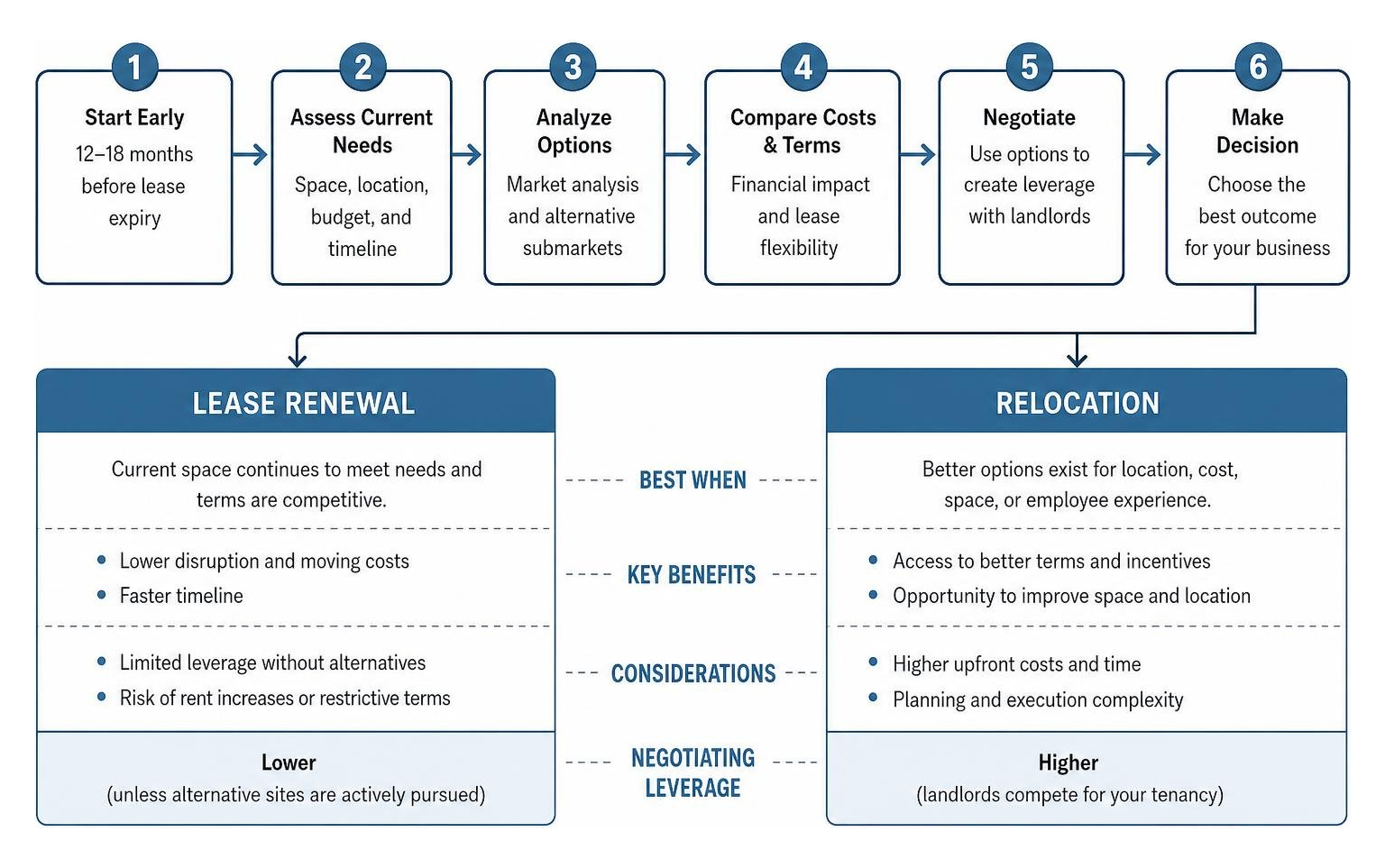
This timeline allows you to run a competitive process where your current landlord must compete against other buildings to keep your business.
| Feature | Lease Renewal | Relocation |
|---|---|---|
| Negotiating Leverage | Lower (unless alternative sites are actively pursued) | Higher (landlords compete for your tenancy) |
| Upfront Capital Costs | Minimal (possible paint and carpet refresh) | Higher (moving costs, technology setup, furniture) |
| Business Disruption | Low (operations continue uninterrupted) | Moderate to High (requires planning and transition time) |
| Space Optimization | Limited to existing footprint | High (can design space to match current hybrid work needs) |
| Tenant Improvements | Typically smaller allowances | Larger allowances to secure the deal |
By evaluating both options simultaneously, you force your current landlord to offer market-rate concessions, such as rental discounts, free rent periods, and updated tenant improvement allowances, just to keep you from moving.
Critical Pitfalls: Free Rent Timing and Holdover Rent Risks
When negotiating a commercial lease in Pittsburgh, many business leaders focus entirely on the starting rental rate. However, the fine print in a lease contract can contain hidden liabilities that easily erase any savings you negotiated on the base rent. Two of the most common pitfalls involve the timing of free rent and the financial risks of holdover rent.

The Free Rent Amortization Trap
Landlords often offer a few months of free rent as an incentive to sign a lease. While this looks great on paper, you must pay close attention to how this concession is structured. In some standard lease agreements, if a tenant defaults on any term of the lease, even years down the road, the landlord can claw back the entire value of the free rent period.
Additionally, if you plan to expand or modify your space later, a poorly structured free rent clause can complicate your financial planning. An experienced tenant representative ensures that your concessions are fully vested and protected throughout the life of the lease.
The Danger of Holdover Rent
What happens if your lease expires but your new space in East Liberty or the Strip District isn’t ready for occupancy yet? If you remain in your current space past the expiration date without a written agreement, you enter “holdover” status.
Most commercial leases contain a holdover clause that increases the rent to 150% or even 200% of your previous rate. In some cases, the landlord can also hold you liable for consequential damages if your holdover causes them to lose a prospective tenant who was scheduled to move into your space.
Working with a tenant rep helps you avoid these risks by building flexible extension options into your initial lease and aligning your construction timelines with your lease expiration dates. If you are wondering whether your business needs this level of protection, take a look at our guide on Should I Hire a Tenant Rep? as well as our article on Do I Need a Tenant Rep?.
Strategic Portfolio Optimization and Case Studies
For regional employers with multiple locations in Western Pennsylvania, real estate is often the second-largest operating expense behind payroll. Managing these locations reactively leads to fragmented decision-making, inconsistent lease terms, and missed opportunities for cost savings.
Through strategic portfolio optimization, we help companies align their real estate footprint with their actual business goals. In 2026, this often involves restructuring existing leases to accommodate hybrid work models, consolidating underutilized offices, or expanding into growing submarkets like Shadyside or Oakland.
A coordinated, portfolio-wide tenant representation strategy can achieve significant financial benefits, sometimes resulting in up to an 18% overall cost reduction across a multi-market portfolio. These savings are achieved by:
- Eliminating redundant square footage across regional offices.
- Standardizing lease terms, renewal options, and operating expense protections.
- Leveraging the scale of your total tenancy to negotiate better terms with regional landlords.
We have successfully helped clients across diverse industries, including technology, professional services, healthcare, and corporate headquarters, reduce their rental expenses even when they have remaining lease terms of more than five years. By conducting a thorough audit of your current leases, we can identify opportunities to approach landlords early, offering them long-term stability in exchange for immediate rent reductions or space contractions.
To see real-world examples of how we have helped regional businesses navigate complex space requirements, you can explore our case studies to learn how strategic planning and market leverage protect tenants during major transitions.
Frequently Asked Questions about Tenant Representation for Multi-Location and Regional Employers
How does tenant representation for multi-location and regional employers support long-term portfolio optimization?
Managing multiple offices means tracking different lease expiration dates, renewal notice windows, and operating expense audits. A tenant representative acts as an extension of your corporate real estate team. We centralize your lease data, track critical dates, and conduct regular portfolio reviews to identify opportunities for consolidation or expansion.
This proactive approach prevents you from making rushed, reactive decisions when a lease is about to expire. To understand how we support your business throughout the lifecycle of your leases, check out our tenant rep services.
When should a regional employer begin the tenant representation process?
The timeline depends on the size and complexity of your offices. For standard regional offices under 10,000 square feet, you should partner with a broker 12 to 18 months before your lease expires. This gives you enough time to conduct a thorough site search, negotiate letters of intent, and complete minor space modifications.
For larger headquarters, specialized medical or technical spaces, or portfolios with multiple concurrent expirations, you should begin the process 18 to 36 months in advance. This ensures you maintain maximum negotiating leverage and have ample time to manage construction and permitting processes. You can review the complete step-by-step timeline on our commercial real estate process page.
Conclusion: Secure Your Lease Strategy Session
Managing a regional real estate footprint in Pittsburgh requires more than just reacting to lease expirations as they arrive. Every office location in your portfolio affects your operational flexibility, your ability to recruit talent, and your bottom line.
At Donahue Real Estate Advisors, we provide conflict-free, tenant-first representation. Because we never represent landlords or list commercial properties, our only fiduciary duty is to you, the tenant. We help you navigate the unique dynamics of Pittsburgh submarkets, from the Strip District to Oakland, ensuring your real estate decisions support your long-term business goals.
Whether you are deciding between renewing your current lease or relocating to a new space, we can help you evaluate your options with clear, data-driven insights.
Ready to optimize your real estate portfolio? Contact us today to secure your custom lease strategy session and start your portfolio review. Let’s work together to make your commercial real estate a competitive advantage for your business. Schedule a free lease review and strategy session today.