

The Scavenger’s Guide to Affordable Office Leases
Why Affordable Office Space Leases Matter for Your Business
Affordable office space lease options can be your best strategic move when real estate ranks as your second-highest expense after payroll. Finding the right space at the right price isn’t just about cutting costs—it’s about freeing up capital for growth, hiring, and innovation.
Quick Guide to Finding Budget Office Rentals:
- Target Class B and C buildings – These offer rates 30-50% below Class A properties while maintaining functionality
- Explore flexible alternatives – Coworking spaces start at $300-500/month; subleases discount 10-25% below market
- Focus on emerging neighborhoods – Areas like Uptown or the Parkway West corridor offer significantly lower per-square-foot costs
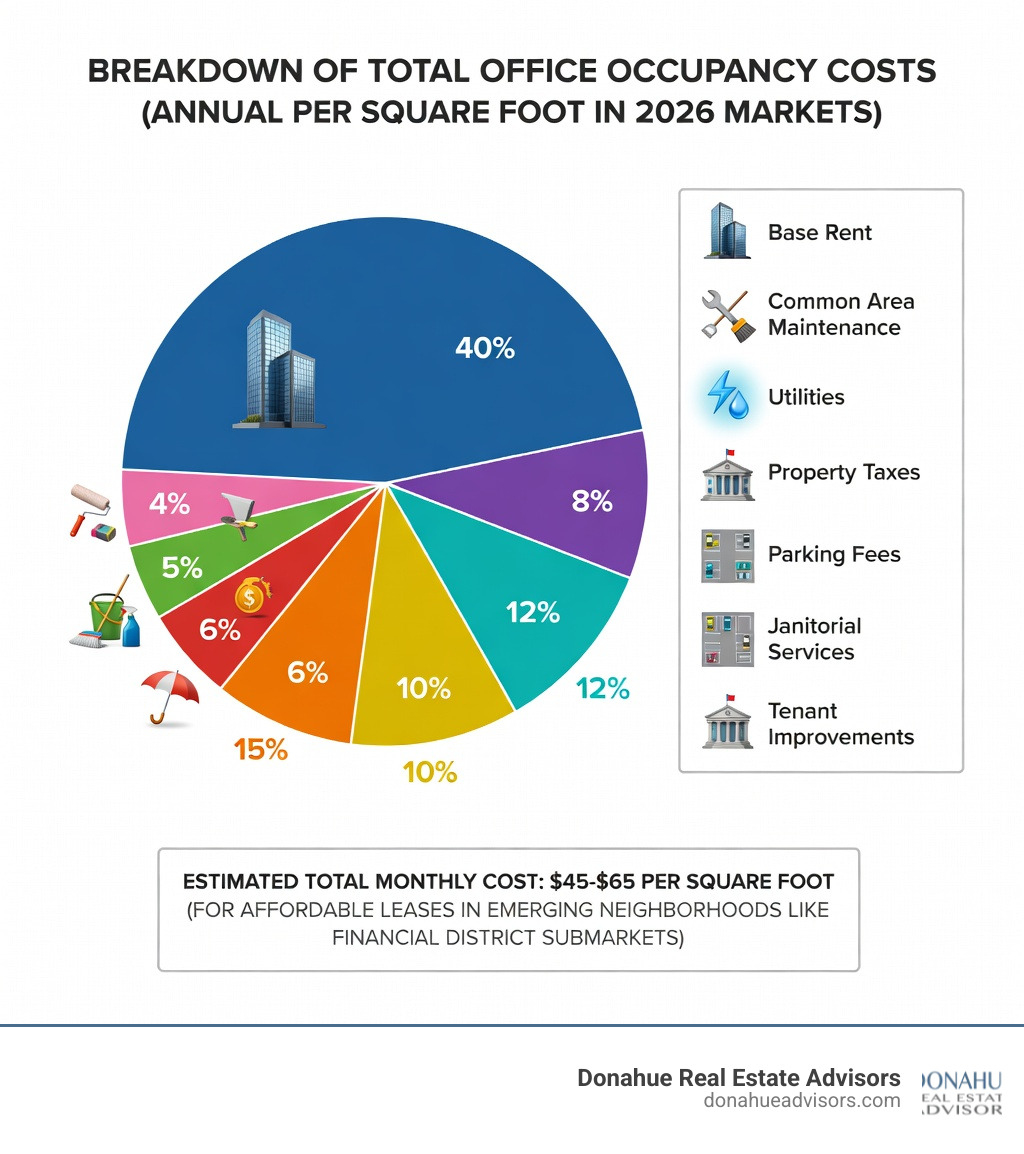
- Calculate total occupancy costs – Look beyond base rent to utilities, maintenance, parking, and hidden fees
- Leverage professional representation – Tenant representatives negotiate better terms at no cost to you
The challenge isn’t just finding cheap space. It’s finding space that won’t drain resources through hidden costs, restrictive terms, or locations that hurt productivity. Many mid-sized businesses remain locked in outdated leases that favor landlords, paying premium rates for spaces that no longer fit their teams.
This guide walks you through the practical steps to secure an affordable office space lease that actually works for your business—not just your budget.
Defining the Affordable Office Space Lease in Today’s Market
When we talk about an affordable office space lease, “affordable” is a relative term that shifts based on the city skyline you’re looking at. In markets like Pittsburgh, where premium Class A rents typically range between $30 and $38 per square foot, “affordable” usually lands in the $18 to $25 per square foot range.
In the current post-pandemic landscape, the definition of affordable has expanded. Truly budget-friendly spaces can sometimes be found for as low as $15 to $20 per square foot in older buildings. This shift has turned previously mid-priced spaces into absolute bargains for businesses willing to do a little “scavenging.”
Why does this matter? For startups and small businesses, every dollar saved on rent is a dollar that can be reinvested into the team. Real estate is typically a company’s second-highest expense. By securing a cheap office space, you are effectively extending your company’s runway.
However, we often see businesses fall into the trap of asking, why is office space so expensive? without realizing that they are looking in the wrong neighborhoods. For example, while the Golden Triangle might command $35 per square foot, the North Shore often offers competitive rates, and areas like Uptown can even dip below $20 per square foot for certain listings. Finding affordability is about knowing which street corners hold the hidden gems.
Navigating Building Classes: Why Class B and C are Your Best Friends
One of the easiest ways to secure an affordable office space lease is to look past the “shiny and new.” Commercial real estate is categorized into three main classes: A, B, and C. Understanding these is the key to balancing your budget with your professional image.
| Feature | Class A | Class B | Class C |
|---|---|---|---|
| Price | Premium / Highest | Average / Market Rate | Lowest / Budget |
| Aesthetics | High-end, glass, steel | Functional, older style | No-frills, utilitarian |
| Amenities | Gyms, cafes, concierge | Basic lobby, standard HVAC | Minimal to none |
| Location | Prime business hubs | Secondary streets | Emerging or industrial areas |
| Best For | Law firms, Fortune 500 | Tech startups, agencies | Back-offices, nonprofits |
Class A: The “Prestige” Trap
Class A buildings are the skyscrapers you see in movies. They have floor-to-ceiling windows, marble lobbies, and high-speed elevators. While they offer prestige, they also come with a price tag that can be double or triple that of nearby alternatives.
Class B: The “Sweet Spot”
Class B buildings are often slightly older but well-maintained. They offer a professional environment without the “luxury tax.” For most small to mid-sized businesses, Class B provides the best value, offering a functional workspace that doesn’t feel “cheap” but keeps the rent manageable.
Class C: The “Budget Hero”
If your primary goal is pure affordability, Class C is your best friend. These are typically older buildings (often 20+ years) located in less central areas. They might lack a fancy lobby or a gym, but they provide the four walls and a roof you need to get work done. For startups that prioritize price over polish, Class C can be a smart, strategic choice.
To dive deeper into these categories, check out our guide on Class A vs Class B office space to see which fits your current growth stage.
Strategic Alternatives: Coworking, Subleases, and Virtual Offices
Sometimes, the most affordable office space lease isn’t a traditional lease at all. If you have a small team or need maximum flexibility, you should look at non-traditional models.
Coworking and Shared Offices
Coworking spaces have revolutionized the “cheap” office market. For teams of under four people, this is almost always the most cost-effective option.
- Hot Desks: Basic memberships for an open desk typically start around $300–$500 a month.
- Dedicated Desks: A permanent spot in a shared area usually ranges from $500–$1,000 depending on the location.
- Private Offices: Many coworking providers offer micro-offices that give you a door that locks while still providing access to shared kitchens and conference rooms.
The Power of the Sublease
Subleases are the “clearance rack” of commercial real estate. When a company grows too fast or downsizes, they often need to offload their remaining lease term. Because they are motivated to stop the financial bleeding, sublease rates are usually discounted 10–25% below market rents.
The best part? Many subleases are “plug-and-play,” meaning they come fully furnished with the internet already hooked up. This saves you thousands in upfront build-out and furniture costs. However, always perform due diligence on the original tenant’s financial health to ensure the master lease stays in good standing.
Virtual Offices
If you don’t actually need a physical desk every day but want a professional image, a virtual office is the ultimate budget move. Starting as low as $99 per month, these services provide you with a prestigious business address, mail handling, and occasional access to physical meeting rooms. It’s an excellent way for solopreneurs to maintain credibility without the overhead of a full-time office.
For more on how these models compare, read our breakdown of coworking space vs office or explore flexible office space to rent options that prioritize social impact and sustainability.
How to Secure an Affordable Office Space Lease Without Hidden Costs
Finding a low base rent is only half the battle. If you aren’t careful, “lease cost creep” can turn a bargain into a burden. We always tell our clients: the rent is just the starting point.
Evaluating Your Affordable Office Space Lease Options
When comparing spaces, you have to look at the “Total Cost of Occupancy.” A space that looks $5 cheaper per square foot might actually be more expensive if it doesn’t include:
- Utilities: Are electricity and water included, or are they sub-metered?
- Janitorial Services: Will you have to hire your own cleaners?
- Parking: In downtown areas, parking fees for your team can add hundreds to your monthly spend.
- Common Area Maintenance (CAM): These are fees for maintaining lobbies, elevators, and landscaping. They can fluctuate wildly.
Before signing, it’s vital to ask, how much office space do I need? Overestimating your square footage by even 10% can waste thousands of dollars over the life of a lease.
Steps to Negotiate an Affordable Office Space Lease
Negotiation is where the real “scavenging” happens. Landlords in areas with higher vacancy rates are often willing to make concessions to get a tenant through the door.
- Tenant Improvement (TI) Allowance: Ask the landlord to pay for paint, carpet, or wall moves. This keeps your cash in your pocket.
- Rent Abatement: It is common to negotiate 1-4 months of free rent at the start of a lease to help you get settled.
- Flexible Terms: Try to negotiate a shorter lease (1-3 years) or a “termination option” that allows you to break the lease if the business hits a snag.
- Audit the CAM: Ensure you understand exactly what is included in common area maintenance so you aren’t surprised by a bill for the landlord’s new lobby art.
Securing these terms requires a deep understanding of a commercial lease and the tactics used to hide lease cost creep. This is exactly why we recommend businesses ask: should I hire a tenant rep? A representative works exclusively for you, ensuring the landlord doesn’t take advantage of your “scavenger” mindset.
Frequently Asked Questions about Budget Office Rentals
What is considered “affordable” in a high-cost market?
In markets like Pittsburgh, “affordable” is generally defined as rent that falls 25-40% below the market average for Class A space. This typically means looking for rents in the $15–$22 per square foot range. It often involves choosing Class B or C buildings or looking in neighborhoods like Uptown or the Parkway West corridor.
Why is securing cheap office space vital for startups?
Real estate is usually the second-largest expense for a business. For a startup, every dollar saved on a lease is a dollar that can be spent on “runway”—the time you have to become profitable. Lowering overhead allows for more aggressive hiring and faster product development.
What are the risks of a Class C office lease?
While Class C is budget-friendly, the risks include older infrastructure (slower elevators, outdated HVAC), fewer security features, and potentially less responsive management. We recommend a thorough inspection of the building’s tech capabilities—like fiber-optic internet availability—before signing, as older buildings may lack modern wiring.
Conclusion
Finding an affordable office space lease doesn’t mean you have to settle for a basement with no windows. It means being strategic about building classifications, exploring neighborhoods that others overlook, and being willing to consider alternatives like subleases or coworking.
At Donahue Real Estate Advisors, we specialize in this type of “scavenging.” We provide tenant-first representation in the Pittsburgh market, ensuring that our clients find the best value without any conflicts of interest. We don’t represent landlords, so our only goal is to find you the most cost-effective, functional space possible.
Ready to find your next headquarters without breaking the bank? Learn more about commercial building classifications or contact us today to start your search.