

Why Strip District Office Space Is One of Pittsburgh’s Smartest Bets Right Now
Located along the Allegheny River between Downtown Pittsburgh and Lawrenceville, the Strip District has evolved into one of the region’s most dynamic commercial corridors. Strip District office space is one of the most in-demand commercial real estate options in Pittsburgh, offering a mix of historic character, modern builds, and a fast-growing live-work-play environment.
Here is a quick snapshot of what you need to know:
- Location: Pittsburgh Strip District
- Primary streets: Penn Avenue, Smallman Street
- Available listings: 39 office spaces currently for rent in the Strip District
- Lease rates: Roughly $17 to $38.75 per SF per year depending on building class and condition
- Size range: From small suites around 2,500 SF up to 140,000+ SF in newer mixed-use buildings
- Building stock: A mix of historic properties (some dating to 1900) and new construction completed as recently as 2022
- Demographics: The Strip District has become one of Pittsburgh’s fastest-growing residential neighborhoods, attracting highly educated professionals working in technology, healthcare, and finance.
- Development momentum: More than 1.5 million square feet of mixed-use development has been delivered or proposed in the Strip District over the past decade, including office, residential, and retail projects.
- Key industries: Technology, robotics, healthcare, professional services
Whether you are a growing tech firm, a law practice, or a healthcare company, the Strip District offers options that most Pittsburgh submarkets simply cannot match in terms of variety, location, and walkability.
At Donahue Real Estate Advisors, we have spent decades advising tenants across Pittsburgh’s commercial real estate market, and we have watched the Strip District evolve from a working industrial corridor into one of the city’s most compelling destinations for strip district office space. That on-the-ground market perspective shapes everything we share in this guide.
Understand the Market Dynamics of Strip District Office Space
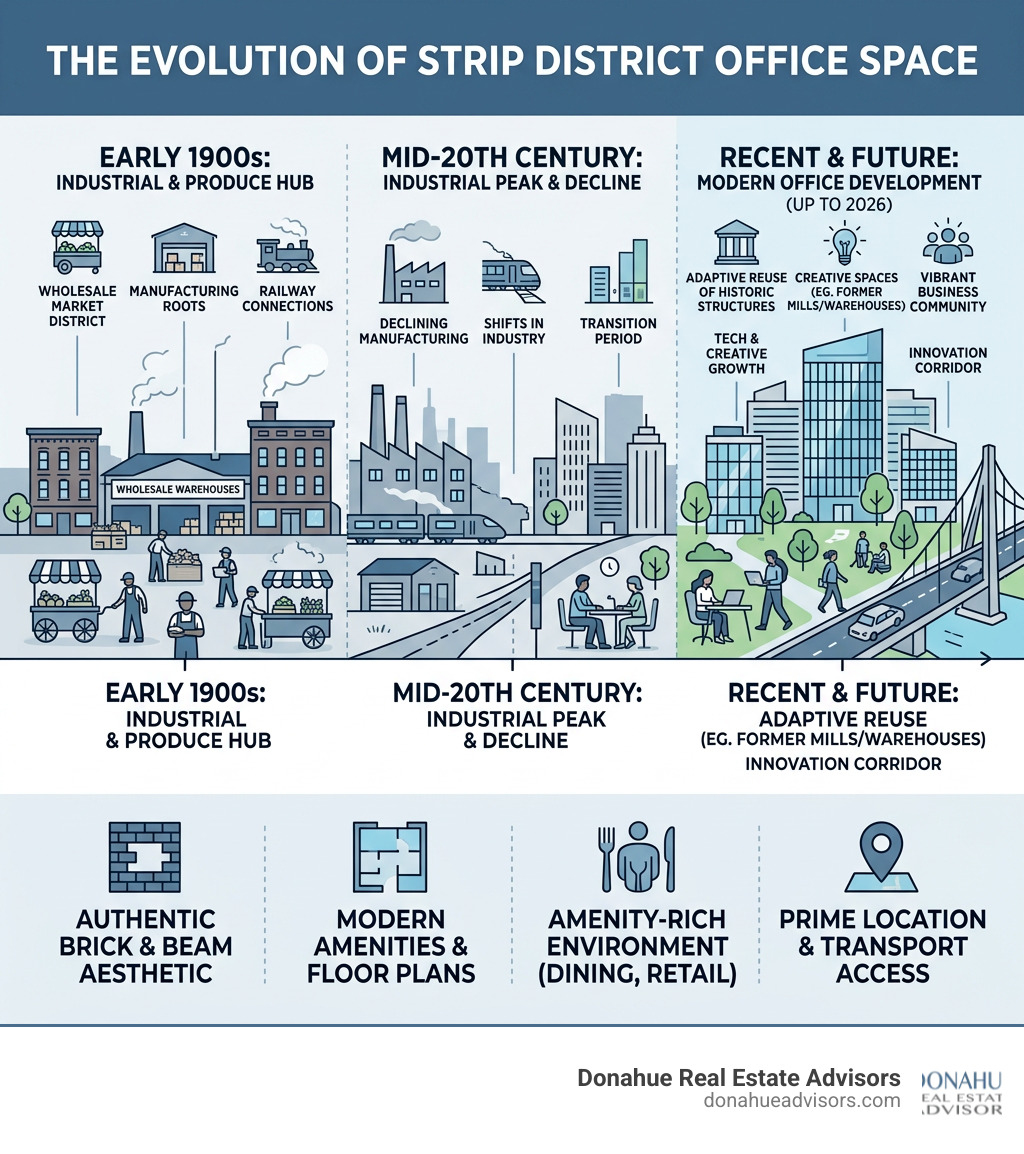
Navigating the Strip District takes a clear view of how the neighborhood has evolved from warehouses and wholesalers into a hub for tech, professional services, and modern mixed-use offices. In the broader Commercial Real Estate Pittsburgh landscape, the Strip District stands out because it offers more than desks and square footage. It gives companies a place with a recognizable brand, energy, and momentum.
As of 2025, the Pittsburgh metropolitan office market contains roughly 85–90 million square feet of office inventory, according to major commercial real estate data providers such as CoStar and CBRE. Within this footprint, the Strip District has become a “hot spot” for companies fleeing the traditional Central Business District (CBD) in search of more vibrant, accessible environments.
The Strip District’s growth has been fueled by a wave of adaptive-reuse projects and large mixed-use developments across the neighborhood, including The Terminal on Smallman Street, the Three Crossings riverfront campus, The Vision on Fifteenth near the Downtown gateway, and modern office buildings like 75 Hopper Place within the Three Crossings development. Together, these projects have transformed the Strip District from a historic produce and warehouse corridor into one of Pittsburgh’s fastest-growing office and innovation districts.
Major Office Developments in the Strip District
The Strip District’s growth has been fueled by a series of large redevelopment projects that have transformed former warehouse and industrial sites into modern mixed-use campuses. Several developments have played a particularly important role in reshaping the office market.
| Development | Approx. Size | Location | Description |
|---|---|---|---|
| The Terminal | 750K+ SF | 2100 Smallman Street | A five-block historic produce terminal redeveloped into retail, office, and public space. |
| Three Crossings | 335K+ SF | Riverfront between 25th–29th Streets | A 20-acre mixed-use campus with office buildings, apartments, retail, and public space. |
| 75 Hopper Place | 250K+ SF | Inside Three Crossings | A modern Class A office building located within the riverfront technology campus. |
| The Vision on Fifteenth | 265K SF | 116 15th Street | A 265,000-square-foot mixed-use office and retail project at the western gateway to the Strip District. |
| 1600 Smallman Street | 140K+ SF | 1600 Smallman Street | Adaptive reuse office building |
Together, these projects have helped transform the Strip District into one of Pittsburgh’s most dynamic office and innovation corridors.
Analyzing Strip District Office Space Inventory
The inventory in the Strip is unique. Unlike the Downtown core, which is heavily weighted toward older Class A towers, the Strip District offers a more balanced—and often more creative—mix.
Data shows that the Pittsburgh office market is currently broken down as follows:
- Class A: 1,110,364 Sq. Ft. (44.13%)
- Class B: 1,331,240 Sq. Ft. (52.91%)
- Class C: 74,353 Sq. Ft. (2.96%)
In the Strip District specifically, Class B dominance is a strength, not a weakness. Many of these buildings are adaptive reuse projects—former warehouses and factories that now house some of the city’s most innovative firms. Furthermore, building sizes in this area are predominantly in the 100,000 to 500,000 square foot range, accounting for over 81% of the market. This scale allows for large, contiguous floor plates that are hard to find in other neighborhoods like Shadyside or East Liberty.
Current Lease Rates and Availability
If you are looking for strip district office space today, you will find roughly 39 active listings on the market. Pricing is varied, reflecting the diverse age and quality of the buildings. According to CoStar 2025 data, lease rates generally fall between $17.00 and $38.75 per square foot per year.
For example, premium modern builds like 75 Hopper Place have seen asking rates around $38.75/SF, while more established or “flex” style spaces can be found closer to the $20/SF mark. It is vital to understand Pittsburgh Vacancy Rates: The Ghost Towns and Hot Spots before signing, as the “hot spots” in the Strip often command a premium due to their proximity to the river and new retail developments.
Prioritize Modern Amenities and Mixed-Use Integration
The days of a “breakroom with a microwave” being considered an amenity are over. In the Strip District, the competition for talent is fierce, and your office space needs to be a tool for recruitment and retention. Modern tenants are looking for Office Space that integrates seamlessly into their employees’ lives.
Standout Features of Strip District Office Space
Newer developments have set a high bar. Take a look at “The Vision on Fifteenth” (116 15th St), a 265,000-square-foot mixed-use project. It isn’t just an office; it’s a “progressive workplace” designed with river and city views, massive glass frontages, and integrated wellness facilities.
Key features we often see in top-tier strip district office space include:
- Parking Ratios: While the Strip is walkable, parking remains a top priority for C-suite executives. Many new builds offer dedicated garage parking, a rarity in older urban pockets.
- Advanced Infrastructure: From 3-phase 400 Amp electrical service to 14-ton HVAC systems, these buildings are designed to support high-density tech users.
- Outdoor Connectivity: Rooftop terraces and balconies overlooking the Allegheny River are becoming standard for Class A builds.
Proximity to Retail and Lifestyle Hubs
One of the biggest mistakes a tenant can make is leasing a “shiny” building that is isolated from the action. The Strip District’s soul lies in Penn Avenue and Smallman Street. Being within a five-minute walk of the historic public market, boutique coffee shops, and world-class dining is a massive benefit for employee morale.
Developments like 2614 Penn Ave | Retail Space for Lease in Pittsburgh’s Strip District highlight the mixed-use nature of the neighborhood. When your office is surrounded by 1.6 million square feet of new retail and residential development, your “office” effectively extends into the entire neighborhood.
Evaluate Adaptive Reuse vs. New Construction
Choosing between a historic loft and a brand-new “glass box” is more than just an aesthetic choice—it impacts your budget, your timeline, and your company culture.
Navigating Strip District Office Space Build-outs
The Historic Loft (Adaptive Reuse): Properties like the “Cigar Factory” at 2740 Smallman (built in 1895) or the massive 1520 Smallman Street offer high ceilings, exposed brick, and a “cool factor” that tech and creative firms crave. However, these often require a more nuanced Tenant Rep strategy. You must account for HVAC capacity and the potential for “shell condition” spaces that require significant tenant improvements (TI).
The New Build: Newer projects like 75 Hopper Place (completed in 2021) offer “plug-and-play” efficiency. These buildings usually feature LEED certification, high-speed fiber, and flexible floorplans that can be easily customized. While the base rent is higher, the efficiency of the space often means you need fewer square feet to accomplish the same goals.
Working with a specialist in Commercial Tenant Representation ensures you aren’t surprised by build-out delays or hidden costs in older industrial conversions.
Leverage Neighborhood Demographics for Talent Recruitment
The Strip District has become a magnet for the “creative class.” If you are a CEO or CFO looking to hire the best in tech, healthcare, or legal services, you want to be where your employees live and play.
The demographics of the Strip are staggering:
- Average Household Income: $133,000
- Education: 87% of residents hold a Bachelor’s Degree or higher
- Home Values: Average home value is approximately $470,000
This is a high-earning, highly educated talent pool. By situating your strip district office space here, you are positioning your firm in an “innovation district” alongside corporate neighbors that range from global tech giants to specialized startups.
Strategic Location and Accessibility
The Strip District is the “connective tissue” of Pittsburgh. It sits perfectly between the Central Business District (CBD) and the East End (Shadyside, East Liberty, Oakland).
- Commuter Access: Easy access to Route 28 and the North Shore.
- Alternative Transit: The neighborhood is a hub for bike trails and is highly walkable, reducing the “commuter dread” often associated with suburban office parks.
Frequently Asked Questions about Strip District Office Space
What are the average lease rates for Class A space in the Strip District?
As of 2025, Class A strip district office space typically commands between $32.00 and $38.75 per square foot, Triple Net (NNN). These rates reflect the premium for new construction, modern amenities, and riverfront views.
How does the Strip District compare to the North Shore or Oakland submarkets?
While Oakland is the heart of “Eds and Meds,” it often suffers from extreme congestion and limited parking. The North Shore offers great stadium views but lacks the 24/7 retail energy of the Strip. The Strip District provides a “middle ground,” offering the corporate prestige of the North Shore with the cultural vibrancy of the East End.
What parking options are available for large corporate tenants?
Newer developments like The Vision on Fifteenth and 75 Hopper Place have integrated parking garages. For older buildings, tenants often utilize surface lots or the “Strip District Hub” garage. When we help clients Schedule a Lease Review, parking ratios and “reserved vs. unreserved” spots are always a primary negotiation point.
Conclusion
The Strip District is no longer just a place to buy produce on a Saturday morning; it is the most exciting office submarket in Western Pennsylvania. With 39 active listings and a healthy mix of Class A and Class B inventory, there is a space for every type of business, provided you know how to navigate the nuances of the market.
At Donahue Real Estate Advisors, we pride ourselves on being a conflict-free partner. We don’t represent landlords, which means our only goal is getting you the best possible deal on your strip district office space. From analyzing CoStar data to managing the “build-out” headaches of an industrial conversion, we handle the strategy so you can focus on growing your business.
For many businesses evaluating office space in Pittsburgh, the Strip District represents the intersection of modern infrastructure, historic character, and long-term growth potential. Whether you are weighing Class A vs Class B Office Space or trying to decide if a river view is worth the premium, we are here to provide an unbiased, data-driven perspective.
>
Ready to secure your spot in the Strip? Schedule a Lease Strategy Session with Donahue Real Estate Advisors Today