

If you run a company with office space in Pittsburgh, you already know real estate is one of your biggest fixed costs. But what many tenants miss is how lease cost creep slowly eats into margins year after year. This silent erosion of capital is a major issue for local businesses.
Lease cost creep shows up quietly. Base rent escalates, operating expenses go up, and before you know it, you are paying well above current market rates for the same space and the same service. It feels inevitable, but it is not.
For tenants in Pittsburgh, that slow grind can mean six or even seven figures of avoidable cost over a lease term. And the toughest part is this often happens without anyone raising a flag inside the organization. You need to identify these leaks before they drain your budget.

What Lease Cost Creep Actually Is
Lease cost creep is the gradual increase in your total occupancy cost over time without a matching increase in value. On paper, it looks reasonable. A three percent annual bump here, an operating expense up there.
In practice, it can leave you paying a premium for space that is no longer competitive with today’s Pittsburgh office market. It often hides in long leases signed in a different economic cycle. These older agreements often favor the landlord heavily.
This shows up not just in rent, but in everything tied to the lease. That includes parking, utilities, building services, management fees, and pass through expenses. The true cost of the space becomes disconnected from its market value.
A Simple Example Of Lease Cost Creep
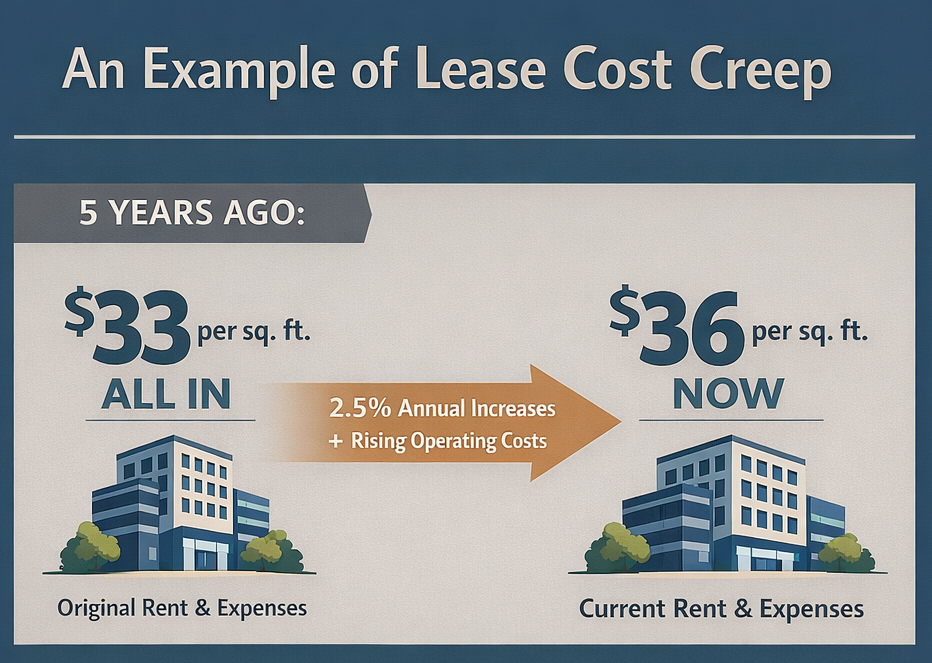
Let’s use a clear example. Say your original rent and operating expenses came to 33 dollars per square foot all in when you signed five years ago. This was a fair rate at the time.
You had two and a half percent annual escalations in base rent and rising building costs pushed operating expenses up. Today, that same space now costs 36 dollars per square foot. The increase happened automatically.
Nothing material changed for you. No new amenities. No big capital improvements. Same four walls, higher cost. That is lease cost creep doing exactly what it does best.
Lessons From The Automotive World
To understand how small fees accumulate, look at your personal finance habits regarding vehicles. When you enter a car leasing arrangement, you scrutinize the monthly payment. You ask the leasing company about the acquisition fee and the disposition fee.
You carefully check the mileage limit to avoid penalties. A lease agreement for a leased car is full of fine print designed to protect the lender. Consumers know that excess mileage on a vehicle lease leads to heavy fees.
Smart drivers worry about tear charges for excessive wear. They ask if the contracts include gap insurance in case of an accident. They want to know the monthly cost upfront without hidden fees.
Business leaders should apply this same scrutiny to office leases. An office lease is just a rental contract with higher stakes than a leased vehicle. You might not face mileage penalties or a mileage cap in an office, but you face operating expense pass-throughs.
With a car lease, you might decide to buy the car outright to avoid mileage restrictions. In commercial real estate, you rarely buy the building. You are stuck with the leasing experience for years.
Just as you compare the cost of a certified pre-owned versus a brand-new model, you must compare your office costs. A newer car often comes with a higher monthly lease payment. Similarly, a new office building commands higher rent, but your old building should not cost the same as a new one.
If you terminate a lease early, you face early termination fees on your office rent. You need to know your lease balance at all times.
Watch out for hidden costs that appear on your statement. In office leases, they are administrative charges and management fees.
Do not let the leasing companies dictate terms without review. Whether you pay a security deposit for a car or an office, you want that money back. Scrutinize the lease paperwork before the lease ends.
Some car leases allow you to pay for an extra mile upfront. Office leases rarely offer this flexibility. You must understand what the fee covers and if fees vary year to year.

How This Connects To Today’s Pittsburgh Market
Across major US markets, corporate occupiers are pushing for lower real estate costs and more flexible terms. Pittsburgh is no different. Sublease space, blended and extended deals, and landlord concessions are all on the table.
Yet many long term tenants here are stuck in leases written during a tighter market. They face steady escalations that now sit above what new tenants are paying for comparable space. In other words, they are funding the building more than they need to.
You might have neighbors on a newer lease enjoying a lower effective rent. Meanwhile, your team quietly swallows increases that were baked in years ago. This disparity creates a competitive disadvantage.
Base Rent vs Total Lease Cost
Most executives focus on base rent, but what really matters is total lease cost. Your accounting team sees this as the full occupancy expense that hits the P and L each year. This is the number that impacts your bottom line.
Total lease cost includes rent, operating expenses, real estate taxes, parking, after hours HVAC, and any other recurring items tied to the lease. Some large enterprises even track this on a per seat or per headcount basis. Breaking costs down this way reveals the true financial burden.
To get a sense of impact, think about how a few dollars per square foot roll up at your scale. The numbers add up quickly once you cross 20,000 square feet. Small changes in rate equal large changes in cash flow.
| Space Size | Old All In Cost | New All In Cost | Annual Difference |
|---|---|---|---|
| 20,000 SF | $33/SF | $36/SF | $60,000 |
| 40,000 SF | $33/SF | $36/SF | $120,000 |
| 80,000 SF | $33/SF | $36/SF | $240,000 |
The chart above illustrates the danger. Monthly payments for office space can balloon unexpectedly. Just as monthly lease rates for cars have risen, office costs follow a similar trend.
What Operating Expenses Are Supposed To Cover
To really understand lease cost creep, you have to look hard at operating expenses, or OpEx. These costs are meant to cover the day to day costs of running the building. They should be transparent and verifiable.
Typical operating expenses include:
- Utilities like electric, gas, and water
- Common area cleaning and janitorial
- Security, maintenance, and repairs
- Building management fees
- Insurance coverage and real estate taxes
These categories make sense. A healthy building needs this spend. The issue is what gets swept into these lines and how quickly they grow over time.
Where Landlords Quietly Push Costs Through
Most landlords are not trying to trick anyone. But they will use the lease to protect their returns. If the lease allows them to recover certain expenses, they will usually do it.
Common problem areas include capital expenses that should be amortized and landlord overhead that has nothing to do with your building. Sometimes administrative fees are charged as a percent of gross revenue rather than actual cost. This creates a profit center for the landlord.
This shows up as bigger year end reconciliations and faster than expected OpEx growth. You might see line items that feel more like ownership expenses than shared building costs. Additional fees often appear without warning.
Questions You Should Ask About OpEx
If you want to put some pressure on lease cost creep, your first move is asking sharper questions about operating expenses. A quick set of items usually exposes issues. You need to contact customer support or your property manager directly.
- What was the per square foot operating expense five years ago versus now?
- Which costs grew the fastest and why?
- Are any landlord capital projects being passed through that should sit with ownership?
- How are administrative fee structures calculated?
- Is the landlord benchmarking these costs against other Pittsburgh assets?
You do not have to become an engineer or property manager to ask these questions. You just have to push past the surface line item labels and ask what sits underneath. Demand to see the fee structures in detail.

What You Can Negotiate To Slow Lease Cost Creep
Most tenants are surprised by how many levers they actually have. It is not just about chasing a lower base rent, although that matters too. You can improve your position significantly.
There are several points that can protect your budget through the full lease term, not just the first year. These include OpEx caps, audit rights, and much cleaner definitions of what can be charged back. Fees upfront should be clearly defined.
Key Items To Target In Your Lease
- Annual rent escalations instead of flat three percent with no context.
- Operating expense caps on controllable costs, such as five percent year over year.
- Clear separation of capital expenditures versus operating items.
- Exclusions for landlord overhead that is not tied to your building.
- Audit rights to review backup invoices for major expense jumps.
Across industries, better control over lease cost is a big theme. In one technology setting, an IBM note around lease cost touches on how cost approvals can move out of line when controls lag behind. Different context, same pattern. Unchecked commitments lead to higher spend.
How Automation Increases Exposure To Lease Cost Creep
Office landlords and large occupiers are investing heavily in technology to process more volume. Automated payments and pre-programmed escalations mean dollars move without a fresh set of eyes each year. Automation breeds complacency.
That’s convenient, but also dangerous if no one pauses to compare those automated bumps against real market conditions in Pittsburgh right now. You need human oversight on these numbers.
Why January Is a Great Month To Review Your Lease
You might be wondering why timing matters. You can audit a lease anytime, but you have a good shot in January to get real traction.
Your team is setting budgets, updating forecasts, and locking in headcount plans for the year. You are likely already revisiting big expense categories, which makes occupancy a natural fit for that list. It is a time of financial reset.
January is also before renewal pressure hits on leases expiring later that year. If you wait until 6 months or less before expiration, your options shrink fast. Lease cost creep gains power when you are out of time.
What A January Lease Review Should Cover
A good January review does more than check a box. It should leave you with a clean, current picture of how your lease compares to real market data. This is your annual health check.
- Current effective rent vs comparable buildings in your submarket.
- Operating expense history and how it stacks up to similar assets.
- Remaining term, renewal options, and notice deadlines.
- Flexibility for expansion, contraction, or relocation.
- Alignment with your hiring and space plans over the next three to five years.
Think of it the way you would think about your technology stack or insurance program. Once a year, you step back and make sure the arrangement still fits your size and risk tolerance. Agreement fees should be re-evaluated.
How Pittsburgh Tenants Get Stuck Above Market
Most C-level teams do not sit in the weeds on rent bills. You should not have to. But that distance is exactly how lease cost creep wins.
A typical pattern in Pittsburgh looks like this. The company signs a seven or ten year lease during a stronger market. Base rent escalates two to three percent each year.
During that term, new buildings come online, sublease space grows, and hybrid work trims footprints. By year six, your effective rate can be well above what new deals are trading at in similar space, so you’re overpaying significantly.

The Risk Of Letting The Market Move Without You
On the consumer side, people shopping for new phones see constant coverage around every lease cost and upgrade. Pricing moves quickly, but at least it’s visible. Commercial real estate is much more opaque.
Office space does not show up in your social feeds in the same way. Deals are quiet, custom, and wrapped in legal language that takes time to sort through. It is hard to know if you are winning or losing.
Without fresh comps, many tenants never realize they have slipped above market. They treat the rent schedule as a fixed cost of doing business. It should be treated as a live financial decision.
Warning Signs Lease Cost Creep Is Hitting Your P&L
If you’re not sure whether this is happening to you, there are a few clear signals to look for. These usually show up long before someone inside the business starts to complain. Watch for these red flags.
- Your effective rent today is more than ten percent higher than at lease start.
- Operating expense reconciliations keep increasing faster than inflation.
- Your finance team cannot explain certain OpEx line items in plain language.
- You see neighbors marketing sublease space in the same building or area.
- Other cost centers are taking cuts while real estate costs just roll forward.
If two or more of these are true, there is a good chance lease cost creep is in play. At that point, the right next step is not to panic, but to benchmark. Get the data you need.
Just as you would address minor issues with a car leasing contract before they become big problems, address these signs now. Do not wait for a final thoughts meeting to raise concerns. Proactive management saves money.
What A Market Positioning Report Does For You
For Pittsburgh tenants, a real market positioning report is one of the fastest ways to bring clarity. This is more than just a broker opinion of value. It is a strategic tool.
You want to see your current deal mapped against real, current transactions in your size range, asset class, and submarket. You want an honest view of where you sit on rent, OpEx, concessions, and flexibility. This data empowers your team.
A strong report helps your C-suite answer a simple question. Are we paying the right price for the right amount of space at the right building for how we operate today? If the answer is no, you must act.
How That Data Turns Into Leverage
Once you know where you stand, you can pick a strategy. Sometimes that is as simple as asking for a blend and extend to flatten rent. You can lock in better OpEx caps or add rights you were missing.
Other times, it is about preparing for a larger move at lease expiration. You might need to right size your footprint to match a hybrid model. The important part is you make those moves with real numbers instead of guesswork.
That’s the difference between living with lease cost creep and putting a fence around it. Leases include many negotiable terms if you have the leverage, so use market data to build your case.
Consider the acquisition fees of moving versus staying; office leasing involves analyzing construction and relocation costs. Every dollar counts in this calculation.
Conclusion
Lease cost creep is not dramatic. It does not hit like a sudden crisis. It just keeps moving quietly in the background until someone finally asks why occupancy has crept so high.
If you are leading a Pittsburgh company, you don’t have to accept that slow squeeze as a given. A careful January review and a real market positioning report can show whether your current lease is a strategic asset or a silent drag on performance. You must stay vigilant.
Take the time to compare your actual terms against live market averages, your growth plans, and the real value your space gives your team. Catching lease cost creep early can free real dollars for hiring, innovation, and the parts of your business that move the needle most. Final thoughts should focus on action and future savings.
