

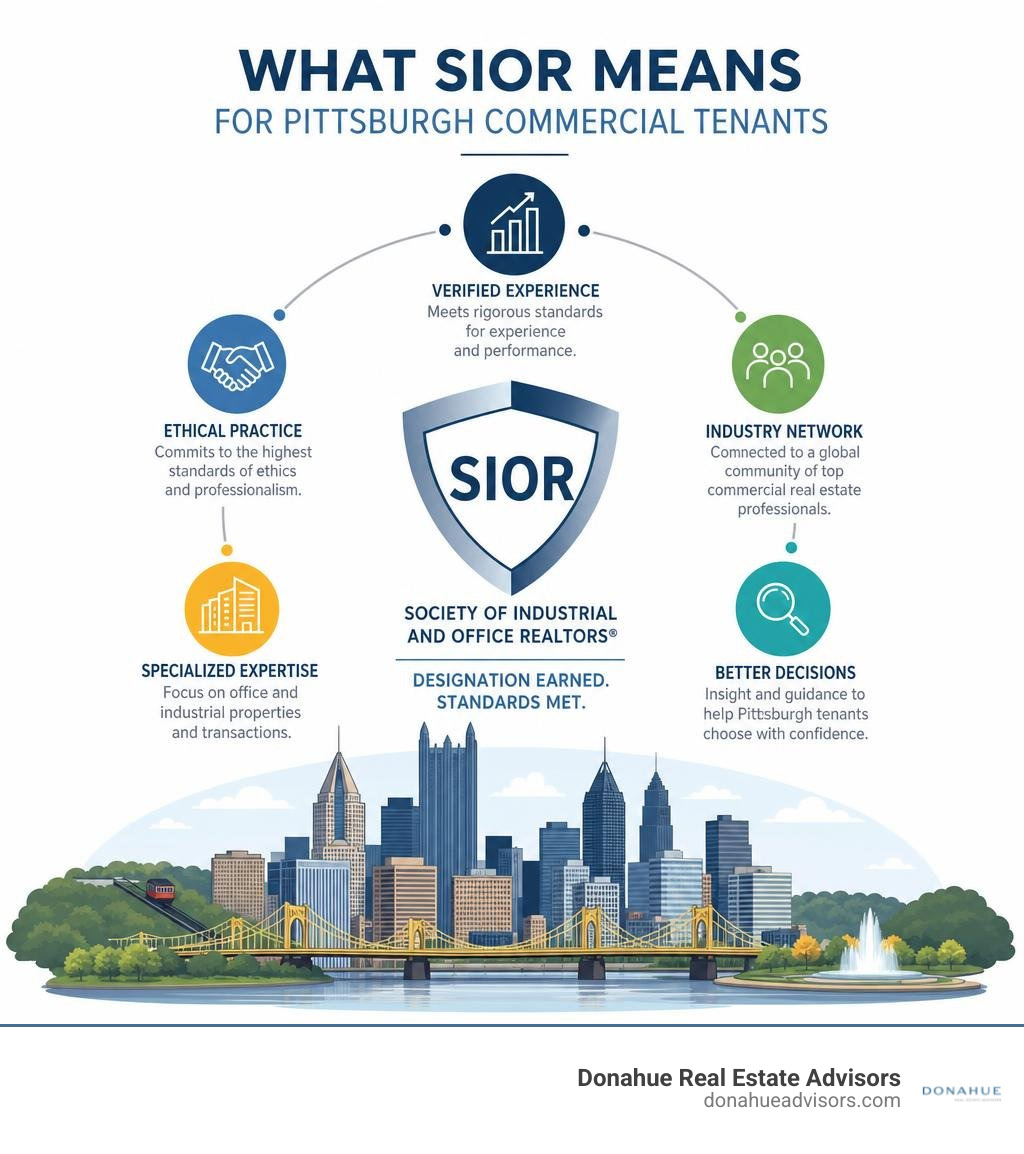
What does SIOR mean? SIOR means that a commercial real estate professional has earned the Society of Industrial and Office REALTORS(R) designation. SIOR is a professional affiliate of the National Association of REALTORS(R) and recognizes commercial specialists who meet standards for experience, production, and ethics.
For a Pittsburgh business deciding whether to renew a lease or move, the letters after a broker’s name are not the whole decision. But they can signal verified experience in office and industrial transactions, which matters when comparing options in the East End, Oakland, the Strip District, North Shore, Southside, Shadyside, or East Liberty.
Donahue Real Estate Advisors’ experience representing tenants, along with its commercial property expertise in Pittsburgh, shapes how the firm explains what SIOR means for business tenants. That background provides a foundation for understanding the practical value of choosing tenant-focused representation for a renewal or relocation decision.
Partner with Expert Tenant Representation: Why Credentials Matter for Pittsburgh Businesses

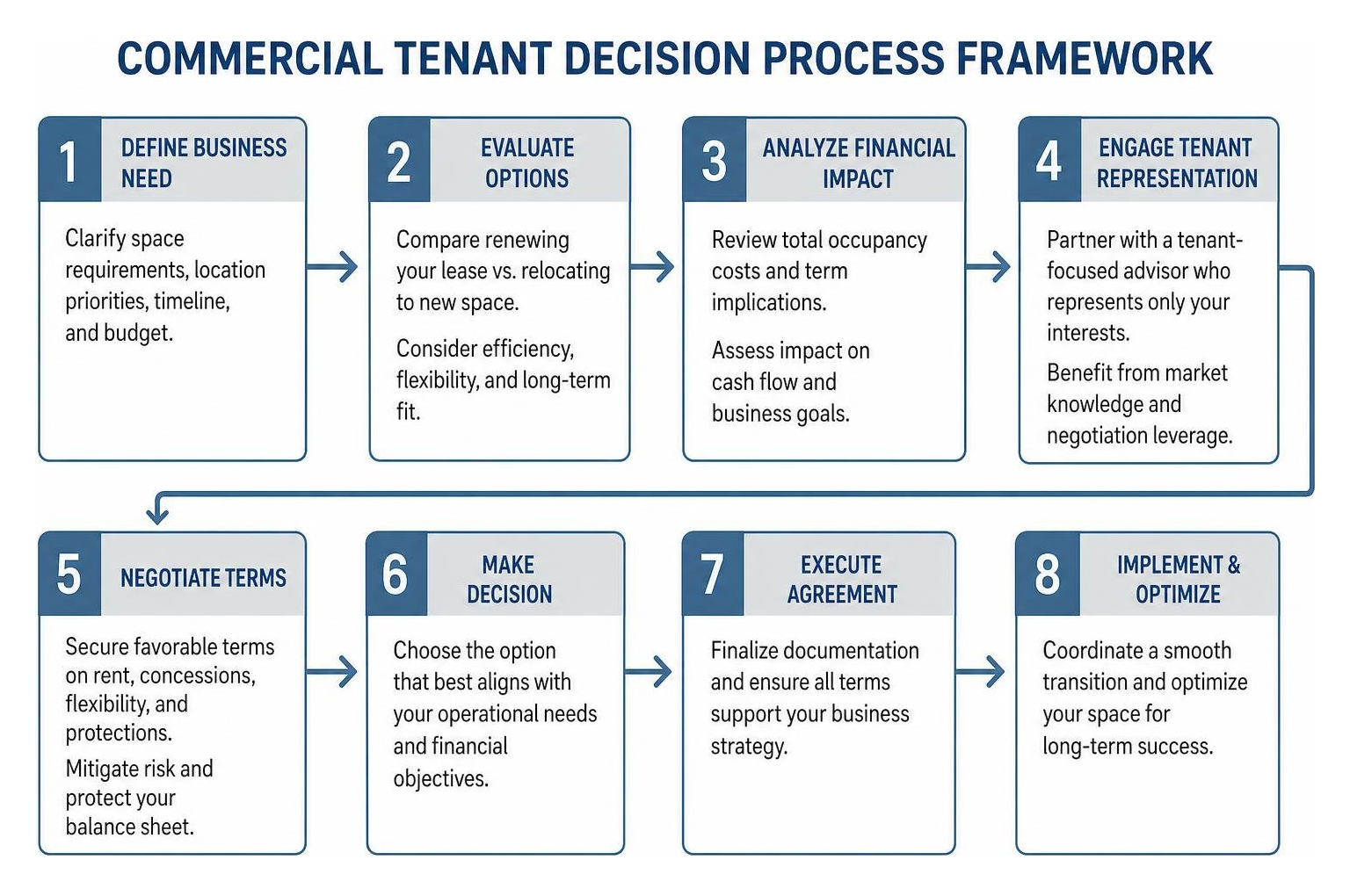
When running a company in Western Pennsylvania, commercial space is often your second-largest operational expense behind payroll. Whether you operate a technology firm in the Strip District, an engineering consultancy in Oakland, or a healthcare practice in Shadyside, choosing between renewing an existing lease and relocating to a new property carries substantial financial weight.
Most commercial real estate firms practice dual agency. They represent landlords who want to maximize rent roll value while simultaneously pitching services to corporate tenants looking to cut overhead. This built-in conflict leaves business tenants vulnerable. At Donahue Real Estate Advisors, we focus on tenant-first representation, ensuring our fiduciary duty remains aligned with your balance sheet.
When organizations face complex timeline shifts, seasoned representation protects capital. In our work guiding clients through structuring long-term commercial leases, we helped an expanding professional firm secure customized terms across multi-year phases while avoiding unnecessary occupancy expenses during buildout delays. That level of protection requires deep market understanding, which industry credentials verify.
What SIOR Means in Commercial Real Estate
To understand what SIOR means, it helps to look at the organization’s background. Founded in 1940, the Society of Industrial and Office Realtors is an elite professional affiliate of the National Association of Realtors (NAR). For over 80 years, the organization has established strict benchmarks for transaction volume, market tenure, and professional ethics.
Unlike general real estate licenses that require only passing a state exam, the SIOR designation is earned by invitation and audit. Today, the network includes roughly 4,000 members across 50 countries. When an advisor holds this credential, it signifies that an independent global governing body has audited their career production, confirmed their local market specialization, and verified their professional standing. You can review the organization’s background on the SIOR global standards and organizational history page.
What SIOR Means for Professional Qualification Standards
Earning the designation is intentionally difficult. A broker cannot simply pay a fee or take an online weekend seminar to obtain it.
To qualify, an applicant must fulfill stringent criteria:
- Five-Year Minimum Experience: Brokers must have at least five consecutive years of active, full-time commercial real estate brokerage experience.
- Audited Production Volume: Applicants must meet or exceed localized Gross Fee Income (GFI) thresholds for at least three of the trailing four 12-month periods. GFI figures reflect actual fees earned by the broker’s firm before splits, verified by a certified CPA or managing broker under penalty of perjury.
- 70 Percent Asset Specialization: At least 70 percent of qualifying production volume must stem directly from industrial and office transactions.
- Formal Peer Endorsements: Every applicant must secure written endorsements from active SIOR members within their local chapter, verifying their reputation and deal integrity.
- Mandatory Ethics Coursework: Candidates must pass comprehensive real estate ethics examinations and commit to ongoing professional conduct reviews.
What SIOR Means Across the Six Specialist Categories

The designation adapts to specific industry roles through six specialist tracks:
- Industrial Specialist: Focuses on logistics hubs, manufacturing plants, flex facilities, and warehouse distribution centers.
- Office Specialist: Concentrates on corporate headquarters, multi-tenant commercial office buildings, medical offices, and technology suites.
- Dual Specialist (Industrial & Office): Achieved by professionals who maintain qualifying transaction volume in both asset classes.
- Advisory Services Specialist: Granted to strategic consultants providing tenant representation, portfolio analysis, and corporate real estate strategy.
- Sales Management Specialist: Designed for leaders directing at least 10 active commercial real estate agents.
- Executive Management Specialist: Tailored for corporate leaders managing at least 100 commercial agents across three or more regional offices.
For tenants, partnering with an Office or Advisory Specialist ensures your broker knows the nuances of base years, operating expense escalations, and space efficiency metrics.
Critical Lease Traps: Free Rent Timing and Holdover Rent Risks
Commercial lease negotiations involve complex legal terms that create financial exposure if mismanaged. When companies manage lease renewals or relocations without specialist guidance, they often encounter two costly timing pitfalls:
1. The Structure and Timing of Free Rent Concessions
Landlords frequently offer “free rent” as an incentive to sign. However, the structure of that concession matters.
- Gross Free Rent vs. Net Free Rent: Many tenants believe free rent means zero occupancy cost. In most standard leases, landlords abate only the base rent, leaving the tenant responsible for operating expenses, real estate taxes, and insurance (CAM fees) from day one.
- Consecutive vs. Spread Abatement: A landlord may offer five months of rent abatement spread across a five-year term (e.g., month 1 of every year) rather than upfront. This structure limits tenant cash flow when capital is needed most during space setup and move-in.
2. The Holdover Rent Penalty Trap
When a company decides to relocate late in their current lease term, construction delays or permit bottlenecks can push move-in dates past the lease expiration.
- Remaining in your existing space without an executed extension triggers the lease’s holdover provision.
- Standard Pittsburgh commercial leases typically penalize holdover tenants at 150 percent to 200 percent of their final month’s gross rent.
- In addition to rate spikes, landlords may hold the outgoing tenant liable for damages if a successor tenant cancels their lease due to the delay.
Starting your lease assessment 12 to 18 months before expiration prevents these costly risks.
SIOR vs. CCIM: Understanding the Difference for Commercial Tenants
Tenants frequently encounter two major commercial designations: SIOR and CCIM (Certified Commercial Investment Member). Both credentials indicate professional capability, but they serve different purposes.
| Feature / Metric | SIOR Designation | CCIM Designation |
|---|---|---|
| Primary Meaning | Society of Industrial and Office Realtors | Certified Commercial Investment Member |
| Core Focus | High-volume transaction brokerage and corporate tenant advisory | Advanced financial, tax, and investment modeling |
| Qualification Basis | Multi-year audited fee volume, 5+ years experience, peer endorsements | Comprehensive 4-course curriculum, portfolio submission, comprehensive exam |
| Target Asset Classes | Exclusively Office and Industrial real estate | All commercial assets (Retail, Multi-Family, Land, Office, Industrial) |
| Typical Client Profile | Corporate tenants, industrial operators, regional business occupiers | Real estate investors, REITs, private equity, property developers |
| Best Used For | Lease negotiations, workplace relocation, tenant advocacy, occupancy cost control | Capital rate analysis, internal rate of return modeling, asset acquisitions |
While a CCIM certification demonstrates strong underwriting skills, an SIOR designation certifies that your broker actively negotiates office and industrial transactions in the local market every week.
Evaluating Lease Renewal vs. Relocation Across Pittsburgh Submarkets
Pittsburgh offers distinct commercial districts, each presenting specific cost dynamics and lease terms. Submarket conditions vary widely across the region.
When evaluating whether to renew in your current building or relocate to a new submarket, maintaining flexibility is essential. In our client work managing temporary space transition strategies, we helped a growing organization bridge operational timelines by negotiating short-term bridge terms while their primary space was finalized. This approach insulated their business from operational disruptions and eliminated holdover penalties.
Frequently Asked Questions About What SIOR Means
What is the difference between an SIOR broker and a standard commercial real estate agent?
A standard commercial real estate agent holds a state sales license, which requires passing an entry exam but mandates no minimum transaction volume or asset specialization. An SIOR broker has completed at least five years of active brokerage, passed financial production audits, specialized in office or industrial real estate, and secured peer endorsements confirming their ethical standard.
How difficult is it to earn the SIOR designation?
Earning the SIOR designation is demanding. Fewer than 4,000 professionals worldwide hold the title. Candidates must document multiple years of production meeting strict local income thresholds, have their fee records verified by an independent CPA or managing broker, pass an ethics review, and receive formal approval from local chapter members.
How does an SIOR-designated advisor help Pittsburgh tenants during lease negotiations?
An SIOR-designated advisor provides verifiable market data, understands current concession packages across Pittsburgh submarkets, and knows how to structure lease terms that eliminate unexpected operating expense pass-throughs. Most importantly, an advisor practicing tenant-only representation uses this expertise to negotiate lower base rents, higher tenant improvement packages, and favorable renewal options without landlord conflicts.
Conclusion
Deciding whether to renew your current commercial lease or relocate your business requires careful market analysis. Understanding what SIOR means helps you identify an advisor with verified transaction volume, deep market knowledge, and an audited ethical record.
At Donahue Real Estate Advisors, we provide conflict-free tenant advocacy across the Pittsburgh region. We protect your operational goals, prevent expensive lease traps, and negotiate lease structures that serve your business over the long term.
If your lease expires within the next 12 to 24 months, contact our team today for a confidential lease strategy session.