

Six Months Left on a Commercial Lease? Act Now to Protect Your Options
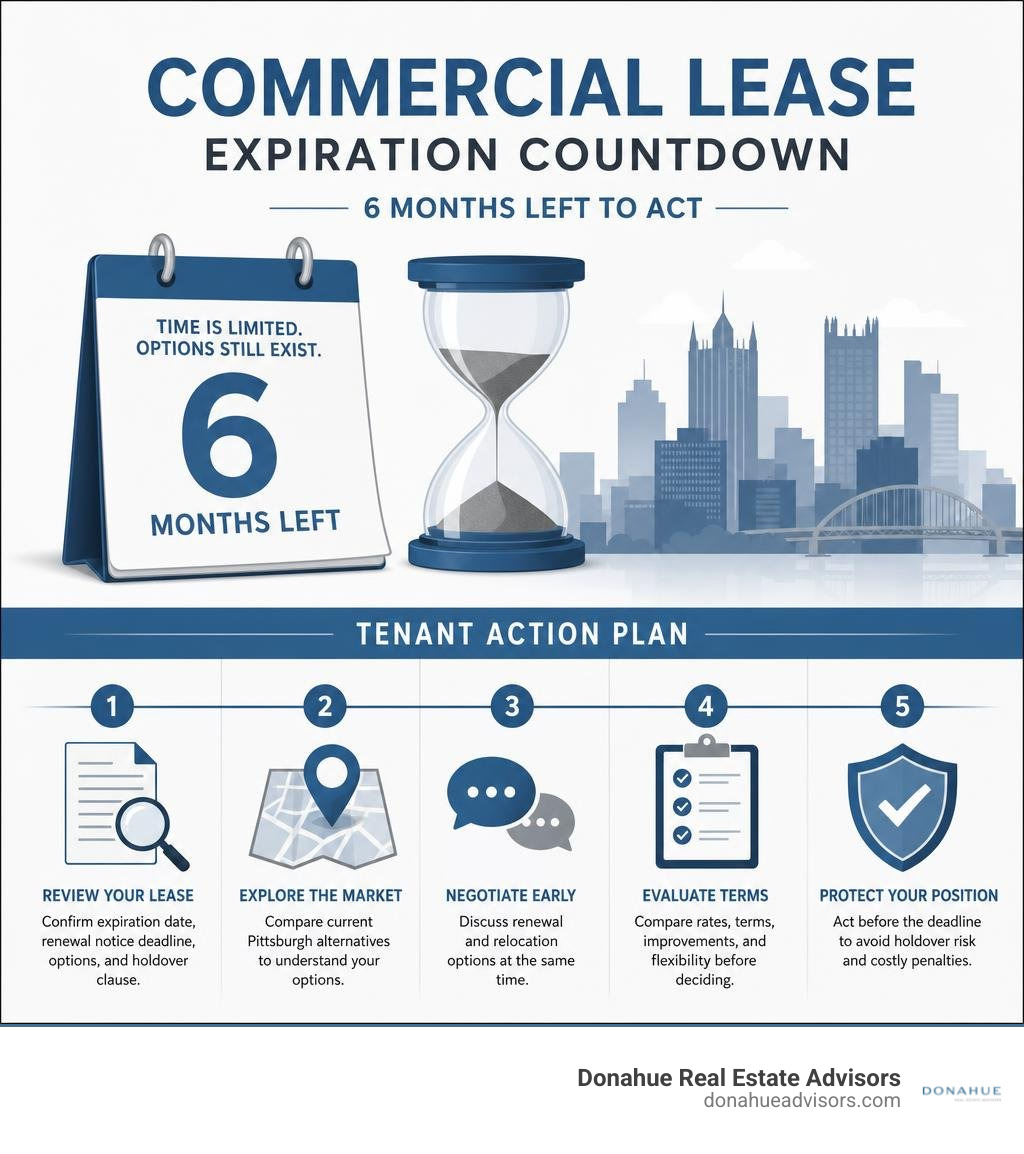
If you are asking What Happens If You Only Have 6 Months Left on Your Lease, the short answer is this: your time to negotiate is tight, but you can still improve your outcome if you act immediately. Review your lease for its expiration date, renewal-notice deadline, options, and holdover clause; compare current Pittsburgh alternatives; and negotiate renewal and relocation options at the same time.
Many commercial leases charge increased rent when a tenant remains after the term ends without a new agreement. Your actual exposure depends on the lease language, so do not assume a renewal discussion protects you from holdover risk. Holdover tenancy rules and remedies can vary, but the contract is usually the first place to look.
A landlord may present a quick renewal as the simplest path. It may be, but signing without a market comparison can mean accepting terms when you have the least leverage. A fast lease audit and parallel search can create options in Pittsburgh’s East End, Oakland, North Shore, Southside, Strip District, Shadyside, or East Liberty before the deadline closes.
With decades of experience representing tenants in commercial real estate, Donahue Real Estate Advisors helps Pittsburgh businesses understand What Happens If You Only Have 6 Months Left on Your Lease and take practical steps to protect occupancy, costs, and negotiating leverage.
Partner with Expert Tenant Representation to Reclaim Leverage
When a commercial lease enters its final six months, the balance of negotiating leverage tilts heavily toward the property owner. Entering this critical window without an advisor leaves your business vulnerable to inflated rates, minimal improvement allowances, and restrictive terms. At Donahue Real Estate Advisors, we exclusively represent commercial tenants across Pittsburgh. Because we never represent landlords, our advisory is completely free from institutional conflicts of interest.
Why Tenant Advocacy Matters in the Final Six Months
Landlord brokers are contractually bound to maximize the building owner’s net effective rent and asset valuation. When a tenant negotiates directly with a landlord’s listing agent, the tenant operates at an immediate information disadvantage. Landlord leasing teams track building occupancy patterns and tenant capital expenditures every day, knowing precisely how expensive and disruptive moving is for your company.
Partnering with an exclusive tenant rep restores institutional parity. We analyze real-time transaction data across Pittsburgh submarkets to uncover concessions that landlords routinely hide from unrepresented tenants. Our advisory fees are standardly paid via the landlord’s pre-allocated leasing commissions, meaning your business gains dedicated market advocacy without adding out-of-pocket overhead to your balance sheet.
How Tenant Reps Defend What Happens If You Only Have 6 Months Left on Your Lease
When time is compressed, our team deploys rapid-response leasing playbooks designed to halt landlord leverage escalation. We benchmark asking rates against active market comps, run financial models on total occupancy costs, and evaluate early lease termination legal parameters alongside bridge extension mechanisms.
Our approach is proven through real-world execution. In our Nelson Mullins temporary space case study, we rapidly secured flexible interim space to maintain full operational continuity during an urgent real estate transition. We followed this with our Nelson Mullins long-term space case study, establishing a structured, long-term commercial lease tailored to our client’s growth requirements. By creating credible alternatives, we establish the competitive tension required to secure tenant-favorable terms even under severe time constraints.
Understanding What Happens If You Only Have 6 Months Left on Your Lease
The final six months of a lease agreement represent the danger zone for commercial tenants. Understanding the operational and legal shifts occurring during this period is essential to avoid costly missteps.

Individual submarkets such as the Strip District and Oakland command tighter availabilities and premium rates for prime spaces. When building owners know you lack the time to execute a complex move, they leverage your timing constraints to quote rates well above actual submarket clearing levels.
At this point, your leverage is already gone. Landlords know a relocation search, buildout, and move don’t fit in six months, so renewal talks shift from negotiation to acceptance of whatever terms are offered.
The tenants who avoid this position start the conversation 18 to 24 months out, while renewal, relocation, sublease, and expansion are all still on the table.
The Critical Pressures of Timeline Asymmetry and Silent Renewal Clauses
Timeline asymmetry is the most significant structural disadvantage facing late-stage tenants. Institutional landlords manage lease expirations on multi-year tracking schedules, planning for your renewal date twelve to eighteen months in advance. In contrast, corporate leadership often delays lease discussions until six months remain, creating a severe operational gap.
Many standard commercial contracts include strict notice windows, frequently requiring written notice between six to nine months prior to expiration. If you miss this window, you risk forfeiting contractual renewal options or tripping automatic evergreen clauses. Reviewing The Ultimate Guide to Key Commercial Lease Dates will help you identify how missed notice milestones immediately transfer negotiating leverage to the building owner.
Holdover Penalties and the Costly Quick-Renewal Push
As the expiration date approaches, building owners often present a quick renewal agreement framed as a simple, low-stress extension. These proposals rarely include competitive tenant improvement allowances, modern base-year resets, or standard rent abatements.
Landlords understand that the alternative for an unprepared business is holdover tenancy. Commercial holdover penalty clauses in the Pennsylvania market typically escalate base rent to 150% or 200% of the concluding rate. Landlords use this penalty structure as leverage, pushing tenants to execute an uncompetitive renewal to avoid substantial month-to-month penalty charges.
Two common client mistakes at this stage involve misjudging free rent timing and underestimating holdover rent liabilities. Many tenants assume free rent concessions apply automatically at renewal, but landlords rarely offer upfront abatement without competitive relocation pressure. Additionally, tenants often mistakenly believe ongoing verbal renewal talks legally stay holdover penalties, leaving them exposed to retroactive penalty billings if negotiations stall past the expiration date.
The Tenant Rep Action Plan for Fast-Approaching Expirations
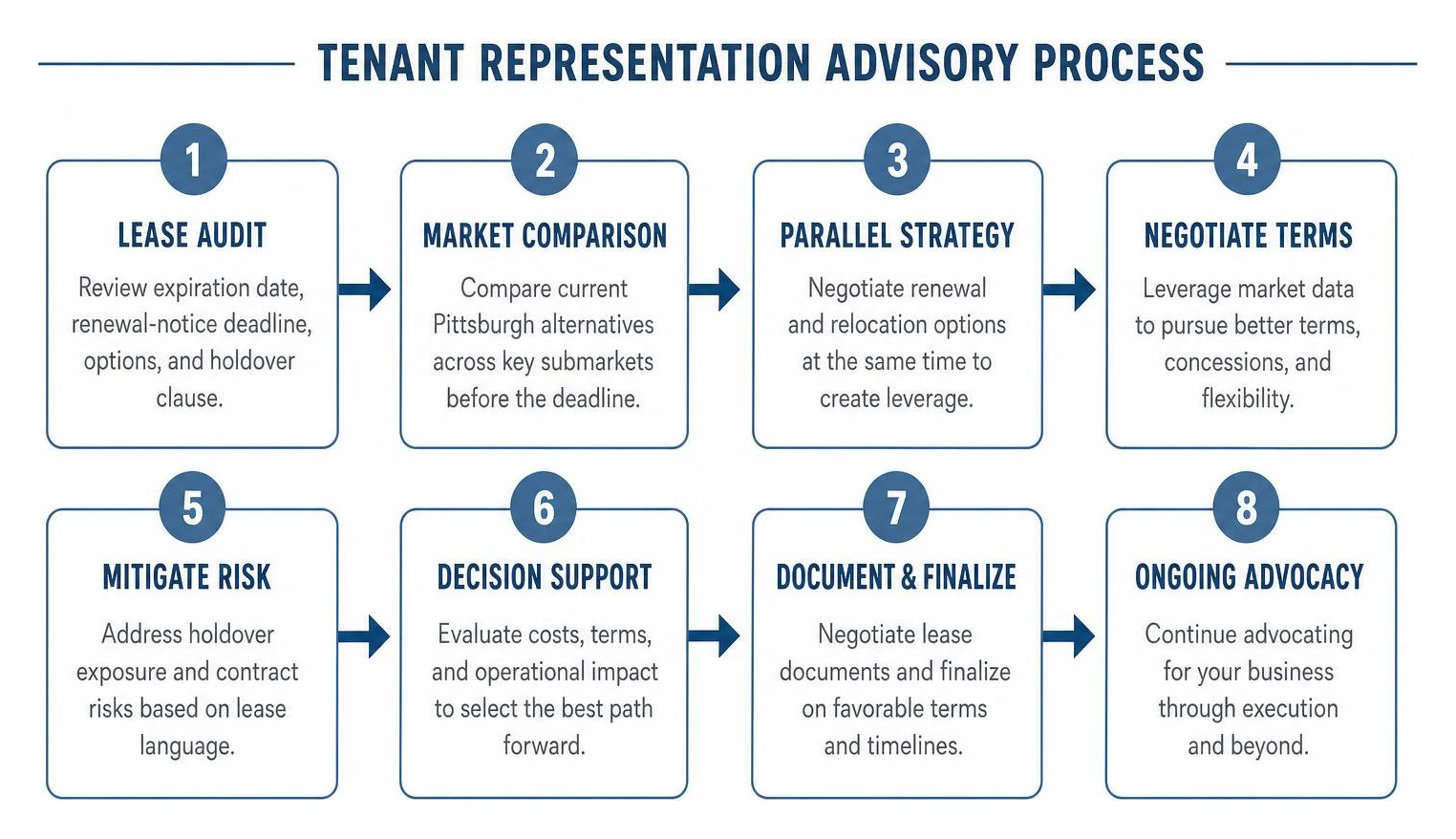
Regaining footing with six months remaining requires a disciplined, structured methodology. We implement a recovery roadmap designed to stabilize the tenant’s negotiating position.
Step 1: Partner with Expert Tenant Representation
Securing dedicated tenant advocacy is the critical first step. Engaging an exclusive tenant representative levels the playing field against landlord brokers, protects your negotiating leverage, and ensures every renewal or relocation strategy across Pittsburgh is backed by real-time market data.
Step 2: Conducting an Immediate Commercial Lease Audit
The recovery process continues with an exhaustive forensic audit of the existing occupancy contract. Our team assesses:
- Expiration dates and specific contractual notice mechanisms
- Holdover rate multipliers and damages liability clauses
- Existing renewal, expansion, or contraction options
- Space restoration obligations and surrender conditions
- Unreturned security deposits, letters of credit, and escrow accounts
Step 3: Running Parallel Tracks for Pittsburgh Renewals and Relocations
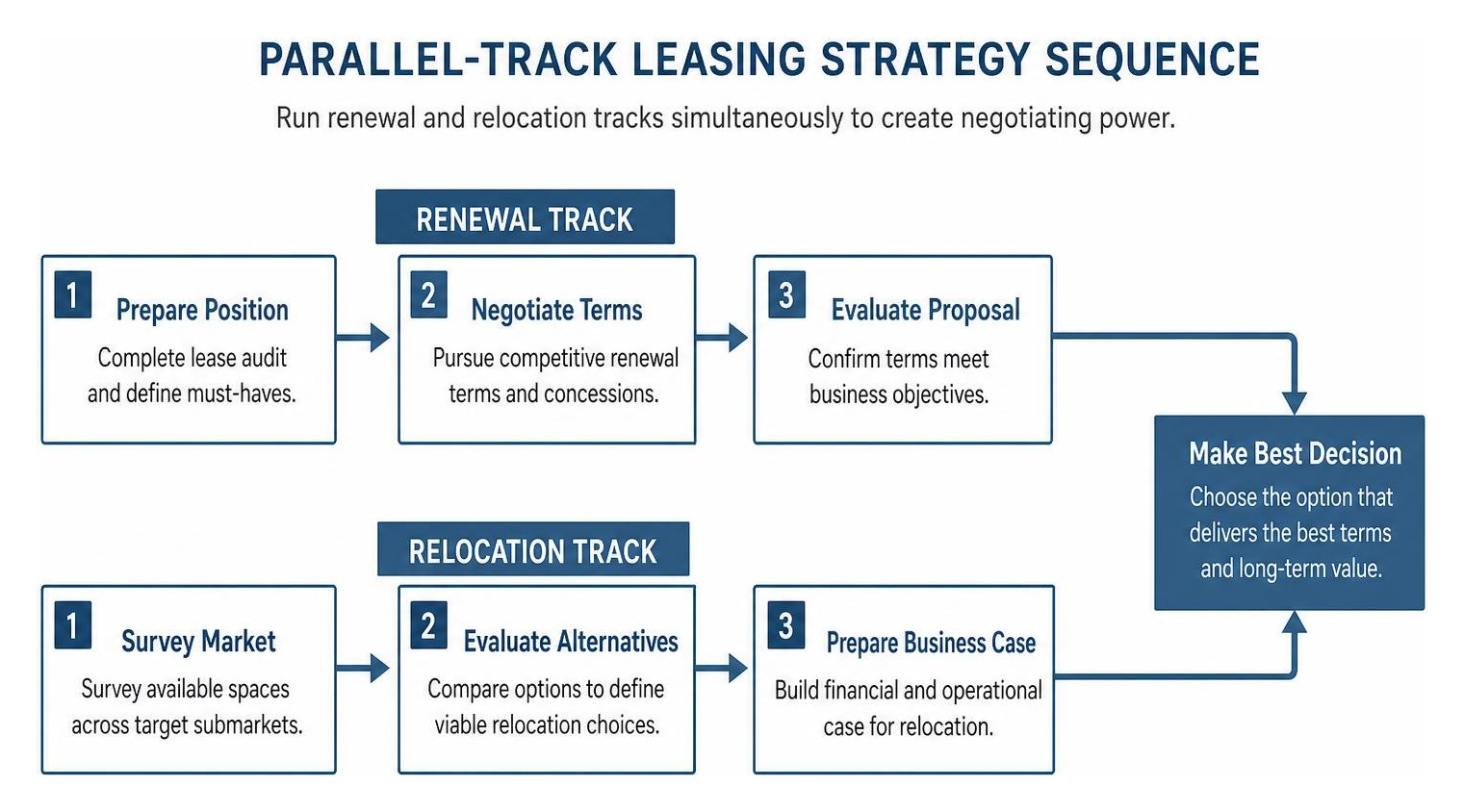
The only way to create true negotiating power is to develop viable outside alternatives. We run simultaneous renewal and relocation tracks, surveying spaces across the Pittsburgh region.
Evaluating outside availabilities shows the current landlord that your business is prepared to relocate if acceptable renewal terms are not met. When you know how to renegotiate a commercial lease the right way, your team can align renewal negotiations with our step-by-step guide to office relocation timeline to benchmark proposals against actual market alternatives.
Strategic Options for What Happens If You Only Have 6 Months Left on Your Lease
If full-scale custom construction is unachievable within a compressed six-month timeframe, several tactical paths remain viable:
- Short-Term Bridge Extensions: Negotiating a formal six- to twelve-month lease amendment at standard rental rates to allow adequate time for a thorough market search.
- Turnkey Move-In Options: Identifying move-in ready spec suites or plug-and-play spaces requiring minimal physical alterations.
- Sublease Acquisitions: Sourcing deeply discounted sublease spaces, as outlined in The Scavenger’s Guide to Affordable Office Leases, which feature existing furniture and infrastructure.
- Flexible Hybrid Environments: Utilizing bridge options such as office vs coworking space to preserve capital and operational flexibility while finalizing long-term arrangements.
Comparing the Six-Month Crunch to a Proactive Timeline
The table below illustrates the stark operational differences between entering negotiations with six months remaining versus executing an optimal eighteen-month strategy:
| Planning Dimension | 6-Month Reactive Window | 18-Month Proactive Strategy |
|---|---|---|
| Negotiating Leverage | Minimal; building owner holds timeline advantage | Maximum; full competitive tension across multiple landlords |
| Market Options | Restricted to turnkey spaces and simple renewals | Accessible across all new developments, spec suites, and custom builds |
| Tenant Improvements | Limited or unfeasible due to construction lead times | Fully customized architecture funded by competitive landlord allowances |
| Holdover Exposure | High risk of triggering 150% to 200% penalty rates | Zero risk; seamless move transition before lease expiration |
| Financial Concessions | Minimal rent abatement or base-year updates | Optimized free rent packages and modernized operating cost structures |
Frequently Asked Questions About Commercial Lease Expirations
Can a landlord enforce holdover penalties if lease negotiations are actively ongoing?
Yes. Unless both parties execute a legally binding standstill agreement or written lease amendment extending the expiration date, a building owner retains the legal right to enforce contractual holdover rates. Verbal discussions do not waive holdover penalty provisions.
Is six months enough time to complete an office relocation in Pittsburgh?
Six months is tight for complex build-outs, but it is sufficient to secure and occupy move-in ready turnkey suites or plug-and-play sublease spaces in submarkets like Oakland, the Strip District, or the North Shore. Immediate coordination with an exclusive tenant representative is essential to meet strict municipal permitting and move-in schedules.
How do short-term bridge extensions protect negotiating leverage?
A properly structured short-term bridge extension extends your current occupancy by six to twelve months at standard market rates rather than punitive holdover rates. This removes immediate time pressure, enabling your team to run a comprehensive, competitive market search that restores full negotiating leverage.
Conclusion
Facing the final six months of your commercial lease can feel overwhelming, but entering this window does not mean you must accept unfavorable landlord terms. By auditing your lease language, establishing real-time market comps, and running parallel renewal and relocation tracks across Pittsburgh’s core business districts, your company can protect its bottom line and operational stability.
Whether you decide to renew in your current building or relocate to an optimized space elsewhere, Donahue Real Estate Advisors provides the conflict-free representation required to achieve superior commercial terms. Review our end of commercial lease guidance to see how structured planning delivers measurable financial savings.
Take the first step toward securing your business’s real estate future. Contact Donahue Real Estate Advisors today to schedule your comprehensive lease strategy session.