

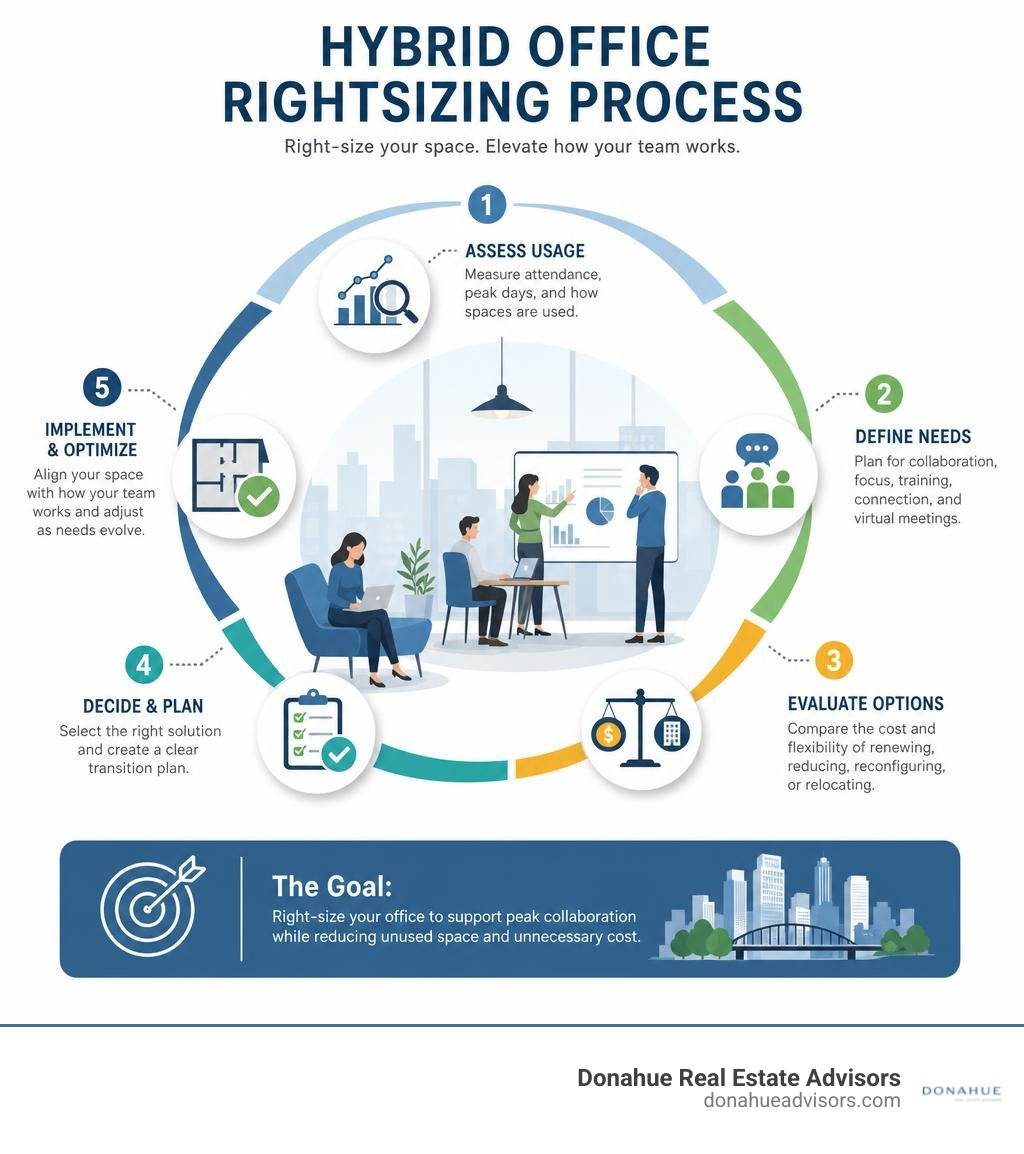
Rightsizing your office for a hybrid workforce means matching your leased space and floor plan to how people actually use the office, not to total employee headcount. For Pittsburgh businesses weighing a lease renewal against relocation, the goal is simple: keep enough high-value space for peak collaboration days while cutting or repurposing space that sits unused.
- Measure real attendance, peak-day demand, and how desks, meeting rooms, and focus areas are used.
- Compare the cost and flexibility of renewing, reducing, reconfiguring, or relocating your space.
- Plan for team collaboration, focused work, training, social connection, and virtual meetings, not just assigned desks.
- Use current market data when evaluating lease timing, availability, and occupancy costs in areas such as the East End, Oakland, the Strip District, North Shore, Southside, Shadyside, and East Liberty.
The team at Donahue Real Estate Advisors has decades of experience representing office tenants in Pittsburgh and helping them evaluate lease, relocation, and space decisions. That tenant-focused background guides our approach to rightsizing your office for a hybrid workforce before a lease deadline limits your options.
Step 1: Partner with Expert Tenant Representation to Evaluate Lease Options
When evaluating whether to renew your current lease or relocate to a new building, partnering with specialized commercial tenant representation is your most vital first move. Landlords employ seasoned property agents who focus exclusively on maximizing building revenue. Without independent representation, tenants frequently leave substantial capital on the negotiating table or accept lease conditions that restrict operational flexibility.
At Donahue Real Estate Advisors, we exclusively represent commercial tenants. This strict policy eliminates financial conflicts of interest, ensuring that our recommendations serve your business objectives without compromise. In our experience working with firms facing complex space decisions, such as our work highlighted in the Nelson Mullins long-term lease case study, strategic timing and unyielding tenant advocacy unlock significant financial advantages.
Beginning your office lease renewal strategy 18 to 24 months before lease expiration ensures maximum leverage. Waiting too close to your lease expiration drastically weakens your bargaining position, giving landlords the upper hand during discussions.
Navigating Lease Milestones and Market Opportunities in Pittsburgh Submarkets
Pittsburgh commercial office market dynamics vary significantly by submarket. Business district dynamics in the Strip District, East End, and North Shore show stable demand for modern Class A spaces, while traditional central core towers contend with shifting tenancy patterns. To better understand these localized market shifts, review our analysis on Pittsburgh Vacancy Rates: The Ghost Towns and Hot Spots.
Whether your firm is considering space in Shadyside, East Liberty, Southside, or Oakland, rightsizing requires negotiating explicit lease protections. Key contractual mechanisms include:
- Contraction Options: Standard contractual rights that allow your organization to return a portion of leased floor space at designated milestones during the lease term.
- Subleasing Strategy: Flexible clauses that permit subleasing excess square footage to third-party subtenants without triggering onerous landlord profit-sharing penalties.
- Flexible Termination Clauses: Strategic break clauses tied to clear business metrics or timeframes.
Critical Lease Pitfalls: Free Rent Timing and Holdover Rent Risks
Many tenants miscalculate the financial mechanics of landlord concessions and lease expiration timelines. Two common mistakes regularly destroy anticipated savings:
- Misunderstanding Free Rent Structure: Tenants often negotiate abatement periods without securing proper timing controls. Landlords may attempt to apply free rent during fit-out periods when occupancy costs are lower, rather than deferring abatement to post-occupancy months where full operational rent applies.
- Exposure to Holdover Rent Penalties: Exceeding your lease expiration without an executed extension or temporary agreement can trigger holdover rates between 150% and 200% of base rent. Proper tenant representation establishes temporary extension rights well before negotiations conclude.
Diagnosing Your Footprint: Data, Metrics, and AI-Driven Space Planning
Accurate diagnostic data forms the foundation of modern real estate decisions. Evaluating space requirements through headcount formulas leads to misallocated capital and underutilized office floors.
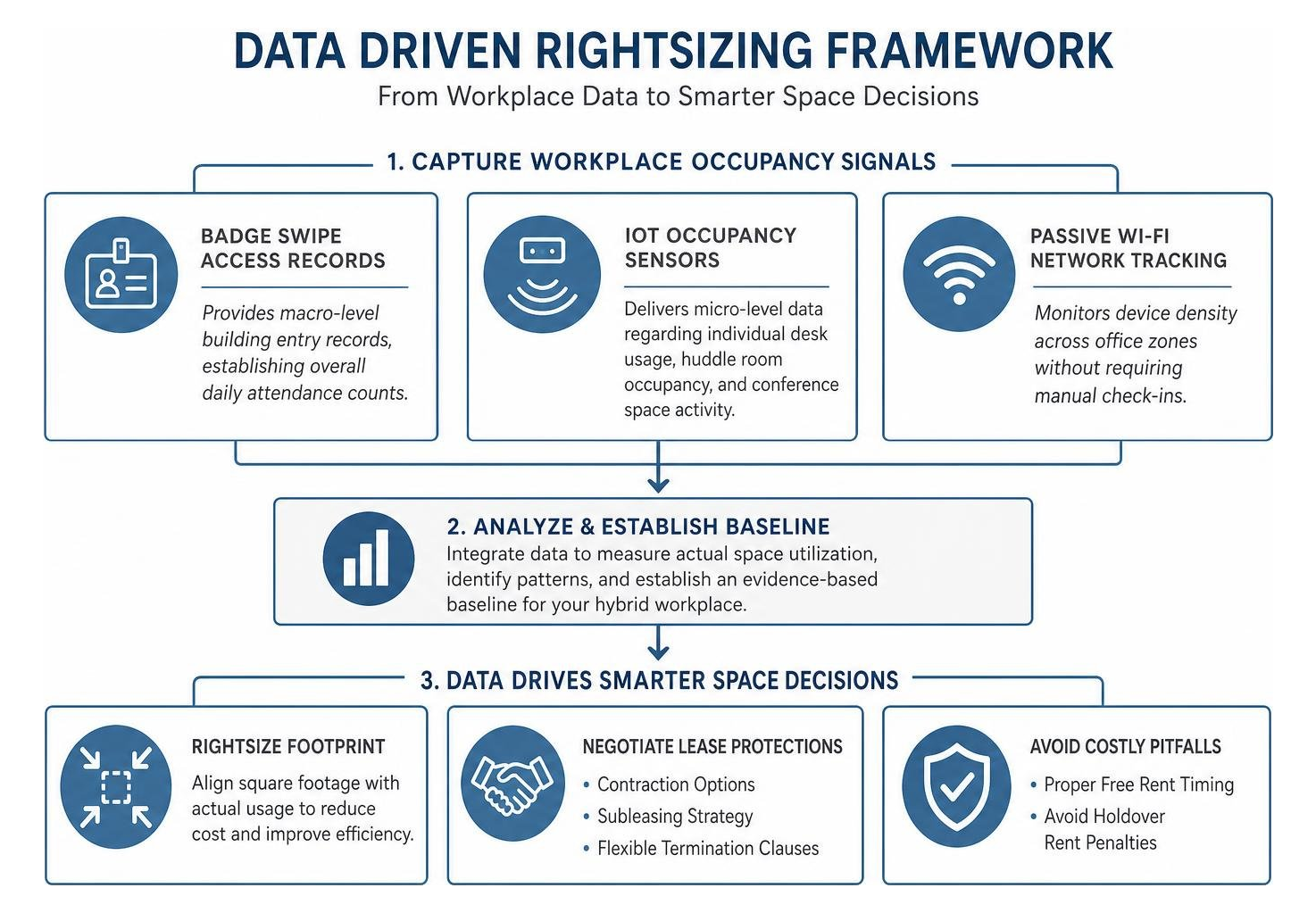
To build a reliable baseline, real estate leaders must gather quantitative occupancy signals across multiple systems:
- Badge Swipe Access Records: Provides macro-level building entry records, establishing overall daily attendance counts.
- IoT Occupancy Sensors: Delivers micro-level data regarding individual desk usage, huddle room occupancy, and conference space activity.
- Passive Wi-Fi Network Tracking: Monitors device density across office zones without requiring manual check-ins.
- Desk and Room Booking Systems: Tracks reservation patterns while highlighting discrepancies between reserved space and physical attendance.
Cross-referencing booking data against passive presence signals eliminates “ghost bookings,” where spaces are reserved on digital calendars but remain empty in reality. According to research from Gable’s 2026 Office Rightsizing Guide, global office utilization reached 53% in 2026, rising from 38% in 2024. However, peak attendance remains heavily concentrated on midweek days.
Why Rightsizing Your Office for a Hybrid Workforce Starts with Real-Time Data
Traditional real estate planning relied on a simple formula: multiply employee headcount by a set square footage multiplier (typically 150 to 250 square feet per employee). In a flexible hybrid model, that calculation is fundamentally broken.
Planning around peak attendance without understanding average utilization creates vast financial waste. According to statistics published by Facilities Dive’s Space Management Report, peak attendance on Tuesdays averages 58.6% globally, while Friday attendance drops sharply to 34.5%.
| Metric | Traditional Headcount Planning | Data-Driven Rightsizing Model |
|---|---|---|
| Core Planning Unit | Total Employee Headcount | Peak Daily Attendance plus Safety Buffer |
| Space Metric Focus | Building Occupancy Percentage | Micro Utilization by Space Type |
| Target Desk Ratio | 1:1 Assigned Desk Allocation | 0.3:1 to 0.7:1 Desk-Sharing Ratio |
| Primary Cost Benchmark | Overall Rent per Square Foot | Cost per Actual Active User |
Transitioning to dynamic data measurement allows organizations to conduct a thorough evaluation of their real real estate requirements. You can explore complete methodology frameworks through The Ultimate Office Space Needs Assessment for Growing Teams.
Leveraging AI and Predictive Analytics for Accurate Portfolio Sizing
Predictive analytics and artificial intelligence have transformed real estate planning from static historical review to forward-looking scenario modeling. According to corporate surveys published in Gable’s 2026 Portfolio Analysis, 92% of corporate real estate teams now actively explore AI tools for space planning and attendance forecasting.
AI algorithms analyze historical badge entry data, holiday calendars, weather patterns, and project schedules to forecast attendance variance week by week. Key capabilities include:
- Predictive Attendance Modeling: Forecasts daily floor-by-floor attendance with up to 97% accuracy, eliminating midweek space shortages.
- Rapid Scenario Simulation: Simulates floor consolidation options, lease reduction scenarios, and team neighborhood layouts before executing physical fit-outs.
- Automated Nudges: Coordinates team co-attendance by recommending optimal in-office collaboration days based on project milestones.
Strategic Paths for Rightsizing Your Office for a Hybrid Workforce
Selecting the appropriate real estate strategy depends on lease timing, current layout flexibility, and regional market liquidity.
When evaluating How Much Office Space Do I Need?, decision-makers generally select from four strategic pathways to align physical square footage with business operations.
Evaluating the Four Strategic Real Estate Pathways
- Shrink in Place: Renewing your lease at your current address while surrendering underutilized floors or suite space back to the landlord. This approach minimizes moving expenses while reducing ongoing baseline rent.
- Consolidate Locations: Merging multiple satellite facilities across the region into a single high-quality regional hub in submarkets like the Strip District or East Liberty.
- Diversify Portfolio Mix: Combining a reduced primary hub lease with flexible on-demand space networks or coworking access to accommodate floating, distributed teams.
- Hold and Reconfigure: Maintaining existing square footage while completely redesigning internal spaces to support activity-based working rather than individual assigned seating.
Organizations evaluating footprint reductions can examine structured downsizing strategies through our guide on office downsizing.
Common Mistakes When Restructuring Corporate Real Estate
Corporate real estate teams frequently encounter predictable traps when adjusting space commitments:
- Executive Peak-Day Bias: C-suite executives who visit the office solely on peak Tuesdays and Wednesdays often assume the facility is fully utilized, overlooking low Friday usage.
- Designing for Averages: Sizing floor plans based on average weekly utilization causes severe overcrowding during midweek peak periods.
- Inflexible Long-Term Commitments: Signing rigid ten-year leases without negotiating break clauses or subleasing rights leaves firms vulnerable to shifting work patterns.
- Neglecting Employee Feedback: Failing to survey staff regarding daily work habits leads to floor plans that do not support daily tasks.
Designing for Activity-Based Working and Desk-Sharing Ratios in 2026
Modern hybrid workplaces require layout concepts that emphasize collaborative experiences over individual desk storage. According to corporate workplace trends highlighted in Upflex’s 2026 Complete Hybrid Workplace Guide, over 53% of enterprise organizations have adopted Activity-Based Working (ABW) as their dominant design structure.

Five Core Office Activities and Space Allocation Guidelines
Activity-Based Working structures physical spaces around five primary employee tasks:
- Deep Focus Work: Quiet zones, single-person focus rooms, and phone booths equipped with privacy acoustics for individual tasks.
- Collaborative Brainstorming: Open team lounges, project war rooms, and interactive spaces with digital whiteboards.
- Community and Social Connection: Central cafes, town hall hubs, and informal break zones designed to build team culture.
- Learning and Mentorship: Dedicated training spaces, seminar rooms, and structured meeting facilities.
- Virtual Hybrid Meetings: Acoustic soundproof pods designed specifically for seamless video conferencing calls.
To review additional spatial design concepts suited for local commercial properties, explore our overview of 2026 office space trends.
Optimizing Desk Ratios and Peak-Day Buffer Allocations
Transitioning away from fixed assigned seating requires establishing balanced desk-sharing ratios. Desk-sharing ratios between 0.3:1 and 0.7:1 (3 to 7 desks per 10 employees) have established the standard benchmark for flexible hybrid operations.
To prevent overcrowding during peak attendance days, workplace planners must build a safety buffer of 15% to 20% above peak daily attendance forecasts. Modern spatial allocation standards typically target 75 to 150 square feet per total employee, compared to traditional metrics of 150 to 250 square feet.
Reinvesting Real Estate Savings and Executing Change Management
Rightsizing corporate real estate is not merely a cost-reduction exercise; it represents an opportunity to upgrade employee experience and operational technology.
Organizations that rightsized physical footprints to reflect actual attendance reduced annual per-employee rent costs from $13,500 down to $10,600, generating a 21% average cost reduction.
The 2026 Playbook for Rightsizing Your Office for a Hybrid Workforce
Forward-thinking organizations redirect captured real estate savings into target workplace enhancements that boost performance:
- Advanced Conference Technology: Equipping meeting rooms with smart cameras, spatial audio, and seamless virtual meeting integration.
- Ergonomic Upgrades: Installing sit-stand desks, high-performance task seating, and adjustable lighting across focus zones.
- Premium Building Amenities: Relocating to Class A facilities in prime submarkets like the North Shore, Southside, or East End that feature wellness centers, secure bike storage, and outdoor green space.
Reallocating capital toward technology and environment directly enhances organizational efficiency. Learn more about optimizing team output in our detailed guide on how to improve employee productivity.
Change Management, Pilot Programs, and Reassessment Triggers
Altering long-standing workplace habits requires clear change management protocols:
- Transparent Communication: Clearly communicate the purpose of rightsizing, emphasizing improved technology, collaboration zones, and workplace flexibility.
- Departmental Pilot Programs: Test proposed neighborhood seating, desk booking platforms, and furniture configurations on a single floor for 60 to 90 days before company-wide implementation.
- Establish Continuous Review Loops: Review occupancy metrics quarterly to adjust desk ratios and space allocations.
Aligning footprint reviews with lease milestones ensures that your real estate strategy evolves alongside your business. Discover practical methods to improve staff satisfaction through our insights on employee workplace experience.
Frequently Asked Questions About Hybrid Office Rightsizing
How do you determine the correct desk-to-employee ratio for a hybrid workforce in 2026?
Calculating the ideal desk-to-employee ratio requires auditing 90 days of peak attendance data rather than overall headcount. Divide your maximum single-day attendance by total headcounts, then add a 15% safety buffer. For most flexible hybrid companies requiring two to three days in-office, target ratios range between 0.3:1 and 0.7:1.
How often should a company reassess its office footprint and space utilization?
Organizations should review utilization metrics quarterly to adjust floor allocations and desk-booking settings internally. Formal real estate footprint reassessments should occur every 18 to 24 months, aligning directly with major lease milestones, contraction option deadlines, or major business expansions.
What is the difference between office downsizing and strategic rightsizing?
Downsizing focuses almost exclusively on cutting square footage to reduce immediate overhead costs. Strategic rightsizing focuses on matching both the total square footage and spatial functionality to modern work patterns, often reallocating savings into higher-quality spaces, collaboration tech, and improved employee experiences.
Conclusion: Realign Your Pittsburgh Office Footprint for Long-Term Growth
Rightsizing your office for a hybrid workforce is an ongoing strategy that aligns real estate liabilities with modern operational habits. Businesses across Pittsburgh facing upcoming lease renewal or relocation decisions must ground their real estate strategy in real-time utilization data, flexible floor planning, and strong tenant representation.
Donahue Real Estate Advisors offers completely conflict-free representation to help commercial tenants navigate complex lease negotiations, space planning decisions, and submarket evaluations. Wherever you’re evaluating options in the Pittsburgh market, our team ensures your lease terms deliver maximum financial value and long-term business flexibility.
Are you ready to evaluate your commercial lease options and optimize your space footprint? Contact Donahue Real Estate Advisors today to schedule an expert lease strategy session, or explore our full range of commercial services.