

Find Pittsburgh Off-Market Office Space Before You Renew or Relocate
“I thought we found the perfect space until we found Donahue Real Estate Advisors. I didn’t know these spaces even existed.”
Most business leaders conduct a standard web search, tour a few listed properties, and feel confident they have surveyed the market. In reality, that process only captures publicly promoted inventory while missing an entire tier of unlisted commercial real estate. Discovering high-caliber, off-market opportunities fundamentally changes how you benchmark value and evaluate your lease options.
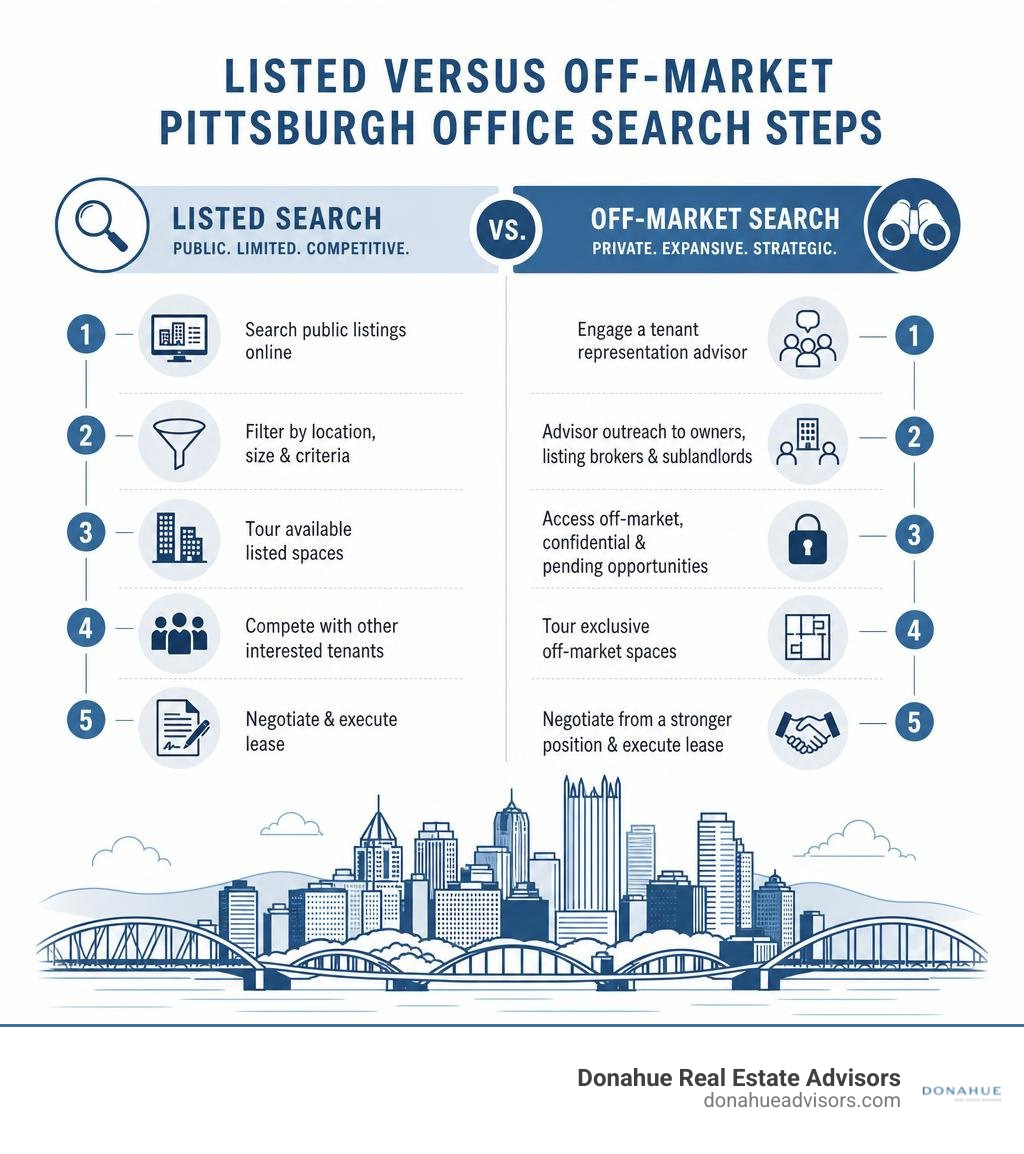
The best Pittsburgh off-market office space is usually found through a tenant representative who can ask owners, listing brokers, and sublandlords about space that is not publicly advertised. Before you renew or relocate, compare your current office against both listed options and quiet availability throughout Pittsburgh.
Public listings are useful, but they are not a complete view of the market. Some spaces are pending vacancy, offered as confidential subleases, or available only when the right tenant and lease terms appear. Market statistics can help establish a baseline, but direct market outreach can reveal options that do not appear in a standard search.
Donahue Real Estate Advisors has experience representing Pittsburgh tenants through lease renewals, relocations, and searches for Pittsburgh off-market office space, focused on helping businesses build a real comparison set before making a long-term office decision.
Partner with Expert Tenant Representation to Uncover Hidden Deals

When business leaders consider renewing an existing lease or relocating their headquarters, the default approach is often a quick web search. However, self-guided searches routinely run into barriers. Online platforms showcase only what property managers actively post, leaving a vast layer of prime real estate completely invisible.
To run a complete review of your options, you can work with a tenant representative who understands your business goals and space needs. At Donahue Real Estate Advisors, we provide conflict-free advocacy. We represent tenants exclusively, never landlords. This independence eliminates the structural conflict of interest found in full-service listing firms that represent both sides of a deal.
Our mission is to align your physical space with your financial, operational, and cultural objectives. We leverage our daily presence across Southwestern Pennsylvania submarkets to ensure you never make an office commitment based on an incomplete set of choices.
Why Public Listings Only Show a Fraction of the Market
Public portals show a curated subset of real estate opportunities. Many listings online are outdated ghost listings, kept live simply to generate inquiry calls for commercial landlords. In other cases, marketing lag means spaces remain displayed for months after a lease is already executed.
Relying solely on consumer-facing engines for Pittsburgh, PA office space for rent creates anchor bias. Tenants frequently tour the first three spaces they find online, assume those reflect current market conditions, and negotiate against an incomplete set of comparables.
Deploying the scavenger’s guide to affordable office leases requires looking past commercial aggregator portals to assess true building conditions, deferred capital projects, operating expense escalations, and real occupancies.
Navigating Pittsburgh Off-Market Office Space Opportunities
Accessing hidden spaces requires systematic, active market outreach. Landlords often test pricing quietly with established tenant reps before investing in marketing campaigns or public listings. In addition, current corporate tenants frequently hold quiet shadow space that they intend to vacate or sublease well before their lease officially expires.
Consider a hypothetical scenario: a mid-sized technology firm needs private office space spanning two full floors with dedicated parking. Public listings turn up no viable configurations in their preferred submarket. In cases like this, targeted off-market outreach can surface options that never appear on public portals, such as a sublease in a corridor like Lawrenceville or the Strip District, complete with dedicated on-site parking and move-in-ready infrastructure at a fraction of listed Class A rates.
Finding these spaces is not about chance. It requires daily engagement with local property owners, sublandlords, and brokerage networks.
What Defines Pittsburgh Off-Market Office Space in 2026
Off-market office space is commercial real estate available for occupancy that is not marketed on public listing databases. This category spans multiple property types, each carrying distinct advantages for tenants who know how to source them.
| Feature / Metric | Publicly Listed Inventory | Off-Market Office Inventory |
|---|---|---|
| Marketing Channel | Public portals, signboards, broker email blasts | Direct broker networks, confidential outreach, direct owner contact |
| Pricing Transparency | Public asking rates, often inflated for testing | Negotiable base rents aligned with current market conditions |
| Confidentiality | Fully public | Governed by non-disclosure agreements (NDA / NCNDA) |
| Competition Level | High public visibility and competing tours | Direct, one-on-one tenant negotiations |
| Build-out Condition | Often standard vanilla shell or dated second-generation | High proportion of turnkey subleases and pre-built suites |
Quiet Availability, Direct Relationships, and Shadow Inventory
Off-market commercial inventory typically falls into three categories:
- Pre-Vacancy Transitions: Spaces where an existing lease is expiring within the next 6 to 18 months, but the current tenant has not yet vacated and the owner has not engaged in public marketing.
- Confidential Sublease Opportunities: Large corporate employers looking to downsize discreetly without signaling restructuring to competitors or public markets.
- Discreet Institutional Blocks: Institutional landlords offering multi-floor contiguous blocks only to vetted tenants through established tenant reps.
Confidential marketing protocols are standard for off-market commercial assets. Large institutional blocks (such as premier multi-floor trophy assets in Downtown Pittsburgh or large mission-critical office facilities) regularly require executing a Non-Circumvention, Non-Disclosure Agreement (NCNDA) before disclosing floor plans, tenant rosters, or financial parameters. Similar discretion applies to flex, industrial, and suburban office parks across Southwestern Pennsylvania, where owners favor targeted placement over wide public exposure.
Submarket Dynamics Across the Strip District, North Shore, and East End
Office conditions across Pittsburgh vary considerably by submarket. Navigating them effectively requires localized intelligence across each distinct business district:
- Strip District: The epicenter of Pittsburgh’s tech, robotics, and creative growth. Finding prime Strip District office space often requires identifying adaptive reuse conversions and quiet subleases before they reach the open market.
- North Shore: With immediate access to major highways and rapid transit into the central business district, the Pittsburgh North Shore office market provides riverfront views and modern Class A floor plates.
- Southside: Highly attractive to companies seeking walkable dining amenities and urban fringe convenience, making Pittsburgh Southside office space an alternative for professional firms.
- East End, Shadyside, and East Liberty: These neighborhoods form an innovation corridor anchored by technology firms and research groups. Office product here frequently trades quietly among regional owner-operators.
- Oakland: Dominated by premier research, life sciences, and university-affiliated institutions, creating high barrier-to-entry space that requires deep local relationships to secure.
Common Tenant Pitfalls: Free Rent Timing and Holdover Rent Risks
When evaluating whether to renew a current lease or relocate, tenants often run into timing and lease administration errors that undermine their negotiating leverage.
Two major areas where tenants make costly mistakes are free rent structuring and lease expiration management:
1. Free Rent Timing and Abatement Realities
Many tenants assume that negotiated free rent translates directly into immediate cash savings on day one of occupancy. However, landlords frequently structure free rent as rental abatement applied over the entire lease term, or they delay its start until full build-out completion.
If construction falls behind schedule and your lease terms do not explicitly protect your rent commencement date, you can burn through your free rent period while paying double rent at your current location. We ensure all rent concession timelines are tied strictly to substantial completion and actual certificate of occupancy delivery.
2. The Holdover Rent Penalty Trap
A critical misstep is initiating renewal or relocation discussions too close to lease expiration. Most commercial leases in Pittsburgh contain aggressive holdover clauses that penalize tenants who stay past their expiration date.
Standard holdover provisions increase rent to 150% to 200% of the previous base rent rate, calculated on a daily or monthly basis without traditional tenant protections. When a business delays its search and realizes a new office requires a six-month build-out, the current landlord gains massive leverage during renewal negotiations.
Beginning the discovery process 12 to 18 months before expiration removes this holdover vulnerability and ensures you negotiate from a position of strength.
Evaluating Relocation vs. Lease Renewal Using Unlisted Comparables

When an existing lease nears expiration, businesses face a fundamental decision: sign a renewal with the current landlord or relocate to a new facility.
Landlords understand that moving entails disruption, moving costs, and capital expenditures. If a landlord believes you are only looking at two or three public listings, their renewal offer will rarely feature top-tier concessions.
Knowing how to renegotiate a commercial lease the right way requires creating legitimate competition. When you present a comprehensive comparison set containing quiet, off-market opportunities alongside public listings, the entire negotiation dynamic shifts in your favor.
Sourcing Pittsburgh Off-Market Office Space for Real Negotiating Leverage
By bringing unlisted comparables to the table, you eliminate your landlord’s home-court advantage.
This leverage unlocks significant lease concessions, including:
- Expanded tenant improvement allowances (TIA)
- Dedicated periods of full base-rent abatement
- Favorable early termination and contraction options
- Capped annual operating expense escalations
The Structural and Financial Assessment of Unlisted Assets
Finding an off-market option is only the first step; evaluating its physical and financial performance is what protects your balance sheet.
Before committing to any space, we conduct a comprehensive office space needs analysis to ensure the usable-to-rentable square footage ratio fits your operational model. Older commercial properties can carry inefficient core load factors of 15% to 20%, meaning you pay rent on hallways, elevator banks, and mechanical rooms you cannot actually use.
Our technical evaluation reviews:
- Mechanical System Age: Evaluating HVAC lifecycle and roof warranties to prevent unexpected tenant operating expense pass-throughs.
- Operating Expense Baselines: Auditing historical base-year operating expenses to ensure clean accounting and protect against artificial maintenance spikes.
- Tenant Improvement Allowances: Negotiating comprehensive turnkey work letters rather than accepting standard, capped allowances that leave your business exposed to construction inflation.
Our strategic advisory was demonstrated when national law firm Nelson Mullins set out to establish a new office in Pittsburgh. Donahue Real Estate Advisors helped secure high-quality temporary space before identifying and structuring their permanent long-term office. You can review the step-by-step strategy in the Nelson Mullins long-term office space case study.
Frequently Asked Questions About Commercial Leasing in Pittsburgh
How do businesses access unlisted commercial real estate in Pittsburgh?
Businesses access unlisted space by partnering with an exclusive tenant representation firm. Tenant reps maintain direct relationships with commercial property owners, institutional asset managers, and corporate tenants planning upcoming moves, identifying spaces before they are publicly listed.
Why do property owners choose not to publicly list prime office space?
Property owners often keep prime office space off public platforms to prevent existing tenants from becoming unsettled, avoid costly public marketing campaigns, or negotiate quietly with credit-grade tenants who value confidentiality and speed.
How does off-market inventory impact lease renewal negotiations?
Introducing off-market properties into your renewal assessment provides authentic market leverage. When your landlord realizes you have viable, competitively priced alternatives that they cannot track on public listing platforms, they are far more willing to offer aggressive rent abatements, higher tenant improvement dollars, and flexible lease terms.
Discover More Options with Donahue Real Estate Advisors
Entering office lease negotiations relying solely on public search portals leaves your business with an incomplete view of the Pittsburgh office market. The best lease terms, optimal build-outs, and competitively priced spaces are frequently secured before a property ever reaches the open market.
Donahue Real Estate Advisors provides completely conflict-free, tenant-only commercial advisory across Pittsburgh, helping you uncover every viable option across the Strip District, North Shore, Oakland, East End, and beyond.
Many tenants believe they have already located the ideal property until they see what was hidden from public view. As our client realized after exploring quiet inventory, you cannot choose the best office space if you never knew it existed.
Schedule a Complimentary Lease Review with Donahue Real Estate Advisors to uncover unlisted inventory, benchmark your current lease, and secure the best possible terms for your organization.