

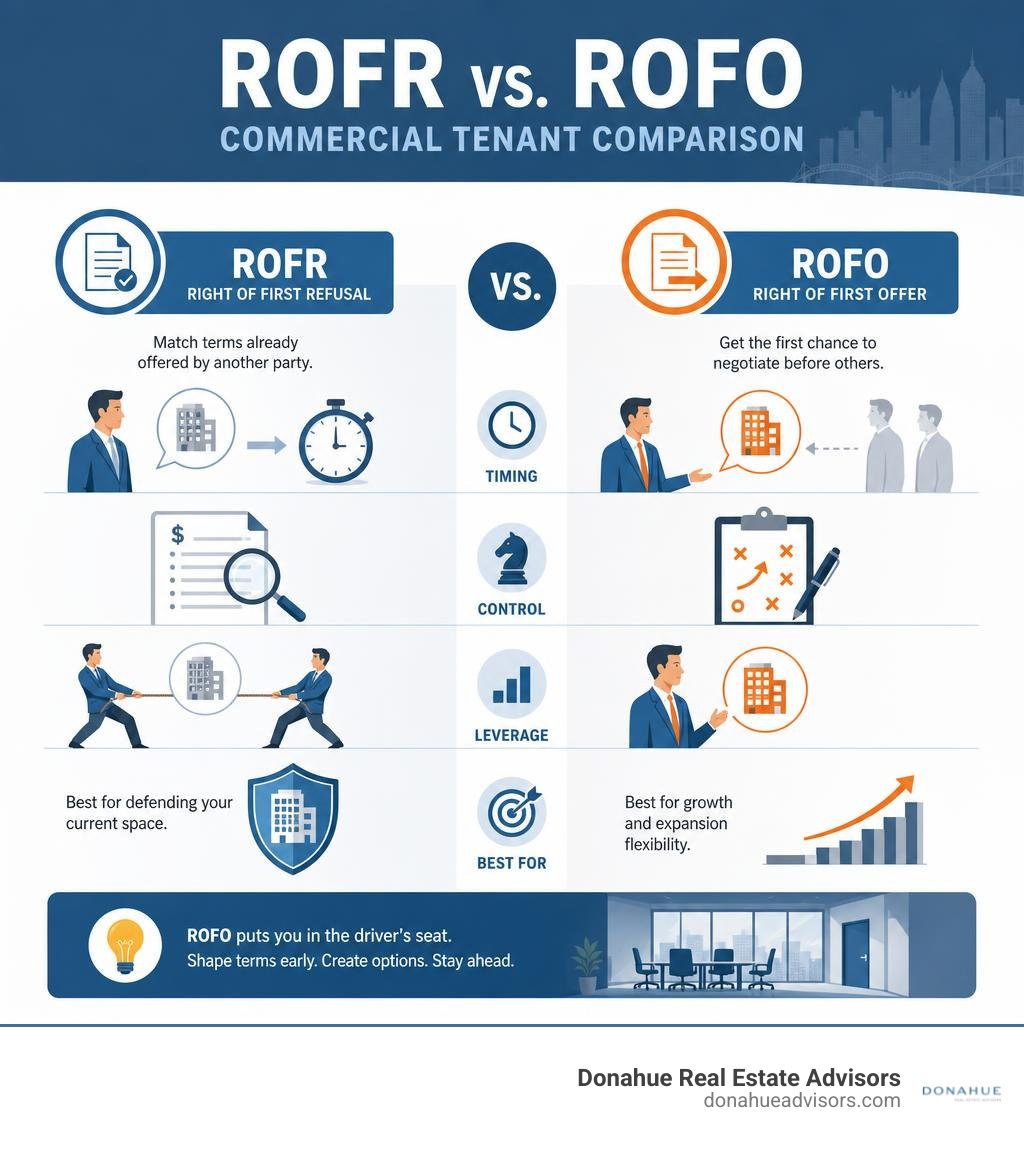
Right of First Refusal vs. Right of First Offer comes down to timing and control. In plain language, a Right of First Refusal (ROFR) means you match what someone else already agreed to. A Right of First Offer (ROFO) means you get first dibs before anyone else is even in the conversation. ROFR and ROFO mechanics define how these options function in everyday lease agreements.
For a company weighing renewal against relocation in Pittsburgh, a ROFO often provides more useful expansion flexibility. It gives the tenant a chance to shape terms for adjacent or future space before a competing tenant sets the price, layout, and lease conditions. A ROFR can still help, but tight response deadlines and vague trigger language can make it far less valuable in practice.
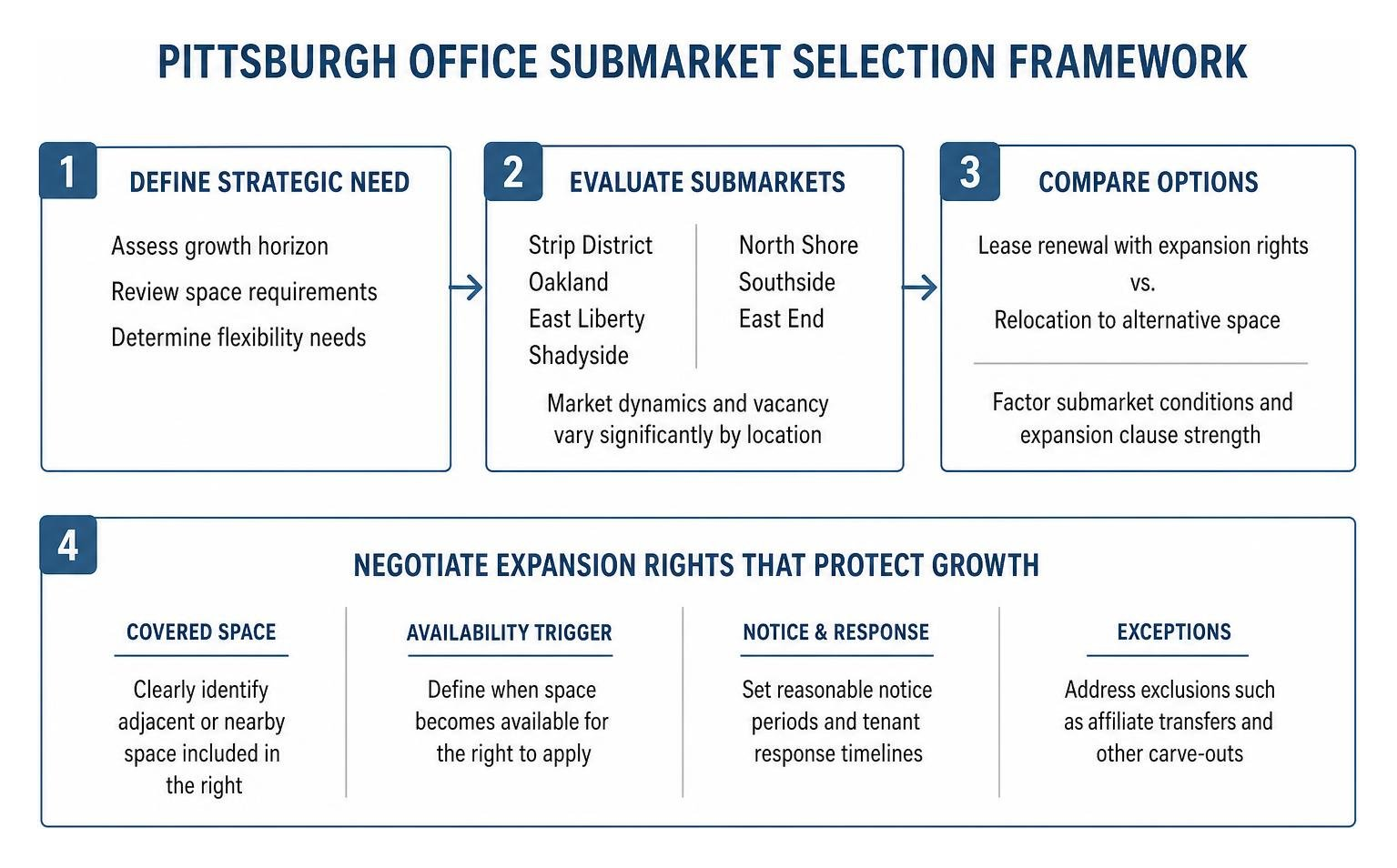
The exact lease language matters. A strong clause should clearly identify covered space, define when it becomes available, set notice and response periods, and address exceptions such as affiliate transfers. These are commercial lease terms that should be negotiated for the tenant, not simply accepted from a landlord’s draft.
Step 1: Partner with Expert Tenant Representation to Secure Expansion Flexibility

Securing expansion rights in commercial real estate is never as simple as checking a box on a standard lease form. Landlords design their initial agreements to maximize their own asset value, liquidity, and operational discretion. When tenants attempt to secure adjacent square footage without dedicated advocacy, they often end up with clauses that offer the illusion of protection without real legal or commercial teeth.
To achieve genuine flexibility, companies must understand how to renegotiate a commercial lease the right way. Partnering with an exclusive tenant advocate is the essential first step to ensure your business gains actionable growth options rather than restrictive landlord terms.
Why Pittsburgh Tenants Need Dedicated Representation Before Drafting Clauses
Landlord brokers have a fiduciary obligation to property owners. Their objective is to keep space fully leased at the highest possible rates with minimal encumbrances. A heavily restrictive tenant expansion right limits a building owner’s ability to market vacant space freely. Consequently, landlord drafts of these provisions frequently include compressed notice periods, vague triggers, and onerous financial qualification hurdles.
At Donahue Real Estate Advisors, we provide conflict-free commercial tenant representation. We exclusively represent occupiers, eliminating the dual-agency conflicts common in institutional brokerages.
Our client work highlights the value of this focused advocacy. In our Nelson Mullins temporary space case study and subsequent Nelson Mullins long-term space case study, we guided the firm through urgent, structured expansion requirements without sacrificing long-term operational leverage. Whether your firm is a technology company, a healthcare operator, a professional services firm, or an industrial business, independent representation levels the playing field against institutional landlords.
Assessing Space Needs Across the Strip District, Oakland, and East Liberty
Selecting between a lease renewal and relocation requires understanding local submarket dynamics across Pittsburgh. Real estate conditions in the Strip District, Oakland, East Liberty, Shadyside, North Shore, Southside, and the broader East End vary significantly.
According to CoStar Pittsburgh Office Market Data, regional market conditions continue to reflect divergent vacancy rates across submarkets. High-demand tech and robotics corridors like the Strip District and East Liberty maintain competitive pockets of Class A space, while other submarkets present tenant-favorable concession environments.
Occupiers undecided between renewing an existing lease or relocating must factor these submarket fundamentals into their expansion clauses. A poorly drafted expansion clause in an expanding corridor like Oakland or Shadyside can prevent you from securing contiguous growth space, forcing an expensive, unplanned office relocation.
Common Client Mistakes: Free Rent Timing and Holdover Rent Risks
When structuring lease expansions and renewals, tenants frequently make critical timing errors around concessions and transition windows.
- Misunderstanding Free Rent Abatement Timing: Tenants often assume rent abatement applies immediately upon notice of expansion. Without explicit lease language, landlords may apply concessions only after extensive buildout periods or delay them to the end of the term, draining tenant cash flow.
- Underestimating Holdover Rent Penalties: If an existing lease expires while an occupier waits for an expansion space to become available under a poorly coordinated ROFO or ROFR, the tenant can be hit with holdover penalties ranging from 150% to 200% of standard base rent.
- Miscalculating Space Delivery Schedules: Expansion clauses must tie directly to firm delivery dates with liquidated damages or termination rights if the landlord fails to deliver the space vacated by an outgoing tenant.
Carefully managing these dates is essential. Review our guide on How to Audit Your Way to Savings: A Guide to Lease Operating Expenses to prevent hidden costs from eroding your expansion budget.
Right of First Refusal vs. Right of First Offer: Key Differences and Mechanics

Understanding the functional distinctions between a Right of First Refusal and a Right of First Offer is critical to protecting corporate real estate flexibility. While both provisions offer priority access to commercial space or property acquisitions, their legal mechanics, initiation triggers, and impacts on bargaining power are fundamentally distinct, as detailed in legal analyses on differentiating between ROFOs and ROFRs.
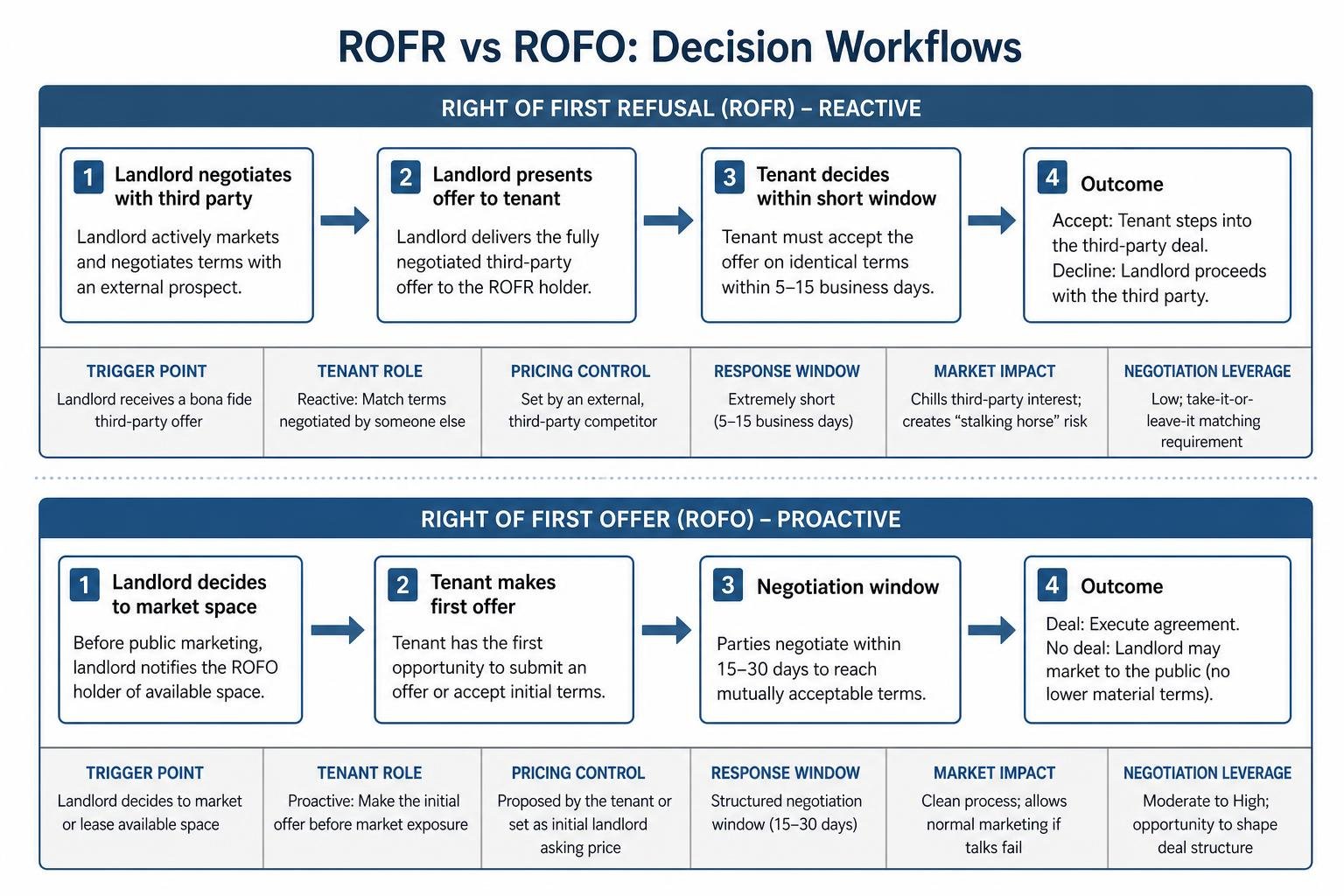
| Feature / Dynamic | Right of First Refusal (ROFR) | Right of First Offer (ROFO) |
|---|---|---|
| Trigger Point | Landlord receives a bona fide third-party offer | Landlord decides to market or lease available space |
| Tenant Role | Reactive: Match terms negotiated by someone else | Proactive: Make the initial offer before market exposure |
| Pricing Control | Set by an external, third-party competitor | Proposed by the tenant or set as an initial landlord asking price |
| Response Window | Extremely short (often 5 to 15 business days) | Structured negotiation window (often 15 to 30 days) |
| Market Impact | Chills third-party interest; creates “stalking horse” risk | Clean process; allows normal marketing if talks fail |
| Negotiation Leverage | Low; take-it-or-leave-it matching requirement | Moderate to High; opportunity to shape deal structure |
Right of First Refusal vs. Right of First Offer: Analyzing the Structural Contrast
The structural difference centers on transaction sequencing.
A Right of First Refusal is a reactive mechanism. The landlord actively markets the space to prospective tenants or buyers. Once the landlord negotiates acceptable terms with a third party, they must present that fully negotiated offer to the ROFR holder. The holder then has a limited window to step into the shoes of the third-party prospect on identical terms. This matching dynamic forces the tenant to accept an externally generated agreement in its entirety.
Conversely, a Right of First Offer is a pre-emptive mechanism. Before the landlord can market the space publicly, solicit bids, or negotiate with outside prospects, they must notify the ROFO holder. The tenant then gets the exclusive first opportunity to submit an offer or accept the landlord’s initial terms. If the parties fail to reach an agreement within the contractual window, the landlord is free to market the space to the public, provided they do not lease it on terms materially lower than those discussed with the ROFO holder.
Right of First Refusal vs. Right of First Offer: Evaluating Tenant Negotiation Leverage
From a strategic standpoint, a ROFO provides superior negotiating latitude for growing companies. Because no external bidder is driving the terms, the tenant can propose a rental rate, improvement allowance, and lease expiration alignment that matches their business plan.
With a ROFR, the tenant faces significant structural disadvantages:
- No Room to Modify Terms: The ROFR holder cannot selectively accept favorable terms while rejecting unfavorable ones. If the third-party offer includes an aggressive rental rate or an inconvenient commencement schedule, the holder must accept the full package or forfeit the space.
- The Stalking Horse Problem: Third-party buyers and tenants dislike competing against a ROFR holder. Knowing an existing tenant can match their hard-negotiated deal, serious third parties may refuse to bid, or submit lower-quality offers that distort market value.
- Compressed Timelines: ROFR windows are deliberately brief, forcing executive teams to make major expansion commitments under intense time pressure.
For commercial occupiers across diverse sectors such as technology, corporate services, and healthcare, reviewing specialized strategies such as a law firm office lease renewal strategy illustrates how proactive rights can be structured to protect corporate capital across any industry.
Critical Contract Clauses: Triggers, Timelines, and Notice Windows
A priority expansion right is only as reliable as its underlying definitions. When drafting these provisions, tenants and their advisors must scrutinize every operational trigger and deadline to prevent inadvertent forfeitures, keeping in mind the ultimate guide to key commercial lease dates.
Essential Notice and Trigger Checklist
- Clear Identification of Subject Space: Precise suite numbers, square footage measurements, and floor plans for potential expansion.
- Specific Trigger Language: Explicit definition of what constitutes space availability, such as expiration of existing third-party leases, early terminations, or landlord intent to market.
- Notice Mechanics: Requirement for written notice delivered via traceable methods directly to designated tenant executives.
- Sufficient Exercise Periods: Minimum response windows of 15 to 30 days for ROFO offers and at least 10 to 15 business days for ROFR evaluations.
- Price Floor and Variance Protections: Clauses preventing landlords from offering space to third parties at rates below 90% to 95% of the ROFO proposal.
- Subordination and Lien Clarification: Clarifying how the right interacts with existing lender agreements, mortgage liens, and superior tenant options.
Defining Trigger Events and Carve-Out Exclusions
A frequent pitfall in commercial lease drafting is the failure to define bona fide trigger events. Landlords often insert carve-out exclusions that permit them to bypass the tenant’s rights entirely.
Common exclusions that must be negotiated include:
- Affiliate Transfers: Landlords frequently exempt leases or sales between related corporate entities. Tenants should ensure that affiliate transfers are strictly defined to prevent sham transactions designed to defeat expansion rights.
- Pre-Existing Tenant Renewal Rights: Expansion clauses must state whether current occupants have superior renewal options that take precedence over the ROFO or ROFR.
- Subordination Clauses: Ensure that senior lenders cannot unilaterally extinguish expansion rights in the event of building refinancing or recapitalization.
Managing Short Decision Deadlines and Notice Requirements
Short decision windows present operational risks to commercial occupiers. A ROFR that requires an executive board decision within five business days is rarely usable for a medium or large enterprise.
Furthermore, ROFO provisions must include strict price floor protections. If a tenant submits a ROFO offer of $30 per square foot that the landlord rejects, the lease must prohibit the landlord from leasing that space to a third party at $28 per square foot six months later without re-triggering the tenant’s right. Standard commercial practice sets a re-offer threshold if the economic terms drop by 5% to 10% below the initial offer.
Reviewing the comprehensive contract frameworks outlined by Zuva on rights of first offer and refusal confirms that clear notice mechanics are vital for lease enforceability.
Practical Applications in Public Policy and Real Estate Transactions
The mechanics of ROFR and ROFO extend beyond private commercial leases into property sales and statutory municipal policies.
Tenant Opportunity to Purchase Programs and Legislative Precedents
Municipal governments across the United States have incorporated Right of First Refusal and Right of First Offer frameworks into statutory housing preservation policies. These programs illustrate the real-world operational challenges of statutory matching rights.
For instance, Washington, D.C.’s Tenant Opportunity to Purchase Act (TOPA) grants tenant associations matching rights on multi-family building sales. According to data tracked under the DC Policy Center TOPA Study, only 771 co-op units have been created since 2006 under TOPA, despite the policy impacting 19,170 units. Research from the Urban Institute notes that TOPA negotiations typically last four to eight months, frequently extending the overall transaction timeline past the one-year mark.
Similarly, municipal data from the San Francisco Mayor’s Office of Housing and Community Development indicates that by late 2023, San Francisco’s Community Opportunity to Purchase Act (COPA) had preserved only 230 units. In Illinois, reports from the City of Chicago Department of Housing show that Chicago’s Woodlawn Housing Preservation Ordinance, enacted in 2020, saw zero participants by late 2023 due to strict financing timelines and valuation hurdles.
These statutory outcomes demonstrate a universal truth of commercial real estate: when matching rights impose lengthy decision cycles and complex execution requirements, transaction velocity slows and market liquidity drops. For commercial tenants, keeping lease expansion rights streamlined is essential to ensure they remain practical and functional.
Layering Purchase Rights for Maximum Protection
In major acquisition and leasing transactions, sophisticated tenants and buyers often negotiate a layered combination of rights.
- Initial Right of First Offer: Grants the tenant early notification and the first opportunity to propose transaction terms before public marketing begins.
- Right of First Negotiation: Requires the property owner to negotiate exclusively with the tenant in good faith for a specified period (typically 30 to 60 days).
- Contingent Right of First Refusal: Serves as a defensive backstop, ensuring that if the owner rejects the tenant’s offer, they cannot sell or lease the space to a third party on terms equal to or less favorable than the tenant’s proposal without offering it back to the tenant.
This multi-tiered structure preserves tenant leverage while giving the property owner a transparent path to market if initial negotiations do not yield an agreement.
Frequently Asked Questions About Commercial Expansion Rights
Is a Right of First Offer better for a growing tenant than a Right of First Refusal?
Yes. For most growing businesses, a Right of First Offer (ROFO) is preferable because it allows the company to initiate discussions based on its own expansion timeline, space configurations, and budget.
Under a ROFO, negotiations take place before any third-party bids are solicited, giving the tenant room to structure the agreement. A Right of First Refusal (ROFR) forces the tenant to react to a deal negotiated by a competitor, often with fixed terms and tight response deadlines.
What happens if a commercial landlord fails to honor an active purchase right?
If a landlord leases or sells space subject to a valid, recorded ROFO or ROFR without notifying the right holder, the landlord is in material breach of contract.
Depending on the jurisdiction and specific lease language, remedies available to the tenant include:
- Seeking an immediate court injunction to halt the unauthorized lease or sale.
- Suing the landlord for monetary damages, including relocation expenses, lost operational value, and difference in rental costs.
- In certain circumstances, unwinding the transaction if the third-party purchaser had actual or constructive notice of the recorded right.
How do response windows impact a company’s ability to exercise expansion options?
Response windows determine whether an expansion right is practically usable. If a lease clause specifies a response window of only 5 to 10 business days, corporate leadership may struggle to complete necessary space planning, financial underwriting, board approvals, and legal reviews in time.
Tenants should always negotiate for response windows of at least 15 to 30 days for a ROFO, and at least 10 to 15 business days for a ROFR, ensuring sufficient time for proper due diligence.
Conclusion
Structuring commercial expansion clauses requires balancing operational flexibility with market reality. Whether your business is expanding its footprint in the Strip District, establishing research operations in Oakland, or evaluating renewal terms in East Liberty, understanding the mechanics of Right of First Refusal vs. Right of First Offer ensures that your commercial lease actively supports your long-term business goals.
At Donahue Real Estate Advisors, we exclusively represent tenants across Pittsburgh, providing the market intelligence and contract structuring required to protect your bottom line. We invite you to schedule a lease review with our team to evaluate your current commercial lease, uncover hidden risks, and negotiate expansion rights that give your business room to grow. Explore our comprehensive tenant representation services to start planning your next lease negotiation.