

Your Complete Office Space Needs Assessment Questionnaire Toolkit
Your Office Space Needs Survey: What It Is and Why It Matters
An office space needs survey is a structured tool that gathers employee feedback on how, when, and where they work best — so you can make smarter decisions about your office layout, size, and lease strategy.
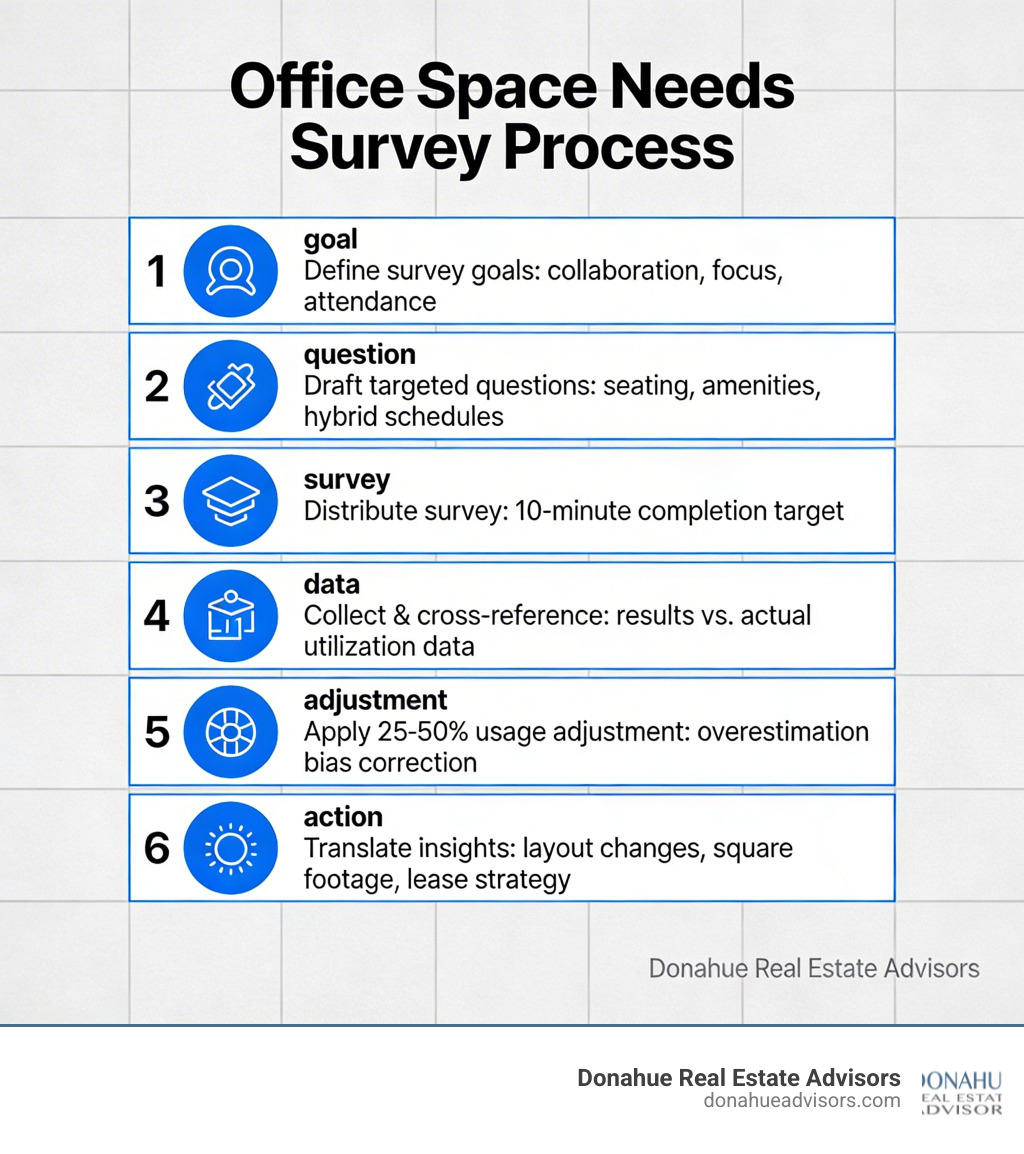
Here’s a quick overview of how to run one effectively:
- Define your goals — Are you measuring collaboration, focus work, or attendance patterns?
- Write targeted questions — Ask about seating preferences, amenities, distraction levels, and hybrid schedules.
- Keep it short — Aim for 10 minutes or less to maximize response rates.
- Cross-reference results — Compare survey data with actual utilization patterns.
- Adjust for overestimation — Employees tend to overstate how often they’ll use the office; expect 25–50% less actual usage.
- Translate findings into action — Use the data to right-size your space, redesign layouts, or negotiate better lease terms.
Most business leaders know their office isn’t quite working. Desks sit empty on Mondays and Fridays. Teams complain about noise. Meeting rooms are either always booked or never used. But without real data, it’s nearly impossible to know what to fix — or how much space you actually need.
That’s where an office space needs survey comes in.
Consider this scenario: a mid-sized company surveyed employees about seating preferences ahead of a hybrid transition and 70% said they wanted more quiet corners. That single insight led to the installation of modular pods — and a measurable boost in morale and productivity.
The stakes are higher now than ever. Recent industry sentiment reports indicate that nearly 40% of companies plan to expand their office footprint — a significant increase from previous years. Meanwhile, nearly half of occupiers are concerned about finding the right space when they need it. Making decisions without solid employee data in this environment isn’t just risky — it’s expensive.
This guide walks you through the templates, questions, and analysis methods you need to turn employee feedback into a real workplace strategy.
Why an Office Space Needs Survey is Critical in the Hybrid Era
Office planning used to be straightforward: one desk per person, plus conference rooms and a break area. Today, the equation is different. According to Owl Labs’ 2025 State of Hybrid Work report, most remote-capable employees now split their time between home and the office, which makes workspace planning far more dynamic.
This shift has created two distinct camps: “Hybrid Adopters” and “Office Advocates.”
- Hybrid Adopters: Usually larger organizations (10,000+ employees) that view flexibility as a core part of their employee value proposition. For these teams, a survey helps determine how to downsize effectively without creating “peak day” chaos.
- Office Advocates: Often found in smaller to mid-sized firms where culture and mentorship are top priorities. These organizations use surveys to prove that the office is “commute-worthy” by identifying which amenities will actually bring people back.
The financial implications are massive. Owl Labs’ 2025 State of Hybrid Work report highlights that 69% of managers believe hybrid work improves productivity. Furthermore, 91% of hybrid organizations now use flexible working as a primary cost-saving measure. Without an office space needs survey, you are essentially guessing with your company’s second-largest expense.

Designing Your Office Space Needs Survey: Best Practices and Objectives
A bad survey is worse than no survey at all. If you ask vague questions, you get vague data—and vague data leads to expensive mistakes. Before you hit “send,” we recommend establishing a clear framework.
| Feature | Best Practice | Why It Matters |
|---|---|---|
| Duration | Under 10 minutes | Higher completion rates and more thoughtful answers. |
| Format | Multiple choice + open text | Quantitative data for charts; qualitative data for “the why.” |
| Timing | Mid-week distribution | Avoids the “Monday blues” or “Friday focus” bias. |
| Cross-referencing | Compare with badge data | Employees often overestimate their actual office attendance. |
Setting Clear Goals for Workspace Feedback
What are you actually trying to solve? We find that the most successful surveys focus on three core pillars:
- Productivity: Does the current layout help or hinder work? Research from the National Bureau of Economic Research suggests remote workers save 72 minutes a day on commuting—40% of which goes back into work. Your office needs to offer a productivity “premium” to compete with the home office.
- Comfort and Wellbeing: Are you measuring ergonomic satisfaction? High-performing workplaces prioritize employee productivity by addressing light, air quality, and noise.
- Departmental Needs: A sales team’s needs differ wildly from a legal team’s requirements. Use your survey to compare how different departments utilize shared zones versus private focus areas.
Analyzing Results from Your Office Space Needs Survey
The “Pinch of Salt” rule is vital here. Industry data from recent workplace satisfaction reports shows that employees typically overestimate their office usage by 25% to 50%. If your survey says 100 people will be in on Wednesdays, plan for 60 to 75.
We also look to the Gensler 2025 Global Workplace Survey for context. Their research shows that since the pandemic, socializing in the office has nearly doubled. If your survey results show a high demand for “connection,” it’s a sign that your square footage should shift away from rows of desks and toward “neighborhood” hubs and cafes.
Essential Questions for Your Office Space Needs Survey
To get actionable data, you need to move beyond “Do you like the office?” Your questions should probe the specific friction points of the workday.
Actionable Prompts for Employee Preferences
Try including these specific questions in your template:
- “On a scale of 1-5, how effectively can you perform ‘deep focus’ work in the current office?” (Identifies if you need more quiet zones).
- “Which amenities would most encourage you to work from the office more frequently?” (Offer options like high-end coffee, fitness centers, or Class A building amenities).
- “How much do you value the flexibility of working from home?” Stanford research suggests many employees view WFH flexibility as equivalent to an 8% pay increase. Understanding this value helps you balance office mandates with employee retention.
Identifying Gaps in Current Office Layouts
Modern offices are failing if they are just “distraction factories.” Use these prompts to find the gaps:
- “How often do you struggle to find a meeting room for 2-4 people?”
- “What is your primary reason for coming into the office?” (Collaboration, social connection, or specialized equipment?)
- “Rate the level of noise distraction in your primary work area.”
If 70% of your staff craves quiet, but your floor plan is 100% open-concept, you have a clear mandate for change. This is often where we see the rise of modular pods—self-contained, soundproof units that offer the “quiet corners” employees are asking for.
Translating Survey Data into Actionable Layout Planning
Once the data is in, it’s time to play architect. You aren’t just looking for a total number of desks; you’re looking for a “workplace ecosystem.”
Calculating Your Ideal Square Footage
Traditional planning used to allow for 250 square feet per person as a starting point. However, with hybrid work, we now look at peak occupancy rather than total headcount.
- The Average: Most modern offices plan for 150–175 square feet per employee on average.
- The Industry Factor: A law firm may still need 300+ sq ft per person due to private offices, while a tech startup might thrive at 120 sq ft with a heavy emphasis on shared zones.
- The Cost Factor: With national average listing rates reaching roughly $32.86 per square foot, every foot counts. Overestimating your needs by just 1,000 square feet could cost you over $32,000 a year in base rent alone.
To get a precise number, check out our guide on how much office space do I need.
Driving Portfolio Strategy Through Data
Your survey data shouldn’t just sit in a drawer; it should drive your long-term real estate strategy.
- Rightsizing: If your survey shows that only 40% of your team is in at once, you might consider office downsizing to a smaller, higher-quality “Class A” space.
- Renewal vs. Relocation: Does your current landlord allow for the modifications your employees want? If not, it might be time to move somewhere that offers the walkability and amenities your team craves.
- Flexibility: Use the data to negotiate “contraction” or “expansion” options in your next lease.
Frequently Asked Questions about Office Space Surveys
How often should we conduct a workspace survey?
We recommend a deep-dive office space needs survey every 18–24 months, or 12 months before a lease expiration. However, “pulse” surveys (2-3 questions) can be done quarterly to track how office sentiment changes as you implement new amenities or policies.
What is the biggest mistake companies make when analyzing survey data?
Taking “intended attendance” at face value. As noted, employees often mean well but life gets in the way. Always cross-reference survey answers with your actual badge-swipe data or sensor technology to find the “truth” in the middle.
How do we handle conflicting feedback between different departments?
Don’t try to please everyone with a “one-size-fits-all” floor plan. Instead, use “zoning.” Create a “Quiet Zone” for departments like Engineering or Legal, and a “Vibrant Zone” for Sales and Marketing. This allows diverse personas of office tenants to coexist happily.
Conclusion
At Donahue Real Estate Advisors, we’ve seen how a well-executed office space needs survey can transform a business. In the Pittsburgh market, where vacancy rates are shifting and the “flight to quality” is real, having data-backed insights gives you a massive advantage at the negotiating table.
We specialize in tenant-first representation, meaning we never represent landlords. Our only goal is to ensure your office space aligns perfectly with your team’s needs and your company’s bottom line. Whether you are looking to renew your current lease, downsize to a more efficient footprint, or relocate to a premier Pittsburgh building, we help you translate employee feedback into a winning real estate strategy.
Ready to analyze your needs? Let’s find the space that actually works for you.